Chimney repair
across Waterford
Coast to Comeraghs, Tramore to Lismore. Free CCTV survey, every face of the stack checked and not just the one you can see, insurance claims handled start to finish.
On this coast the chimney is being attacked from both sides at once
Every chimney in the country is under attack from the inside, where flue gases work on the mortar. On the Waterford coast there is a second front. Salt-laden air drives into the outside face of the masonry, salt crystallises in the pores of the brick and stone as it dries, and the crystals physically force the surface apart. It is the same mechanism that takes render off seafront houses, working on a structure that is already the most exposed part of the roof.
This is a recognised design condition rather than something a contractor invented to justify a price. I.S. EN 1996-2 classifies masonry exposure, and its most severe category, MX4, covers masonry exposed to salt-laden air near the coast. Tramore, Dunmore East, Ardmore, Bonmahon and the Copper Coast sit squarely in that world.
The practical consequence is that an identical stack, built the same year by the same builder, will be in genuinely different condition in Dunmore East than in Cappoquin. Which means a survey on this coast has to look at the seaward face specifically, and that is frequently the face nobody can see from the road.
54,847 homes, 2,147 of them holiday homes, 1,916 without a smoke alarm
Census 2022 counted 54,847 dwellings in County Waterford, up 4% on 2016, with 18,207 owned outright. Vacancy fell sharply, down 25% from 5,194 to 3,871.
Two figures shape the work here. The first is 2,147 holiday homes, the highest count of any county we cover, concentrated along the coast. The second is 1,916 homes with no smoke alarm at all.
Why the holiday-home number matters for chimneys
A flue that stands cold and unused for months stays damp. Jackdaws nest in it over spring and summer and nobody is there to notice. Then the house fills up in July or at Christmas and the fire gets lit hard for a fortnight straight, on a flue that has not been swept and may not be clear. That is a textbook route to a chimney fire, and one inspection before the season prevents it. If the property is let, the certificate matters as well.
Figures from the CSO's Census 2022 housing results for Waterford.
Why Waterford chimneys fail, and where
Salt crystallisation, and the face you cannot see
Salt-laden air wets the masonry, the water evaporates, and the salt left behind grows crystals inside the pores. Those crystals exert real pressure and they spall the surface off brick, stone and mortar alike. It is progressive, it concentrates on the seaward elevation, and it is why so many coastal surveys come back worse than the homeowner expected. The road-facing side looked fine.
Sulphate attack from the inside
Meanwhile the usual mechanism carries on. Sulphates from burning coal and peat soak into the mortar of an unlined flue and expand it over years, swelling the joints until the stack starts to lean, nearly always away from the prevailing wind. On the coast the two processes compound: masonry being eaten from outside has less left to resist what is happening inside.
Lead flashing and Atlantic weather
Where the stack passes through the slates there should be lead soakers and a stepped flashing dressed into the mortar joints. A mortar fillet instead of lead will not survive many winters anywhere, and on this coast it fails faster. Once water tracks into the roof timbers a chimney problem has quietly become a roof problem.
Inland Waterford is a different chimney entirely
It is worth saying that not all of this county is coastal, and the salt argument stops applying surprisingly quickly once you go up the Blackwater. Lismore, Cappoquin, Tallow and the Comeragh foothills behave like inland Ireland: no salt loading, ordinary sulphate attack from the inside, and failures driven by flaunching and flashing rather than by spalling.
What those areas get instead is exposure of a different kind. Houses on the Comeragh side sit high and take wind-driven rain, which keeps masonry saturated for longer and lets freeze-thaw work on it. So an inland Waterford stack and a coastal one can both be failing badly while needing quite different explanations and, occasionally, different repairs.
Which is the argument for surveying rather than assuming. A contractor who has decided in advance that every Waterford chimney is a salt problem will misread half the county.
Waterford City's older core
The city has a long-settled centre with dense terraced housing, and long runs of it have stacks serving two or more houses with flues side by side behind a party wall. When the parging fails the flues start sharing air, which is how somebody ends up smelling a neighbour's fire. A smoke test finds it quickly and it is not something to sit on.
What to look for on a coastal stack
- →Spalling concentrated on one elevation. Faces of brick or stone flaking away on the seaward side while the other three look respectable. Classic salt damage.
- →White powdery deposits on the brickwork. Salt working its way back out to the surface. It is the mechanism made visible.
- →A damp patch high on the chimney breast. Usually failed flaunching or flashing. It shows after heavy rain and fades between.
- →Debris in the grate after the house has been empty. On a holiday home that is often nesting material rather than masonry. Both need looking at before the fire is lit.
- →Smelling a neighbour's fire. In a terrace that means flues are sharing air through a failed party wall.
- →A roaring sound with no obvious cause. Chimney fire in progress. Ring 999, then have the flue inspected before it is used again.
If you are unsure, the photo-based damage assessment gives a straight answer before anybody visits. On a coastal stack, send a photo of the seaward face if you can get one.
Every type of chimney repair, done properly
Partial rebuild. Down to sound masonry above roof level and rebuilt. On a salt-damaged stack this is the most common answer, because the damage is concentrated where the weather reaches and the lower masonry is often perfectly sound.
Full rebuild. To the roofline and back up, with new flaunching, pots and lead. Single and double stacks are different jobs and are priced separately below.
Relining. A stainless liner sized for the appliance, fed from the top, connected at the appliance and sealed at the pot with a closure plate and cowl. Under TGD J Table 2 a closed appliance up to 20 kW burning timber, peat or bituminous coal needs at least 150 mm internal diameter; only smokeless fuel or pellets may drop to 125 mm. On the coast a liner does a second job, keeping flue gases off masonry that is already being attacked from outside.
Flaunching renewal. Cut out and recast to the correct fall, pots rebedded. On an exposed coastal stack treat this as periodic maintenance rather than a one-off.
Lead flashing. Proper code lead, stepped and dressed into the joints with soakers under the slates. Not a mortar fillet and not a tin of flashing compound, neither of which lasts on this coast.
Fire and storm damage, with insurance handled alongside. See insurance and fire damage, or the main chimney repairs page.
What chimney repair costs in Waterford
Including VAT, labour, materials, scaffold or hoist where needed, waste away and the certificate.
| Work | Typical range |
|---|---|
| CCTV survey | Free with any repair |
| Flaunching renewal | €450 – €1,100 |
| Lead flashing | €600 – €1,400 |
| Relining | €1,400 – €2,800 |
| Partial rebuild, above roof level | €2,000 – €4,500 |
| Full rebuild, single stack | €3,500 – €8,000 |
| Full rebuild, double stack | €8,000 – €14,000 |
| Insurance excess on an approved claim | €200 – €300 |
Coastal jobs land higher within their band more often than inland ones. Salt damage runs deeper than it looks, so a stack that appeared to need the top three courses off frequently needs six once it is open. That possibility is flagged at survey rather than discovered on the invoice.
Indicative only. An exact figure follows the survey, in writing, before any work starts.
What a rebuild involves on the coast
Weather decides the schedule more here than inland. Nobody should be rebuilding a stack on an exposed coastal roof in a gale, so jobs get planned against a forecast and occasionally moved. Worth knowing in advance rather than reading as disorganisation.
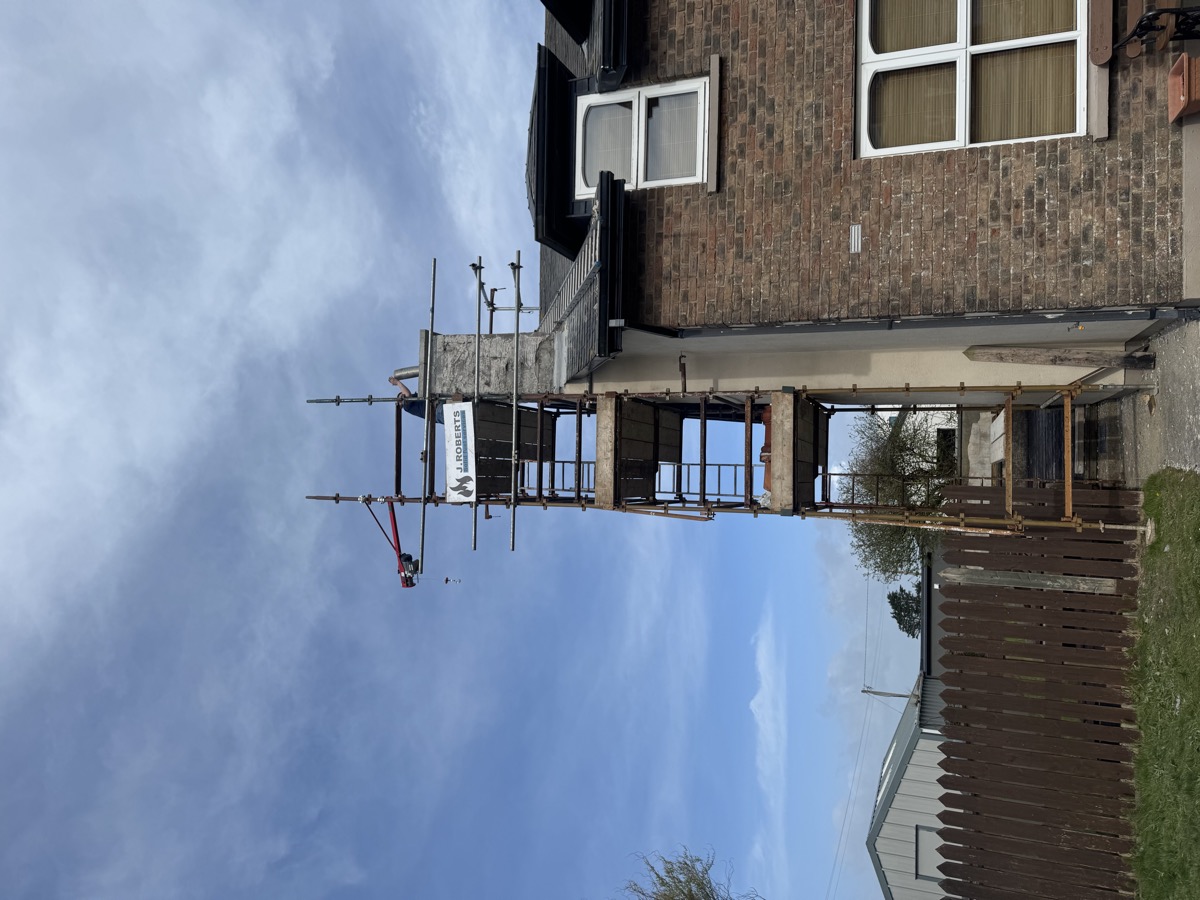
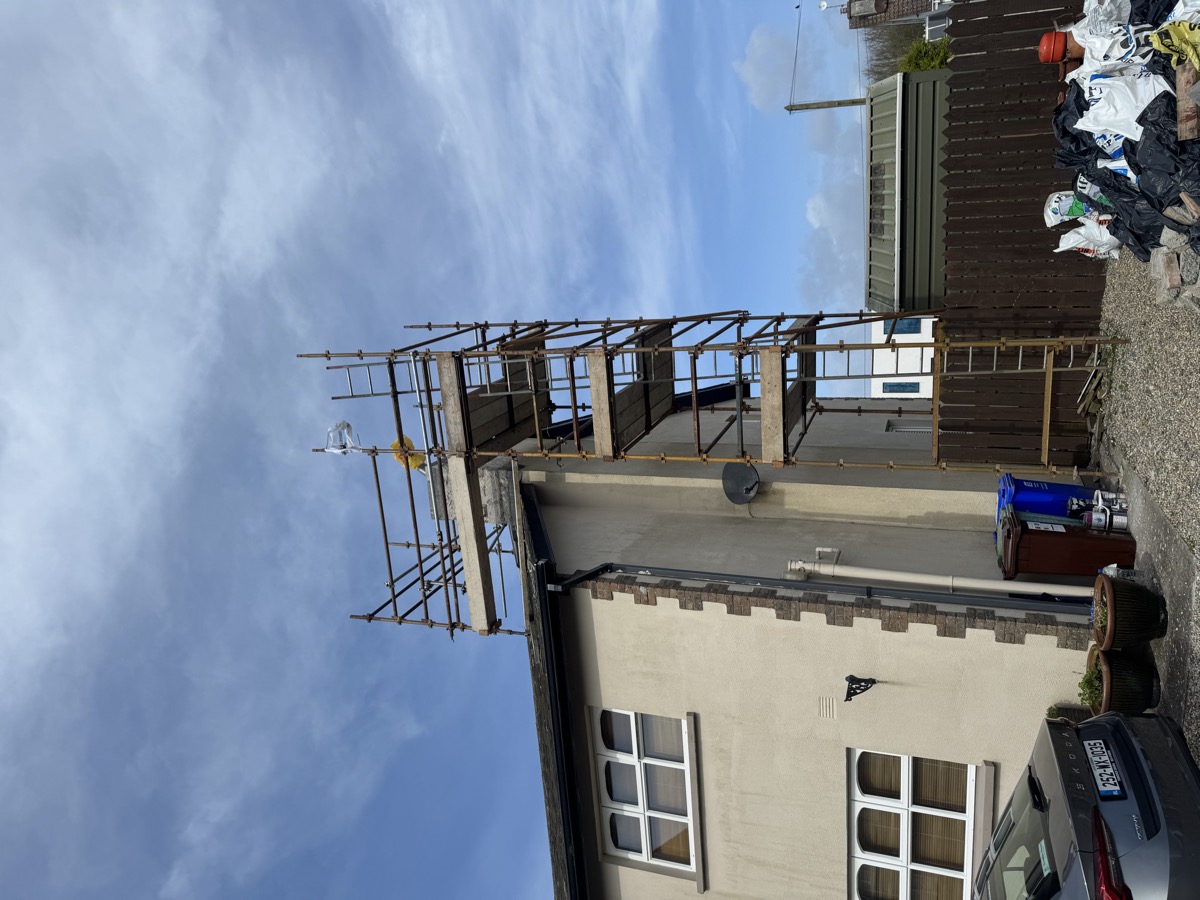
Access first: a yard or a field means a hoist and a roof ladder; a Waterford City or Tramore terrace fronting the footpath means scaffold and a council licence, which carries lead time and goes in the quote.
The stack then comes down to sound masonry, and on a salt-damaged chimney that is routinely deeper on the seaward face than on the sheltered one. It is normal for one side to need three more courses off than the other. How far is decided on the roof once the bad work is off, and you hear about it before the rebuild starts.
Rebuilding goes back up in a sulphate-resisting mortar, with flaunching cast to a proper fall, pots rebedded or replaced, and lead dressed into the joints with soakers under the slates. Cowl choice gets made deliberately on an exposed site rather than by default.
Everything is then cleared and goes on the van. The certificate is issued before we leave and the CCTV footage is yours to keep.
We handle the Waterford claim from start to finish
Storm damage and chimney fires are covered by most Irish household policies. Gradual deterioration is not. On this coast that distinction gets argued harder than anywhere, because salt damage is gradual by definition and a stack weakened by twenty years of it will eventually lose its top in a storm. Whether that reads as storm damage or as wear depends entirely on how it is documented.
So: CCTV of the flue, photographs of every face before anything is touched, a written report describing the mechanism of failure, and an itemised costing set out the way loss adjusters expect to read it. Johnny deals with the adjuster directly rather than leaving you to explain salt crystallisation over the phone.
On an approved claim you pay your excess, typically €200 – €300, and nothing else.
And plainly, because it circulates as fact: no Irish insurer makes annual sweeping a condition of cover. Sweeping is worth doing and a record helps a claim, but nobody voids a policy over a missed year.
More on insurance and fire damage work.
What needs doing now, and what can wait
Being told a €6,000 job is needed this week when it could safely wait until spring is one of the reasons people distrust the trade. The honest split, with the coastal ones marked.
| Finding | How urgent |
|---|---|
| Leaning stack | Stop using the fire. Same week. |
| After a chimney fire | Do not relight until inspected |
| Loose pots on an exposed coastal stack | Before the winter gales |
| Holiday home due to be occupied | Sweep and check before the season |
| Spalling on the seaward face only | This year, not this week |
| White salt deposits, masonry otherwise sound | Monitor. Often several years left |
Loose pots sit higher on that list here than they would inland. A pot coming off a stack in an Atlantic gale has a long way to fall and usually something underneath it.
Every corner of the county
Waterford spans three Eircode routing keys: X91 for Waterford City, X35 for Dungarvan and X42 for Kilmacthomas. All covered, coast and inland.
Waterford is the furthest county we cover regularly, so it takes more scheduling than Carlow or Wexford. Emergency work still gets prioritised, and it is worth grouping a survey with anything else you have been putting off.
One man, one van, his own name over the door
Johnny Roberts runs J.Roberts Solid Fuel Services on his own out of Clonegall, Co. Carlow. Ring the number and you get him. The person who surveys the chimney is the person who does the work.
There is no statutory register for solid fuel work in Ireland, so what is checkable is insurance, the work itself and the certificate. All three are available to see.
Chimney repair in Waterford. FAQ
Does being near the sea really damage a chimney?
Yes, and it is a recognised design condition. I.S. EN 1996-2 classifies masonry exposure, and its most severe category MX4 covers masonry exposed to salt-laden air near the coast. Salt crystallising in the pores physically forces the surface apart, which is why a Tramore or Dunmore East stack can be visibly worse than an identical one inland built the same year.
How much does a chimney rebuild cost in Waterford?
Partial rebuild above roof level €2,000 to €4,500. Single stack from the roofline €3,500 to €8,000. Double stack €8,000 to €14,000. Relining €1,400 to €2,800. Coastal jobs sit higher within their band more often, because salt damage runs deeper than it looks.
The house is a holiday home. Does that change anything?
It does, and Waterford has 2,147 of them on the last census. A cold unused flue stays damp, birds nest over spring and summer, then it gets lit hard for a fortnight in the season. One inspection before the season beats a claim after it, and if the property is let, keep the certificate with the paperwork.
Why does my stack look fine from the road but fail the survey?
Salt damage is worst on the seaward face, which is frequently the face you cannot see from the road or the garden. A stack can present a respectable elevation to the street and be spalling badly on the side facing the water. It is the commonest surprise on a coastal survey.
Do you handle the insurance claim?
Start to finish. CCTV, photographs of every face before anything is touched, a written report on the mechanism of failure, and an itemised costing in the format loss adjusters expect. On an approved claim you pay your excess and nothing else.
My chimney is leaning. Is that urgent?
Treat it as urgent. Usually sulphate attack expanding the mortar over years, leaning away from the prevailing wind. On this coast the salt makes it worse because the masonry is under attack from outside at the same time. Stop using the fire and ring somebody the same week.
What does the free survey involve?
About an hour. The stack from every face rather than just the visible one, a CCTV camera down the flue, a check of flaunching, pots and flashing, and a look at the fireplace and any damp inside. No charge, no obligation.
Do I get a certificate?
On every job. Insurers ask for evidence of maintenance when a claim is made, and buyers' solicitors ask during a sale. It matters more than usual on a let property.
Is there a registration scheme in Ireland?
No. There is no statutory register for solid fuel work in the Republic. HETAS withdrew from Ireland in March 2022 and is a UK body regardless. Check insurance, previous work and the certificate instead.
Does my flue have to be lined?
Not automatically. TGD J requires the flue to be suitable for the appliance, not lined as a matter of course. On the coast there is an extra argument for it, because a liner keeps flue gases off masonry already under attack from outside.
How soon can you get to me?
Waterford is the furthest county covered regularly, so it takes more scheduling than Carlow or Wexford. Emergency work after a storm or a chimney fire gets same or next day where possible. Surveys usually within a week or two.
Free planning tools
Plan your Waterford chimney project in 5 minutes, free
Related guides & nearby counties
Chimney trouble in Waterford?
The survey is free and it checks every face of the stack, not just the one facing the road. On this coast that is usually where the answer is.