Chimney repair
across Kildare
From the gas-heated commuter towns to the turf-burning west. Free CCTV survey, insurance claims handled start to finish, certificate the day we finish.
Kildare is an hour away, and that is worth saying out loud
J.Roberts Solid Fuel Services works out of Clonegall, Co. Carlow. Athy is about forty-five minutes up the road, Naas around an hour and five, Newbridge closer to an hour and ten. Nobody is going to pretend there is a van sitting in Newbridge.
For a rebuild, a reline, or an insurance job that runs over several days, an hour is irrelevant. It is a morning's start, the same as any other job. For a small one-off look at a cowl, you are probably better off with somebody in Naas, and you will be told that on the phone rather than after a wasted morning at your end.
What the distance does change is scheduling. Kildare surveys get grouped, so two or three jobs in the Naas, Newbridge and Kildare town corridor happen on one run rather than as three separate hour-long trips. If you ring and the answer is "Thursday", that is why.
The reason Kildare is worth the run is that it is a genuinely interesting county for this trade, and almost nobody writes about why.
89,000 homes, and 2,720 of them built in a single year
Kildare has a total housing stock of just under 89,000. That is the seventh highest of the thirty-one local authorities and 4.2% of the entire State. It is also growing faster than almost anywhere: 2,720 homes were completed in Kildare in 2023, the fourth highest count in the country and 8.3% of the national total, three quarters of them scheme houses.
The CSO makes the same point from the other direction. In South Dublin, Kildare and Meath, more than three times as many occupied dwellings were built between 2016 and 2022 as were built in the five years before that.
There are also 4,528 vacant properties, 5.1% of the stock, down from 5.7% in 2016. A vacant house is where chimney problems compound quietly, because there is nobody inside to notice a damp patch spreading on a bedroom wall.
Why the new-build number matters here
A new house is airtight by design, and an airtight house starves a stove of the air it needs to draw. Most of the "my chimney smokes and it is a brand new house" calls trace back to ventilation, not the flue. More on that below, with the actual figure from the regulations.
Housing stock, vacancy and completion figures from Kildare County Council's Census 2022 housing profile, drawing on CSO data.
Kildare is two different counties for chimney work
Most counties have one story. Kildare has two, and the census draws the line for you.
As of 2022 the main central heating fuel in Kildare was natural gas at 38.2%, oil at 37%, electricity at 11.4%, then peat and turf at 4.5%, coal at 1.3% and wood at 1.1%. But those figures are not spread evenly across the county. Kildare County Council notes that gas dominates in the metropolitan parts, specifically the Celbridge-Leixlip and Naas municipal districts, while peat use has "a very clear spatial pattern with highest rates in the north-west and western parts of the county". That is ground now inside the EU Just Transition Fund area.
The gas belt: Naas, Newbridge, Celbridge, Leixlip, Maynooth
Here a stove is almost never the main heat source. The house is on gas, and the stove is in the sitting room because people want a fire, not because they are trying to cut a heating bill. That changes what goes wrong. These flues are not tarred up from decades of hard burning; they are often barely used. What they suffer from instead is ventilation, sizing, and the fact that a lot of them were installed into houses that were never designed around a solid fuel appliance at all.
The other half of the gas-belt problem is that 51.2% of Kildare homes built since 2016 run on electricity for central heating, against oil at just 3.8% in the same age band and 41% in pre-2016 stock. A heat-pump house with a stove in it is a specific engineering situation, not a generic one.
The turf west: Rathangan, Monasterevin, the Bog of Allen fringe
This is the older, opposite problem. 3,731 Kildare households burn peat or turf as their main heating fuel, and they are concentrated out here. Turf burns cooler and wetter than well-seasoned hardwood. Cool, wet smoke condenses on the way up the flue rather than leaving it, and what it leaves behind is tar. Tar is what catches fire.
None of that is an argument against burning turf. It is an argument for a camera. A flue carrying turf smoke needs looking at more often than a flue carrying kiln-dried ash, and the interval is a fact about the fuel rather than a sales pitch.
If you are somewhere between the two, in Athy, Castledermot, Kilcullen or Ballymore Eustace, you are likely to have an older house on oil with a flue that has seen a bit of everything over the years. That is the most common Kildare survey of all.
Why Kildare chimneys fail, and where
Kildare is landlocked. It does not get the salt-laden air that eats mortar along the Wexford and Waterford coasts, which removes one failure mode entirely. What it gets instead is wind with nothing in the way of it, and the slow chemistry of flues that have burned solid fuel for a long time.
Sulphate attack, and why stacks lean
Burning coal and peat produces sulphates. In an unlined flue those gases soak into the mortar joints, and over years the sulphates react with the cement and expand it. The joints swell, the stack grows unevenly and it begins to lean, almost always away from the prevailing wind because that face stays wet longest and the reaction needs moisture. Once it starts it does not stop, and it cannot be pointed out of existence. Given where turf burning is concentrated in this county, the western half sees more of this than the commuter towns do.
Exposure on open ground
The Curragh and the flat country around it have very little to break the wind. A stack on an exposed site takes driving rain on one face for days at a time, and wind-driven rain is what finds a hairline crack in flaunching. It is not coastal exposure and it should not be sold as such, but a farmhouse standing alone on open ground weathers differently from the same house in a Naas estate with neighbours either side.
Flaunching, the most common single failure
Flaunching is the sloped mortar cap on top of the stack that beds the pots and sheds water. It is the most exposed mortar on the entire building and it is the first thing to go. When it cracks, rain runs down inside the brickwork instead of off the top, and the first sign indoors is a damp patch on the chimney breast in an upstairs bedroom. Caught early it is a small job. Left alone it saturates the stack and takes the mortar with it.
Lead flashing at the roofline
Where the stack passes through the slates there should be lead soakers and a stepped flashing dressed into the mortar joints. Plenty of older Kildare houses have flashing that was mortar-filleted instead, and a mortar fillet cracks within a few winters. Water then tracks into the roof timbers, which is how a chimney problem quietly becomes a roof problem and a much bigger bill.
Oversize flues serving small stoves
A great many older houses had a stove dropped into a fireplace built for an open fire. The flue is far wider than the stove can fill, so the gases slow, cool and condense on the way up instead of drawing cleanly. That condensate is acidic and it goes straight into the masonry. An oversize flue is a genuine safety problem, not merely an inefficiency.
The airtight house problem, with the actual number
With 2,720 completions in 2023 alone, Kildare has more new houses per head of population than almost anywhere in the country, and new houses bring a specific complaint: the stove smokes, and it is a brand new build.
Nine times in ten that is not the flue. It is air. A stove burns air, and it has to come from somewhere. An older draughty house supplies it through gaps you never knew existed. A house built to current standards does not have those gaps, so the stove and the extractor fan and the range hood all compete for the same air, and the stove loses.
The Irish rule is specific. TGD J 4.2.1 requires a permanent vent of at least 6,500 mm² of free area for any non-room-sealed solid fuel appliance, with a further 550 mm² per kilowatt above 5 kW where the appliance sits in an airtight dwelling. An 8 kW stove therefore needs 8,150 mm². That is a real hole in a real wall, and no amount of relining substitutes for it.
One thing worth being blunt about, because it comes up constantly: there is no under-5kW exemption in Ireland. That is a UK rule, from Approved Document J, and it gets repeated on Irish forums and by Irish retailers as though it applied here. It does not. Neither do DEFRA exemption or Smoke Control Areas, which are UK law. Ireland's regime is S.I. 529/2022, which is nationwide and regulates the fuel that may be sold, not which appliance you are allowed to own.
The second new-build issue is flue diameter. Under TGD J Table 2, a closed appliance up to 20 kW burning timber, peat or bituminous coal needs at least 150 mm internal diameter. Only smokeless fuel or wood pellets may drop to 125 mm. Plenty of stoves ship with a 125 mm spigot, which catches people out when the fuel they actually intend to burn is turf.
What chimney damage looks like from inside the house
Almost nobody rings about a chimney. They ring about something else that turns out to be the chimney.
- →A damp patch high on the chimney breast. Usually flaunching or flashing. It appears after heavy rain and fades between, which is why people live with it for a year.
- →Brown, tar-like staining, often with a smell. Condensate coming through the masonry from an unlined or oversize flue. Common on flues that have carried turf. Painting over it achieves nothing.
- →Smoke coming back into the room. In an older house, usually a blockage, a nest or a cracked flue. In a house built since 2016, usually ventilation. Different problems, different fixes, and a camera tells them apart in ten minutes.
- →Debris in the grate. Mortar and brick fragments coming down the flue mean the inside of it is breaking up.
- →The stack looks off plumb from the garden. Sight it against the gable on a clear day. If it is leaning, stop using the fire.
- →A roaring sound with no obvious cause. That is a chimney fire in progress. Ring 999, then have the flue inspected before it is used again. A chimney fire cracks liners and masonry even when the house comes through fine.
If you are unsure what you are looking at, the photo-based damage assessment takes a picture and gives you a straight answer before anybody visits.
Every type of chimney repair, done properly
Relining. A stainless liner sized for the appliance, fed from the top, connected at the stove or fire and sealed at the pot with a closure plate and cowl. Sized to TGD J Table 2, which for turf means 150 mm rather than the 125 mm spigot on the box.
Partial rebuild. The stack taken down to sound masonry above roof level and rebuilt. This is the right call when the damage is confined to the exposed section, which it usually is.
Full rebuild. Down to the roofline and back up, with new flaunching, new pots and new lead. A single stack and a double stack are genuinely different jobs, which is why they are priced separately below rather than hidden inside one range.
Flaunching renewal. The mortar cap cut out and recast to the correct fall, pots rebedded. Cheap, quick, and it prevents the expensive job.
Lead flashing. Proper code lead, stepped and dressed into the joints with soakers under the slates. Not a mortar fillet and not a tin of flashing compound.
Ventilation corrections. Cutting in a permanent vent to the 6,500 mm² minimum, or more where the output demands it. On Kildare new builds this is often the entire fix.
Fire and storm damage. Assessed, documented and rebuilt, with the insurance side handled in parallel. See insurance and fire damage.
There is more detail on each on the main chimney repairs page and the lining and cleaning page.
What chimney repair costs in Kildare
Real ranges, including VAT, labour, materials, scaffold or hoist where needed, waste away and the certificate. None of it is a teaser figure.
| Work | Typical range |
|---|---|
| CCTV survey | Free with any repair |
| Flaunching renewal | €450 – €1,100 |
| Lead flashing | €600 – €1,400 |
| Relining | €1,400 – €2,800 |
| Partial rebuild, above roof level | €2,000 – €4,500 |
| Full rebuild, single stack | €3,500 – €8,000 |
| Full rebuild, double stack | €8,000 – €14,000 |
| Insurance excess on an approved claim | €200 – €300 |
The ranges are wide because chimneys are. A single stack on a bungalow outside Rathangan with a yard to work from sits at the bottom of its band. A double stack on a Naas town-centre terrace with no rear access, needing a scaffold licence from Kildare County Council, sits at the top. Nobody can tell you which you are over the phone, which is why the survey is free and the quote follows in writing.
Indicative only. An exact figure follows the survey, in writing, before any work starts.
We handle the Kildare claim from start to finish
Storm damage and chimney fires are covered by most Irish household policies. Gradual deterioration is not. That single distinction decides most claims, and it gets decided by how the damage is documented rather than by what actually happened on the roof.
In practice that means CCTV footage of the flue, photographs of the stack before anything is touched, a written report describing the mechanism of failure, and an itemised costing set out the way loss adjusters expect to read it. Then Johnny deals with the adjuster directly. You are not the one explaining sulphate attack down the phone to somebody in a call centre.
On an approved claim you pay your excess, typically €200 – €300, and nothing else.
One thing worth saying plainly, because it gets repeated as though it were fact: no Irish insurer makes annual sweeping a condition of cover. Sweeping is still worth doing and a record of it helps a claim, but nobody is going to void your policy over a missed year.
Full detail on insurance and fire damage work, and on how a claim actually runs.
What a rebuild actually involves
Chimney work is roof work, and roof work needs access sorted before anything else. On a bungalow or a farmhouse with a yard, that is usually a hoist and a roof ladder and the job starts the morning it is booked. On a Naas or Newbridge terrace with the front door onto the footpath it means scaffold, and scaffold on a public footpath means a licence from Kildare County Council. That takes lead time, and it is factored into the quote rather than sprung on you afterwards.
Once there is access, the stack comes down to sound masonry. How far down is decided on the roof, not from the ground, because the only way to know where the good brickwork starts is to take off the bad and look. If that turns out deeper than the survey suggested, you get told before the rebuild starts, not when the bill arrives.
Rebuilding goes back up in a sulphate-resisting mortar rather than an ordinary mix, which matters on a flue that will be carrying solid fuel gases for the next thirty years, and matters more again where the fuel is turf. New flaunching is cast with a proper fall so water runs off instead of sitting. Pots are rebedded or replaced. Lead is dressed into the joints with soakers under the slates.
A liner, if one is going in, is fed from the top and connected at the appliance before the flaunching is finished, because it is far easier to get right while the top of the stack is still open.
Then everything gets cleared. The old brick, the old pots, the debris out of the flue, all of it goes on the van. No skip left sitting on the drive for a fortnight. The certificate is issued before we leave and the CCTV footage is yours to keep, which matters if you ever need it for a claim or a sale.
What needs doing now, and what can wait until spring
Not everything found on a survey is urgent, and being told a €6,000 job is needed immediately when it could safely wait eight months is one of the reasons people distrust the trade. Here is the honest split.
| Finding | How urgent |
|---|---|
| Leaning stack | Stop using the fire. Same week. |
| After a chimney fire | Do not relight until inspected |
| Heavy tar on camera, turf-burning flue | Before the next heating season |
| Stove smoking in a new build, no vent fitted | Before further use |
| Loose pots, spalling near the top | Before winter storms |
| Cracked flaunching, no damp yet | This year, not this week |
| Pointing tired but sound | Monitor. Often several years left |
The one that catches people out is near the bottom of that table. A cracked flaunching with no damp showing inside feels like nothing, and it is the cheapest thing on this page to fix. Leave it three winters and it becomes the partial rebuild.
Every corner of the county
Kildare is spread across seven Eircode routing keys, which tells you something about how dispersed it is compared with a compact county:
| Routing key | Post town |
|---|---|
| W91 | Naas |
| W12 | Newbridge |
| W23 | Maynooth |
| W34 | Monasterevin |
| R51 | Kildare |
| R14 | Athy |
| R56 | Curragh Camp |
Athy and the south of the county are the closest to base and the easiest to schedule. Naas, Newbridge and the Curragh corridor are the busiest. The north-east, meaning Leixlip, Celbridge and Maynooth, is the far end of the run and best booked alongside another job. Mention which town you are in when you ring and the estimate lands closer first time.
One tradesman, not a call centre
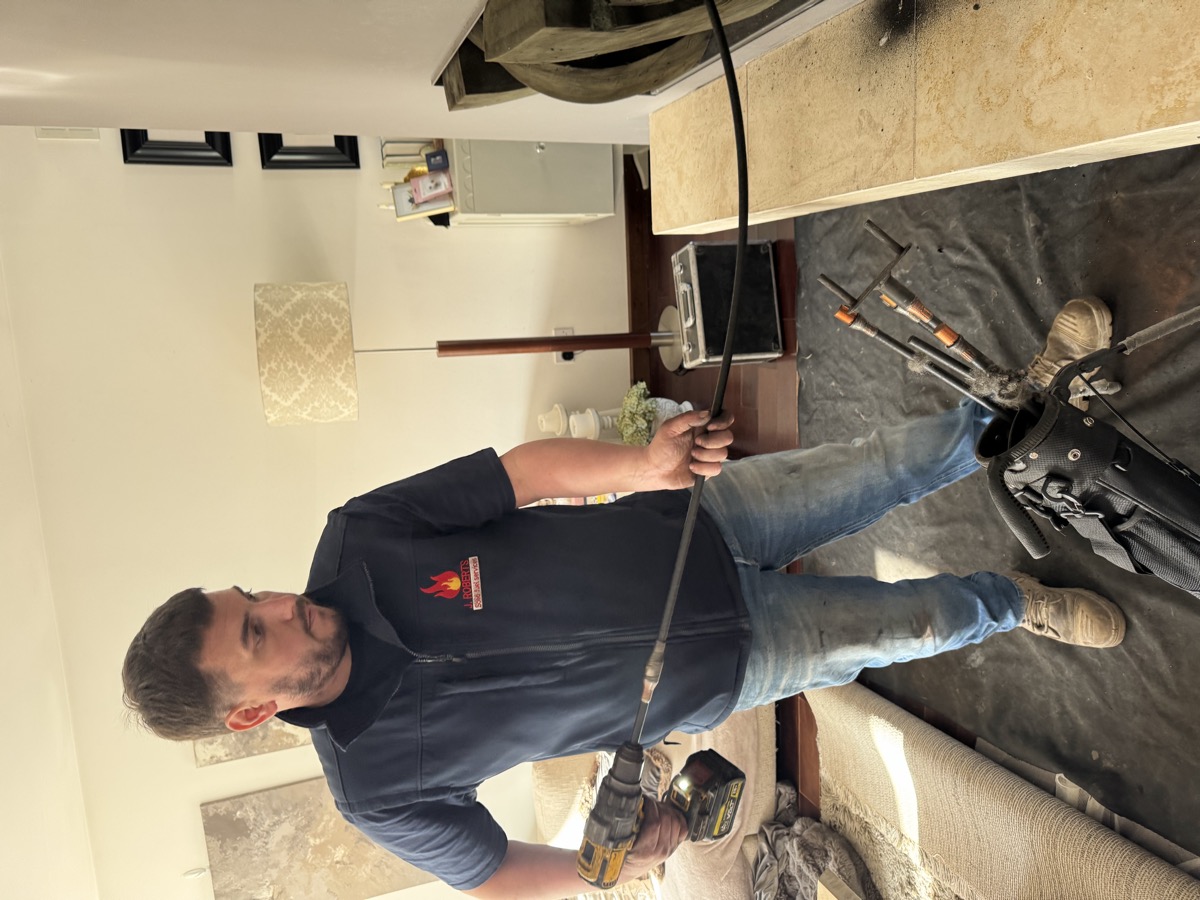
Johnny Roberts runs J.Roberts Solid Fuel Services on his own out of Clonegall, Co. Carlow. Ring the number and you get him. The person who surveys your chimney is the person who does the work, and the person who comes back if anything needs a second look.
There is no statutory register for solid fuel work in Ireland, so what is actually checkable is the insurance, the work itself and the certificate. All three are available to see.
Chimney repair in Kildare. FAQ
Do you actually cover Kildare, or is it just on a list?
Kildare is covered, and it is an hour away rather than ten minutes. The van works out of Clonegall in Co. Carlow. Athy is about forty-five minutes, Naas around an hour and five, Newbridge closer to an hour and ten. That is worth being straight about. For a rebuild, a reline or an insurance job it is no obstacle at all. For a small one-off call-out you may well be better served by somebody in Naas, and you will be told so on the phone rather than after a wasted morning.
How much does a chimney rebuild cost in Kildare?
A partial rebuild above roof level typically runs €2,000 to €4,500. A single stack taken down and rebuilt from the roofline is €3,500 to €8,000. A double stack is €8,000 to €14,000. Relining a flue is €1,400 to €2,800. The survey is free and nothing is quoted until a camera has been down the flue. Naas and Newbridge terraces with no rear access sit toward the top of their band because of scaffold.
Why does my chimney smoke in a house that is only a few years old?
Almost always air supply rather than the flue. Kildare recorded 2,720 housing completions in 2023, the fourth highest in the State, and new houses are built airtight. A stove cannot draw what the room will not give it. Irish TGD J 4.2.1 requires a permanent vent of at least 6,500 mm² of free area for any non-room-sealed solid fuel appliance, with a further 550 mm² per kilowatt above 5 kW. An 8 kW stove needs 8,150 mm². There is no under-5kW exemption in Ireland. That is a UK rule people import by mistake.
Does burning turf damage a chimney faster?
It tars a flue faster than well seasoned timber, yes, and it matters in Kildare because peat use is concentrated rather than spread evenly. Census 2022 recorded 3,731 Kildare households, 4.5%, using peat or turf as their main heating fuel, and the county council notes the highest rates are in the north-west and west. Turf burns cool and wet, and cool wet smoke condenses on the way up instead of leaving. That deposit is what catches fire. It is not an argument against turf, it is an argument for a camera.
Do you handle the insurance claim?
Start to finish. CCTV footage, photographs of the stack before anything is touched, a written report describing the mechanism of failure, and an itemised costing in the format loss adjusters expect, then dealing with the adjuster directly. Most Irish household policies cover storm and fire damage but not gradual wear, so documentation decides most claims. On an approved claim you pay your excess, typically €200 to €300, and nothing else.
My chimney is leaning. Is that urgent?
Treat it as urgent. It is usually sulphate attack, where flue gases have soaked into the mortar over years and expanded it, and it almost always leans away from the prevailing wind because that face stays wet longest. It does not correct itself and it does not stop. Stop using the fire and ring somebody the same week. On the Curragh and the open ground around it, where there is nothing to break the wind, a leaning stack has less shelter than it would in a town.
What does the free survey involve?
About an hour. A look at the stack from the roof, a CCTV camera down the flue, a check of the flaunching, the pots and the lead flashing where the stack meets the slates, and a look at the fireplace and any damp staining inside. You get told what is wrong, what needs doing now and what can safely wait. No charge and no obligation, and the footage is yours to keep.
Why is there a damp patch on the chimney breast upstairs?
Usually one of three things. Failed flaunching, the mortar cap on top of the stack, which cracks and lets water straight down through the brickwork. Failed lead flashing where the stack passes through the roof. Or an unlined flue, where condensing flue gases carry moisture into the masonry. A survey separates them quickly and they need completely different fixes, so guessing is expensive.
Does my flue have to be lined?
Not automatically. TGD J requires the flue to be suitable for the appliance, not lined as a matter of routine. Lining becomes necessary where the flue is oversize for the stove, leaks between floors, or shows cracking on camera. An oversize flue is a genuine safety problem and not merely an inefficiency, because the gases slow and cool and condense inside the masonry instead of leaving.
Is there a registration scheme for chimney work in Ireland?
No. There is no statutory register for solid fuel chimney work in the Republic. HETAS withdrew from Ireland in March 2022 and is a UK body in any case, and DEFRA exemption and Smoke Control Areas are UK law that does not apply here. Gas has RGI; solid fuel has nothing equivalent. What you can actually check is public liability insurance, previous work in your own area, and the certificate issued at the end. Ask any contractor for all three.
How soon can you get to me in Kildare?
Emergency work after a storm or a chimney fire gets same or next day where it can. Surveys in Kildare are usually inside the week, and they get grouped so that two or three jobs in the Naas, Newbridge and Kildare town corridor happen on the same run rather than as separate hour-long trips. September to November books out furthest ahead, so a stack you already know is loose is best looked at in summer.
Free planning tools
Plan your Kildare chimney project in 5 minutes, free
Related guides & nearby counties
Chimney trouble in Kildare?
The survey is free and the footage is yours to keep. Worst case you find out the stack is grand and you needed less than you thought.