Chimney repair
across Wicklow
From the uplands to the coast, Carnew to Bray. Free CCTV survey, downdraught diagnosed before anybody quotes for masonry, insurance claims handled start to finish.
Wicklow puts chimneys higher and wetter than anywhere else we work
Wicklow is not one place as far as chimneys are concerned. There is upland Wicklow, where houses sit on exposed ground with weather coming at them sideways for half the year. There is the coastal strip from Bray down through Greystones and Wicklow Town to Arklow, where the housing is denser, older and terraced. And there is the south of the county, Carnew, Shillelagh, Tinahely and Aughrim, which is effectively our own back yard: Carnew is about fifteen minutes from Clonegall.
Those three Wicklows fail in different ways, and a contractor who treats them the same will misdiagnose at least two of them.
59,629 homes, 986 of them empty most of the year
Census 2022 counted 59,629 dwellings in County Wicklow, up 8% on 2016, with 20,049 owned outright. It also counted 2,057 homes with no smoke alarm at all, which is worth sitting with for a moment in a county where a lot of houses still have a working fire.
The figure that changes how we work here, though, is 986 holiday homes. Wicklow has one of the higher counts in Leinster, and a chimney in a house that stands empty for weeks does not behave like one in daily use.
The holiday-home pattern
A flue that is cold and unused for months stays damp. Birds nest in it across spring and summer, and nobody is there to notice. Then the house fills up at Christmas and the fire gets lit hard for four days straight, on a flue that has not been swept and may not be clear. That is a textbook route to a chimney fire, and it is entirely preventable with one inspection before the season rather than a claim after it.
Figures from the CSO's Census 2022 housing results for Wicklow.
Why Wicklow chimneys fail, and where
Downdraught, and why it is usually the hill and not the chimney
This is the Wicklow call we take most often, and it is the one most likely to be misdiagnosed by somebody quoting from the ground. A house sitting below rising ground gets wind spilling down off the slope above it, and that moving air creates a pressure zone over the roof that pushes down the flue instead of drawing across the top of it. Smoke comes back into the room, and it does it on some wind directions and not others.
The important part: that is a terrain problem, not a masonry problem. Rebuilding the stack will not fix it. The answer is normally extra height on the flue or an anti-downdraught cowl, both of which cost a fraction of a rebuild. If somebody has quoted you for a rebuild on a chimney that only smokes when the wind is in one quarter, get a second opinion before you spend the money.
Wind-driven rain and freeze-thaw on high ground
Two mechanisms working together. Wind-driven rain pushes water into the vertical face of the masonry rather than letting it run off, so an exposed stack stays saturated far longer than a sheltered one. Then, on high ground, the freeze-thaw cycle goes to work on that saturated masonry: water in the pores expands as it freezes and takes the face off brick and stone a fragment at a time.
It is why upland Wicklow stacks so often fail on one face while the sheltered side still looks respectable. People see a sound-looking chimney from the road and are surprised when the survey comes back badly.
Shared stacks in coastal terraces
Bray, Greystones, Wicklow Town and Arklow have long runs of older terraced housing where one stack serves two or more houses, with flues running side by side behind a shared party wall. When the parging between them breaks down, flues start sharing air. That is how somebody ends up smelling their neighbour's fire, and in the worst case how combustion products cross from one house into another. A smoke test finds it quickly and it is not something to leave.
Sulphate attack and leaning stacks
The same slow chemistry as everywhere else, accelerated by how wet Wicklow masonry stays. Sulphates from burning coal and peat soak into the mortar of an unlined flue and expand it over years. The joints swell, the stack grows unevenly and it leans away from the prevailing wind. It does not correct itself and it cannot be pointed out of existence.
What to look for before it becomes a rebuild
- →Smoke back into the room on certain wind directions only. Classic downdraught. Note which direction and mention it when you ring, because it narrows the diagnosis immediately.
- →Spalling on one face of the stack. Brick or stone faces flaking away, usually the side that takes the weather. Freeze-thaw. It only goes one way.
- →A damp patch high on the chimney breast. Usually failed flaunching or failed lead flashing. It comes after heavy rain and fades between, which is how people live with it for a year.
- →Smelling a neighbour's fire. In a terrace that means flues are sharing air through a failed party wall. Get it tested.
- →Debris in the grate. Mortar and brick fragments mean the inside of the flue is breaking up.
- →A roaring sound with no obvious cause. Chimney fire in progress. Ring 999, then have the flue inspected before it is used again.
Not sure what you are looking at? The photo-based damage assessment gives you a straight answer before anybody visits.
Every type of chimney repair, done properly
Downdraught remedy. Height added to the flue, or an anti-downdraught cowl fitted, once the cause has been confirmed as terrain rather than masonry. Cheapest job on this page and the one most often replaced with an unnecessary rebuild.
Relining. A stainless liner sized for the appliance, fed from the top, connected at the appliance and sealed at the pot with a closure plate and cowl. TGD J Table 2 requires at least 150 mm internal diameter for a closed appliance up to 20 kW burning timber, peat or bituminous coal; only smokeless fuel or pellets may drop to 125 mm.
Partial rebuild. Down to sound masonry above roof level and rebuilt. On exposed upland stacks this is frequently all that is needed, because the damage is concentrated where the weather reaches.
Full rebuild. To the roofline and back up, with new flaunching, pots and lead. Single and double stacks are genuinely different jobs and are priced separately below.
Flaunching renewal. The mortar cap recast to the correct fall and pots rebedded. On exposed ground this is maintenance rather than a one-off, and doing it early prevents the expensive job.
Lead flashing. Proper code lead, stepped and dressed into the joints with soakers under the slates. Not a mortar fillet, which cracks within a few Wicklow winters.
Fire and storm damage, with the insurance handled alongside. See insurance and fire damage, or the main chimney repairs page for more on each.
What chimney repair costs in Wicklow
Including VAT, labour, materials, scaffold or hoist where needed, waste away and the certificate.
| Work | Typical range |
|---|---|
| CCTV survey | Free with any repair |
| Flaunching renewal | €450 – €1,100 |
| Lead flashing | €600 – €1,400 |
| Relining | €1,400 – €2,800 |
| Partial rebuild, above roof level | €2,000 – €4,500 |
| Full rebuild, single stack | €3,500 – €8,000 |
| Full rebuild, double stack | €8,000 – €14,000 |
| Insurance excess on an approved claim | €200 – €300 |
Access moves the number more in Wicklow than almost anywhere. A Bray or Greystones terrace with no rear access, needing a scaffold licence off the council, sits at the top of its band. A bungalow outside Tinahely with a field to work from sits at the bottom. Tell us which when you ring and the estimate lands closer first time.
Indicative only. An exact figure follows the survey, in writing, before any work starts.
We handle the Wicklow claim from start to finish
Storm damage and chimney fires are covered by most Irish household policies. Gradual deterioration is not. In an exposed county that distinction gets argued more than most, because a stack that has been weathering for thirty years and then loses its top in a storm can be characterised either way depending on who writes it up.
That is exactly why the documentation matters: CCTV of the flue, photographs of the stack before anything is touched, a written report describing the mechanism of failure, and an itemised costing set out the way loss adjusters expect to read it. Johnny then deals with the adjuster directly rather than leaving you to explain freeze-thaw spalling over the phone.
On an approved claim you pay your excess, typically €200 – €300, and nothing else.
Worth saying plainly, because it circulates as fact: no Irish insurer makes annual sweeping a condition of cover. Sweeping is still worth doing and a record helps a claim, but nobody voids a policy over a missed year.
More on insurance and fire damage work.
What a rebuild involves on an exposed site
Wicklow adds a variable most counties do not: the weather decides when the work happens. Nobody should be rebuilding a stack in a gale on high ground, and anybody who says they will is either not going to turn up or should not be up there. Upland jobs get scheduled against a forecast, and occasionally moved. That is worth knowing in advance rather than taking as a sign of disorganisation.
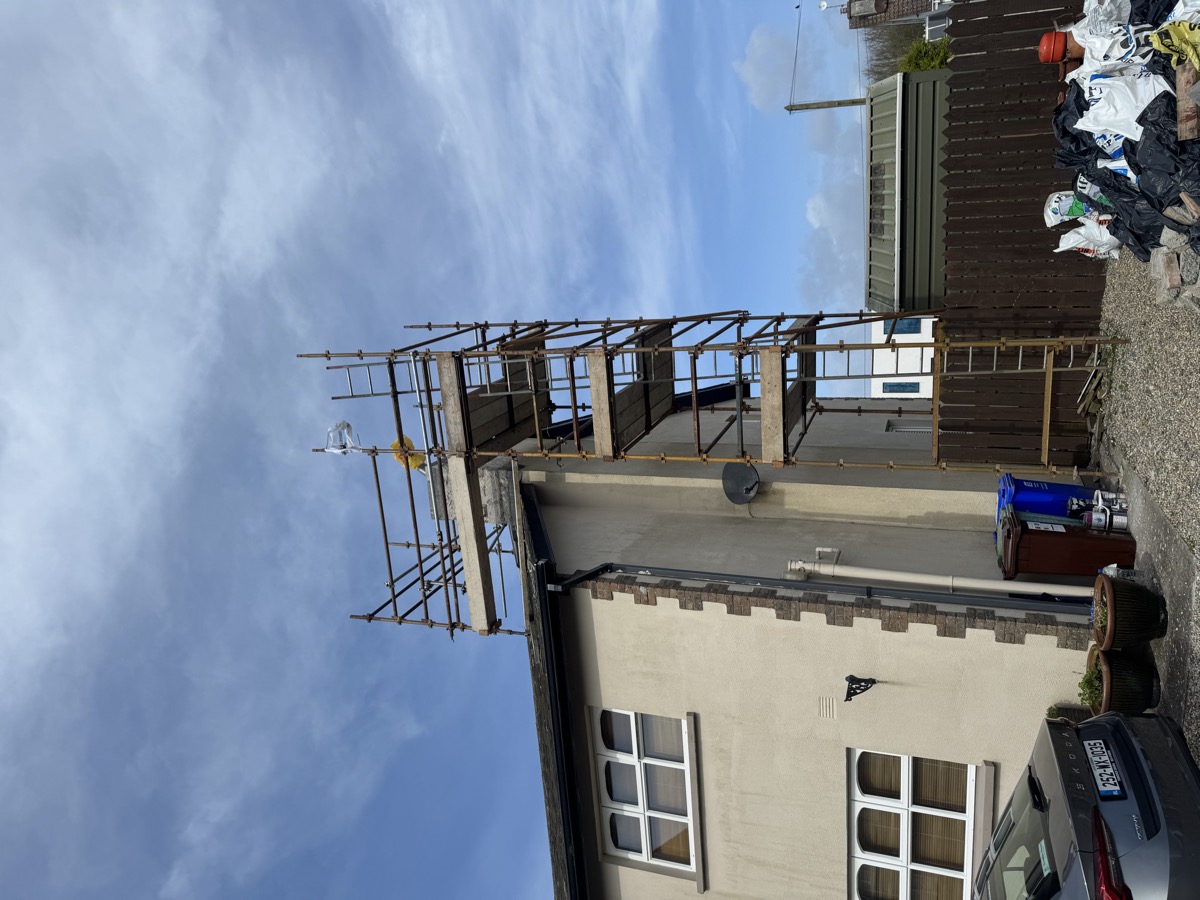
Access comes first. A farmhouse with a yard takes a hoist and a roof ladder. A Bray or Greystones terrace fronting the footpath needs scaffold, and scaffold on a public footpath needs a licence from Wicklow County Council, which carries lead time. It goes in the quote rather than appearing later.
The stack then comes down to sound masonry, and on exposed sites that is frequently deeper on the weather face than on the sheltered one. It is normal for one side of a stack to be perfectly serviceable while the other has to come down another three courses. How far is decided on the roof once the bad work is off, and you hear about it before the rebuild starts.
It goes back up in a sulphate-resisting mortar, with flaunching cast to a proper fall, pots rebedded or replaced, and lead dressed into the joints with soakers under the slates. On a genuinely exposed stack the cowl gets chosen deliberately rather than by default, because it is doing two jobs here: keeping rain out and helping the draw.
Everything then gets cleared and goes on the van. The certificate is issued before we leave and the CCTV footage is yours to keep, which matters for a claim or a sale.
What needs doing now, and what can wait
Being told a €6,000 job is needed this week when it could safely wait until spring is one of the reasons people distrust the trade. The honest split, with the Wicklow-specific ones marked.
| Finding | How urgent |
|---|---|
| Leaning stack | Stop using the fire. Same week. |
| After a chimney fire | Do not relight until inspected |
| Loose pots on an exposed upland stack | Before the winter gales |
| Smelling a neighbour's fire in a terrace | Get it smoke-tested now |
| Spalling on the weather face only | This year, not this week |
| Downdraught on one wind direction | Annoying, not dangerous. Cheap to fix. |
Loose pots deserve their place near the top of that list here in a way they would not inland. A pot coming off a stack in a Wicklow gale has a long way to fall and something underneath it.
Every corner of the county
Wicklow spans four Eircode routing keys: A67 for Wicklow Town and Rathnew, A98 for Bray, A63 for Greystones, Delgany, Kilcoole and Newtownmountkennedy, and Y14 for Arklow. All covered.
South Wicklow is close enough to be routine: Carnew is about fifteen minutes from base, Shillelagh under twenty, Tinahely around twenty-five, Aughrim about thirty. North Wicklow and the Bray side take more scheduling but are covered.
One man, one van, his own name over the door
Johnny Roberts runs J.Roberts Solid Fuel Services on his own from Clonegall, a quarter of an hour from the Wicklow border at Carnew. Ring the number and you get him. The person who surveys the chimney is the person who does the work.
There is no statutory register for solid fuel work in Ireland, so what is checkable is insurance, the work itself and the certificate. All three are available to see.
Chimney repair in Wicklow. FAQ
Why does my chimney smoke back on windy days?
Usually downdraught, and in Wicklow it is often the terrain rather than the chimney. Where a house sits below rising ground, wind spilling off the slope pushes down the flue instead of drawing across it. The fix is normally height or an anti-downdraught cowl rather than a rebuild, which is why it should be diagnosed before anybody quotes for masonry.
How much does a chimney rebuild cost in Wicklow?
A partial rebuild above roof level is €2,000 to €4,500. A single stack from the roofline €3,500 to €8,000, a double stack €8,000 to €14,000. Relining is €1,400 to €2,800. Access moves the figure more here than in most counties.
Do you cover the whole county?
Yes, across A67, A98, A63 and Y14. South Wicklow is very close to base. Carnew is about fifteen minutes from Clonegall, Shillelagh under twenty, Tinahely around twenty-five.
The house is only used at weekends. Does that matter?
More than people expect. Wicklow has 986 holiday homes on the last census. Flues stay cold and damp, birds nest over spring and summer, and then the fire gets lit hard for a few days at Christmas on a flue nobody has checked. Have it inspected before the season, not after.
Do you handle the insurance claim?
Start to finish. CCTV, photographs before anything is touched, a written report on the mechanism of failure, and an itemised costing in the format loss adjusters expect. Most policies cover storm and fire but not gradual wear, so documentation decides it.
My chimney is leaning. Is that urgent?
Treat it as urgent. Usually sulphate attack, expanding the mortar over years, leaning away from the prevailing wind. On exposed Wicklow ground it moves faster because the masonry spends more of the year wet. Stop using the fire and ring somebody the same week.
Why does exposure matter so much here?
Wind-driven rain pushes water into the face of the masonry instead of letting it run off, so the stack stays saturated. Then freeze-thaw works on that saturated masonry and spalls the face off. It is why upland stacks often fail on one side while the sheltered face looks sound.
Do I get a certificate?
On every job. Insurers ask for evidence of maintenance when a claim is made, and buyers' solicitors ask during a sale.
Is there a registration scheme in Ireland?
No. There is no statutory register for solid fuel work in the Republic. HETAS withdrew from Ireland in March 2022 and is a UK body regardless. Check insurance, previous work and the certificate instead.
Does my flue have to be lined?
Not automatically. TGD J requires the flue to be suitable for the appliance, not lined as a matter of course. Lining is needed where the flue is oversize, leaks between floors, or shows cracking on camera.
How soon can you get to me?
South Wicklow is close to base and usually quick. North Wicklow and the Bray side take more scheduling but are covered. Emergency work after a storm or a chimney fire gets same or next day where possible.
Free planning tools
Plan your Wicklow chimney project in 5 minutes, free
Related guides & nearby counties
Chimney trouble in Wicklow?
The survey is free. If it turns out to be downdraught rather than the stack, you will be told that, and it will cost a fraction of what you were bracing for.