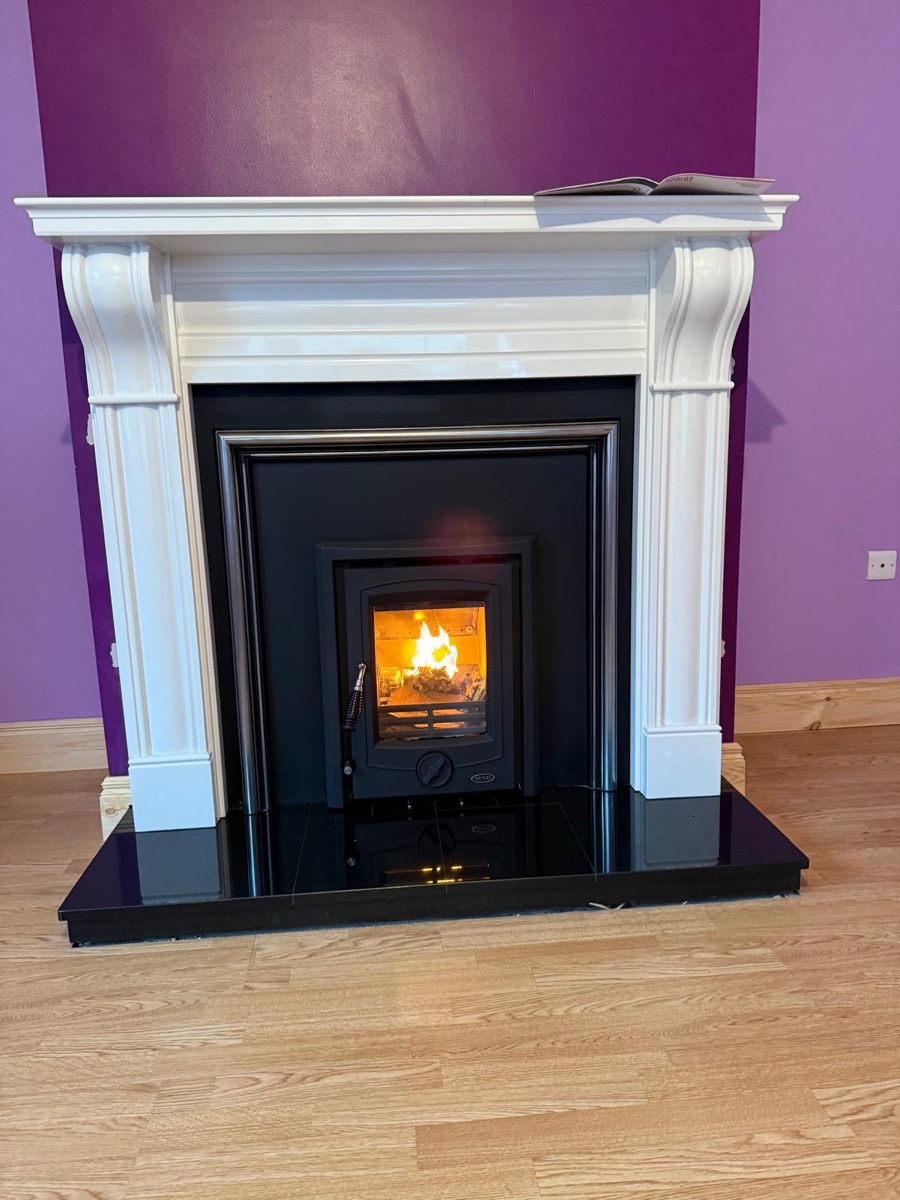
Wood burning stoves
across Kildare
Supplied and fitted in Naas, Newbridge, Maynooth, Athy and everywhere between. Free survey, flue measured before you buy, certificate the day we finish.
In Kildare, a stove is usually the wrong way to save money
That is an odd thing for a stove fitter to open with, so here is the reasoning.
Census 2022 found that the main central heating fuel in Kildare is natural gas at 38.2%. The SEAI's domestic fuel cost comparison puts mains gas at about 13.00 cent per useful kilowatt hour. Bulk loose softwood comes in at 8.5 cent, so it beats gas comfortably. Hardwood bought in small bags from a forecourt is 15.26 cent, so it loses to gas.
In other words, whether a stove saves a Kildare household anything depends almost entirely on how you buy wood, not on which stove you buy. If you have somewhere dry to store three cubic metres and you buy it loose in summer, the sums work. If you are going to pick up bags in the garage forecourt on a Friday, they do not.
Most people in Naas and Newbridge who ring about a stove already know this without doing the arithmetic. They want a fire in the room. That is a perfectly good reason, and it is the honest reason for the majority of installations in this county. What it changes is the specification: a stove bought for the room needs sizing for the room, not sizing to heat a house it will never heat.
The county is also an hour from the van. Clonegall in Co. Carlow is about forty-five minutes from Athy, an hour and five from Naas, an hour and ten from Newbridge. For a supply-and-fit job that is irrelevant. It is worth saying rather than implying a depot in Newbridge.
Gas in the east, turf in the west, oil almost everywhere
Kildare has a total housing stock of just under 89,000, the seventh highest of the thirty-one local authorities. The fuel split as of 2022: natural gas 38.2%, oil 37%, electricity 11.4%, peat and turf 4.5%, coal 1.3% and wood 1.1%.
Those averages hide the real picture. Kildare County Council notes that gas dominates in the metropolitan districts, specifically Celbridge-Leixlip and Naas, while peat use shows "a very clear spatial pattern with highest rates in the north-west and western parts of the county". So the county has two quite different stove customers.
The 1.1% burning wood as a main heating fuel is the number worth dwelling on. It confirms what the calls suggest: in Kildare a stove is nearly always secondary heat sitting alongside gas or oil, not the thing keeping the house warm in February. Sizing follows from that.
The oil households are the ones doing the sums
Kerosene at a discounted rate runs about 17.20 cent per useful kilowatt hour on the SEAI comparison, against 8.5 cent for bulk loose softwood. That is where a stove genuinely changes a bill, and 37% of Kildare homes are on oil. If you are in Athy, Castledermot or out toward Rathangan on an oil boiler, the case is much stronger than it is for a gas house in Naas.
Fuel shares from Kildare County Council's Census 2022 housing profile. Running costs from the SEAI domestic fuel cost comparison, in cent per useful kilowatt hour delivered.
New houses need a hole in the wall, and there is a number for it
Kildare completed 2,720 homes in 2023, the fourth highest count in the State and 8.3% of the national total. 51.2% of Kildare homes built since 2016 run on electricity for central heating, against 3.8% on oil in the same age band. The CSO notes that South Dublin, Kildare and Meath each built more than three times as many dwellings between 2016 and 2022 as in the five years before.
That makes ventilation the single most common Kildare stove problem, and it has nothing to do with the stove.
A stove burns air. An older house leaks enough of it through gaps nobody designed. A house built to current standards does not, so the stove, the extractor and the range hood all compete for the same air and the stove loses. The symptom is smoke rolling back into a brand new sitting room, and the owner assumes they bought a bad stove.
TGD J 4.2.1 requires a permanent vent of at least 6,500 mm² of free area for any non-room-sealed solid fuel appliance, with a further 550 mm² per kilowatt above 5 kW where the dwelling is airtight. An 8 kW stove therefore needs 8,150 mm². That is a real vent, cut and fitted, and it is not optional.
Worth stating plainly because it is repeated constantly by Irish retailers: there is no under-5kW exemption in Ireland. That comes from UK Approved Document J. So do DEFRA exemption and Smoke Control Areas. Ireland's rule is S.I. 529/2022, which is nationwide and governs the fuel that may be sold, not which appliance you may own.
If your house is a heat-pump build, say so when you ring. A stove in a heat-pump house is a specific job, not a generic one, and the survey looks at different things.
Getting the size right matters more than getting the brand right
The most common mistake is buying too big. An oversized stove in a well-insulated Naas semi gets run shut down to stop the room becoming unbearable, and a stove run shut down smoulders. Smouldering produces tar, tar coats the flue, and tar is what catches fire. The oversized stove is therefore both less pleasant and less safe than the correctly sized one.
A rough starting point for a reasonably insulated modern room is the room volume in cubic metres divided by fourteen, which gives kilowatts. A 4 by 5 metre room with a 2.4 metre ceiling is 48 cubic metres, so roughly 3.5 kW. Most Kildare sitting rooms land between 4 and 6 kW. Draughty older houses in the south of the county need more, new builds need less. The stove size calculator does this properly with insulation and window area factored in.
On efficiency, the relevant law is EU Regulation 2015/1185: since 1 January 2022 a closed-fronted solid fuel room heater sold in the EU must reach at least 65% seasonal space heating efficiency. Anything currently on sale meets it. Beware of shops selling that baseline as a feature, and beware of comparative emissions claims in either direction, since the ASA upheld complaints against exactly that claim shape in July 2026.
There is no SEAI grant for a stove. The Domestic Technical Standards document has a clause referencing them, but the eligibility table gives stoves no scheme coverage. If anyone tells you a grant is available, ask them to point at the table.
Will the chimney you have take a stove?
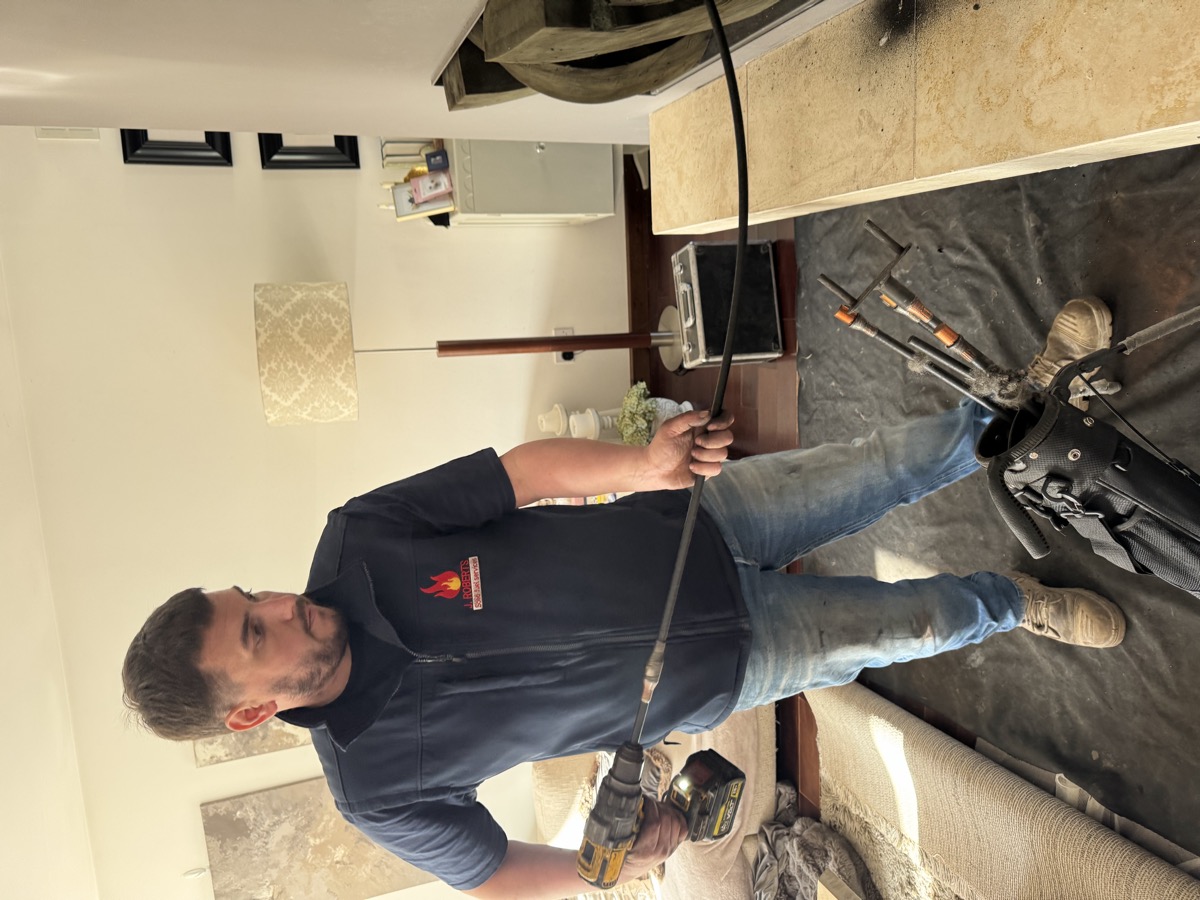
This is the question that decides the price, and it cannot be answered from a photo of the fireplace. A camera goes up the flue during the survey, before you have bought anything.
Under TGD J Table 2, a closed appliance up to 20 kW burning timber, peat or bituminous coal needs a flue of at least 150 mm internal diameter. Only smokeless fuel or wood pellets may drop to 125 mm. This catches people out constantly, because a great many stoves ship with a 125 mm spigot, and in the west of Kildare where turf is still burned the 150 mm requirement applies.
The opposite problem is just as common in older Kildare farmhouses: a flue far too wide. A big open-fire flue with a small stove connected to it means the gases slow, cool and condense inside the masonry rather than leaving. That is why relining is often the right answer even when the chimney looks perfectly sound from the road.
Relining is not automatic, though. TGD J asks that the flue be suitable, not that it be lined as a matter of routine. A sound, correctly sized, properly drawing flue can take a stove as it is. The camera decides.
The hearth matters too. TGD J 2.7.1 calls for a constructional hearth of at least 125 mm. A free-standing stove on a non-combustible floor needs a hearth of at least 12 mm, and a back boiler needs 125 mm, or 25 mm on 25 mm non-combustible supports. Plenty of Kildare new builds have a tiled floor that looks like a hearth and is not one.
If you want a rough read before booking, the chimney suitability checker asks five questions and tells you what is likely.
What a stove costs in Kildare
Supply and fit, including VAT, labour, flue components, hearth work where needed, waste away and the certificate.
| Work | Typical range |
|---|---|
| Home survey | Free, no obligation |
| Inset stove, supplied and fitted | €2,200 – €3,500 |
| Freestanding stove, supplied and fitted | €2,500 – €4,000 |
| Boiler stove, plumbed to radiators | €3,500 – €5,500 |
| Chimney liner, if the survey calls for it | €1,000 – €2,500 |
| Twin-wall flue, where there is no chimney | €1,800 – €3,200 |
Twin-wall is worth flagging for Kildare specifically. A lot of newer houses in Naas, Sallins, Clane and the Newbridge estates were built with no chimney at all, because the design assumed gas or a heat pump. Putting a stove into one of those means running an insulated twin-wall flue up through the house or the gable, and that is the biggest single cost swing on this page.
Indicative only. An exact figure follows the survey, in writing, before any work starts.
What actually happens in your sitting room
A straightforward installation is one day. A liner adds a few hours. A twin-wall flue through two floors, or an opening that has to be widened, is two days.
The room gets covered before anything starts, and that means the floor and the furniture, not one sheet thrown over the sofa. Opening up an old fireplace produces a remarkable quantity of soot and rubble, and a Kildare farmhouse fireplace that has been closed up since the seventies produces more than anyone expects.
The hearth goes in first if one is needed, then the stove is set and levelled, then the flue is connected and sealed at the register plate. If a liner is going in it is fed from the top and connected before the closure plate goes on. The vent gets cut and fitted at this stage rather than left as a snag, because it is part of the installation and not an extra.
Then it gets lit and left running while everything is checked: the draw, the seals, the door closing properly against its rope, the flue temperature settling where it should. You get shown how to run it, which mostly means how not to run it shut down, because that is what wrecks flues.
Everything goes on the van. The certificate is issued before we leave. Keep it with the house paperwork, because insurers ask for evidence of a compliant installation after a fire and buyers' solicitors ask during a sale.
Running the radiators off the fire
A boiler stove has a water jacket and heats radiators as well as the room. In Kildare it makes most sense in the 37% of homes on oil, particularly out west and south where the mains gas network does not reach. Against kerosene at roughly 17.20 cent per useful kilowatt hour, a boiler stove burning bulk timber at 8.5 cent changes the winter bill in a way a room heater never will.
It is a bigger job. The stove is plumbed into the heating system, which needs the right pipework, a heat leak radiator that cannot be valved off, and correct integration with whatever boiler is already there. A back boiler also brings a stricter hearth requirement under TGD J 2.7.1: 125 mm, or 25 mm on 25 mm non-combustible supports.
It also demands more of the owner. A boiler stove wants feeding properly and running hot. Somebody who lights a fire twice a week for the look of it should buy a room heater and spend the difference on better wood.
In a gas-heated Naas or Celbridge house, a boiler stove rarely makes financial sense at all, for the reason set out at the top of this page. Say what your house runs on when you ring and the recommendation follows from that rather than from what is in stock.
What you burn decides how long the installation lasts
Under S.I. 529/2022, wood sold for residential burning in Ireland must be at or below 25% moisture content, tightening to 20% from 1 September 2026. The regulation governs the sale of fuel, so it does not apply to timber you season yourself, though the same physics does.
Wet wood is the single most expensive mistake available. A large part of the energy goes into boiling off water instead of heating the room, and the cooled smoke condenses in the flue as tar. That is the mechanism behind most chimney fires, and it is entirely avoidable.
Turf deserves its own note in Kildare, because 3,731 households here still burn peat as their main fuel and they are concentrated in the north-west and west of the county. Turf burns cooler and wetter than seasoned hardwood, so a flue carrying it tars faster and wants looking at more often. That is a fact about the fuel, not a criticism of it, and it is worth knowing before choosing between a 125 mm and a 150 mm flue.
On cost, the SEAI comparison is the honest reference: bulk loose softwood about 8.5 cent per useful kilowatt hour, wood pellets in bulk 10.25 cent, softwood by the pallet 10.41 cent, mains gas 13.00 cent, hardwood by the pallet 14.40 cent, hardwood in small bags 15.26 cent, discounted kerosene 17.20 cent, electricity on direct debit 34.38 cent.
Read that list next to Kildare's fuel split and the conclusion writes itself. Against gas at 13 cent, only well-bought bulk timber wins. Against oil at 17.20 cent, most timber wins. Which of those two houses you live in should decide how much you spend here.
Every corner of the county
Kildare spans seven Eircode routing keys, which says something about how spread out it is:
| Routing key | Post town |
|---|---|
| W91 | Naas |
| W12 | Newbridge |
| W23 | Maynooth |
| W34 | Monasterevin |
| R51 | Kildare |
| R14 | Athy |
| R56 | Curragh Camp |
Athy and the south are closest to base. Naas, Newbridge and the Curragh corridor are the busiest. Leixlip, Celbridge and Maynooth are the far end of the run and best booked alongside another job in the area.
One man, one van, his own name over the door
Johnny Roberts runs J.Roberts Solid Fuel Services on his own out of Clonegall, Co. Carlow. The person who surveys your room is the person who fits the stove and the person who comes back if something needs adjusting.
There is no statutory register for solid fuel installers in Ireland. HETAS withdrew in March 2022 and is a UK body regardless. So what is actually checkable is the public liability insurance, previous work, and the certificate at the end. Ask any fitter for all three.
Wood burning stoves in Kildare. FAQ
Will a stove actually save me money in Kildare?
It depends entirely on what you heat with now and how you buy wood. Gas is the main heating fuel in 38.2% of Kildare homes and mains gas costs about 13.00 cent per useful kilowatt hour on the SEAI comparison. Bulk loose softwood is 8.5 cent, so it wins. Hardwood in small bags is 15.26 cent, so it loses. If you are on oil, which 37% of Kildare homes are, discounted kerosene is about 17.20 cent and almost any sensibly bought timber beats it. Buy the stove for the room and treat any saving as a bonus.
What does a stove cost fitted in Kildare?
An inset stove supplied and fitted runs €2,200 to €3,500. Freestanding is €2,500 to €4,000. A boiler stove plumbed to radiators is €3,500 to €5,500. A liner, where the survey calls for one, adds €1,000 to €2,500, and a twin-wall flue where there is no chimney adds €1,800 to €3,200. The survey is free and the flue is checked with a camera before you buy anything.
My house has no chimney. Can I still have a stove?
Yes, using an insulated twin-wall flue run up through the house or the gable. This comes up a lot in Kildare because many newer houses in Naas, Sallins, Clane and the Newbridge estates were designed around gas or a heat pump and built with no chimney at all. Budget €1,800 to €3,200 for the flue on top of the stove, and expect the route to be decided on the survey rather than over the phone.
Do I need an air vent, even in a new house?
Especially in a new house. TGD J 4.2.1 requires a permanent vent of at least 6,500 mm² of free area for any non-room-sealed solid fuel appliance, with a further 550 mm² per kilowatt above 5 kW in an airtight dwelling, so an 8 kW stove needs 8,150 mm². There is no under-5kW exemption in Ireland; that is UK Approved Document J and it gets quoted here by mistake constantly. With 2,720 homes completed in Kildare in 2023, this is the single most common problem we are called out to.
What size stove do I need?
Most Kildare sitting rooms land between 4 and 6 kW. A rough guide for a reasonably insulated modern room is the volume in cubic metres divided by fourteen, so a 4 by 5 metre room with a 2.4 metre ceiling is about 3.5 kW. Too big is worse than too small, because an oversized stove gets run shut down, and a stove run shut down smoulders and tars the flue. The stove size calculator on this site does it properly.
Does my chimney need relining?
Not automatically. TGD J asks that the flue be suitable for the appliance, not that it be lined as routine. Relining becomes necessary where the flue is oversize for the stove, leaks between floors, or shows cracking on camera. Older Kildare farmhouses often have a very wide open-fire flue, and connecting a small stove to it means the gases cool and condense inside the masonry instead of leaving. The camera decides, not a guess from the fireplace.
Is there a grant for a stove?
No. The SEAI Domestic Technical Standards document contains a clause referencing stoves, but the eligibility table gives them no scheme coverage. If a retailer tells you a grant is available, ask them to point at the table. There is also no statutory installer register in Ireland for solid fuel; HETAS withdrew in March 2022 and is a UK body in any case.
Can I burn turf in it?
Yes, if the stove is multi-fuel, and it matters here because 3,731 Kildare households burn peat as their main fuel, concentrated in the north-west and west of the county. It changes the specification though. TGD J Table 2 requires at least 150 mm internal flue diameter for a closed appliance burning timber, peat or bituminous coal, and only smokeless fuel or pellets may drop to 125 mm. A lot of stoves ship with a 125 mm spigot. Turf also burns cooler and wetter, so the flue tars faster and wants checking more often.
How wet can the wood be?
Wood sold for residential burning in Ireland must be at or below 25% moisture content under S.I. 529/2022, tightening to 20% from 1 September 2026. That regulates the sale of fuel, so it does not cover timber you season yourself, though the physics is the same either way. Wet wood spends its energy boiling off water instead of heating the room, and the cooled smoke condenses in the flue as tar. That is how most chimney fires start.
How long does the installation take?
A straightforward fit is one day. A liner adds a few hours. A twin-wall flue through two floors, or an opening that has to be widened, is two days. The room is covered properly before anything starts, everything goes on the van afterwards, and the certificate is issued before we leave. Keep it with the house paperwork; insurers ask for it after a fire and solicitors ask during a sale.
Do you actually come to Kildare?
Yes, and it is about an hour rather than ten minutes. The van works out of Clonegall in Co. Carlow: roughly forty-five minutes to Athy, an hour and five to Naas, an hour and ten to Newbridge. For a supply-and-fit job that makes no difference. Surveys get grouped so several Kildare jobs happen on one run, which is why the offered date may be a few days out rather than tomorrow.
Free planning tools
Plan your Kildare stove in 5 minutes, free
Related guides & nearby counties
Guides
Chimneys in Kildare
Thinking about a stove in Kildare?
The survey is free and the flue gets checked with a camera before you spend anything. You will be told straight if your house is not a good candidate.