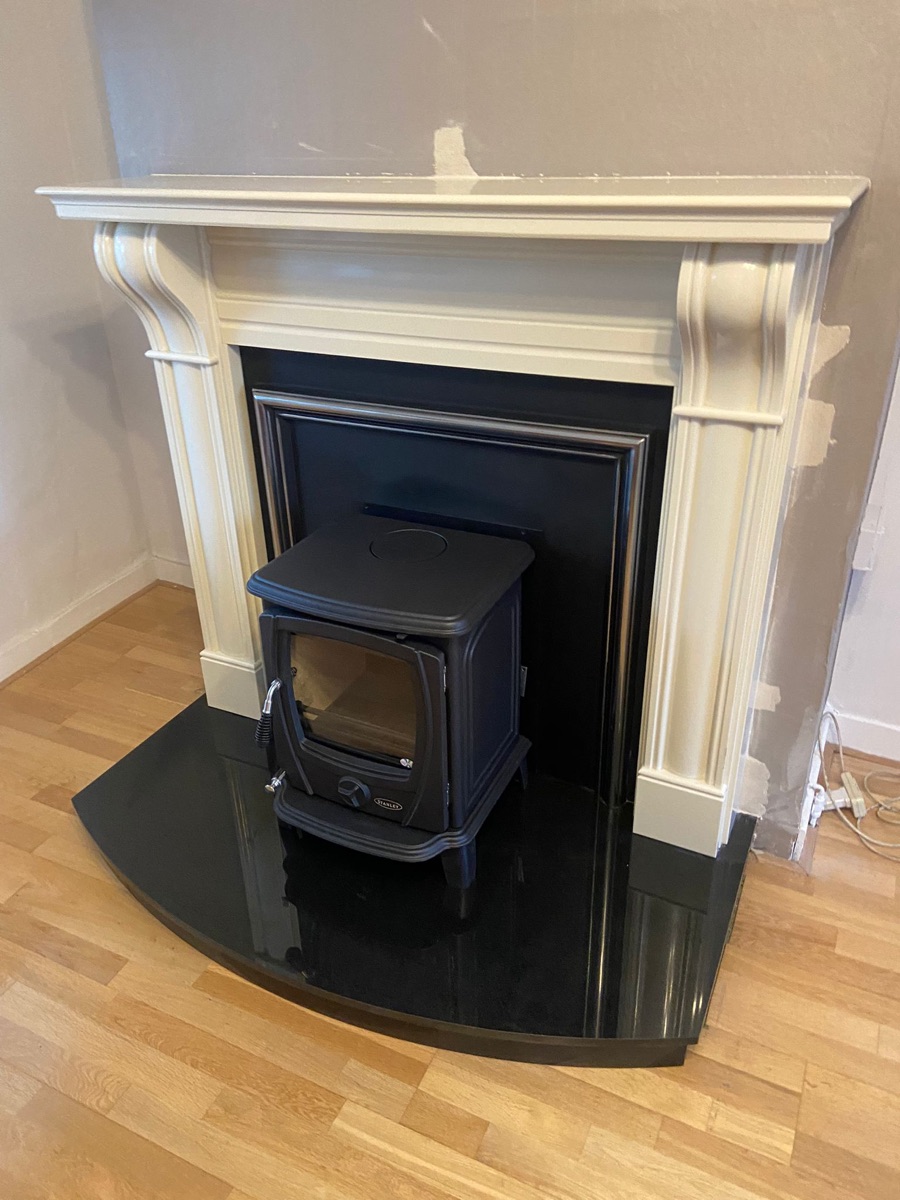
Wood burning stoves
across Kilkenny
Supplied and fitted from Graiguenamanagh to Castlecomer. The flue gets measured before you buy the stove, which in this county is not a formality.
In Kilkenny, measure the flue before you choose the stove
That advice applies everywhere, and in this county it is not boilerplate. The Leinster Coalfield sat on the Castlecomer Plateau, and Deerpark Colliery outside Castlecomer worked until it closed on 31 January 1969, ending about three hundred years of mining. What it produced was anthracite, and for generations that is what households across the north of the county burned.
Anthracite is a smokeless low-volatile fuel, and the regulations treat it differently from wood. Under TGD J Table 2, a closed appliance up to 20 kW burning smokeless low-volatile fuel or wood pellets may use a flue of 125 mm internal diameter. The same appliance burning seasoned timber, peat or bituminous coal needs at least 150 mm.
So a Kilkenny house whose flue has been entirely correct for fifty years can be undersized the moment somebody decides to burn logs. Finding that out after the stove has been bought and delivered is an expensive way to learn it.
Two honest options, and the cost of each
If the survey finds a 125 mm flue and you want a stove, there are two legitimate routes. Neither is wrong. They cost differently over time and the right answer depends on how you actually buy fuel.
Option one: line it to 150 mm and burn wood
Adds €1,000 – €2,500 to the job. Opens up burning timber, including anything you season yourself, which in a county with this much woodland is a real consideration. Cheapest running cost of all if you buy bulk loose softwood delivered, at about 8.5 cent per kWh on SEAI's figures.
Option two: keep the flue, fit a multi-fuel stove, burn smokeless
No liner cost at all. Low-smoke coal ovoids run about 9.5 cent per kWh, which is close to bulk softwood and comfortably below kerosene at 17.2 cent. The catch is that you are committed to smokeless fuel for the life of the appliance, and you cannot burn logs off your own land.
The number that decides it is how you would actually buy wood. Bulk loose softwood delivered beats smokeless fuel. Hardwood in small bags from a filling station is 15.3 cent per kWh, well above the smokeless option, and at that point the liner has bought you nothing but inconvenience. Somewhere dry to stack a bulk load is the real qualifying condition, not the stove.
Fuel costs from SEAI's Domestic Fuel Cost Comparison, updated quarterly.
40,996 homes, and a lot of them still heating with fire
Census 2022 counted 40,996 dwellings in County Kilkenny, up 5% on 2016, with 15,425 owned outright. Outright ownership skews towards longer-settled owners in older houses, which is the stock where a stove does real heating rather than sitting there for the look of it.
Nationally, 41% of homes built before 1919 still use oil as their main heating, against 9% of homes built since 2016. Outside Kilkenny City that older, oil-heated profile dominates, and it is why a stove here is usually bought to displace oil rather than to decorate a room.
The census also recorded 1,415 Kilkenny homes with no smoke alarm at all. If you are putting in a stove and there is no alarm in the house, fit one the same week. It costs a fraction of the stove.
Figures from the CSO's Census 2022 housing results for Kilkenny.
Almost everyone asks for too big a stove
The instinct is to buy plenty of stove so the room is never cold. It backfires. A stove too large for its room gets run with the air shut down to make the place bearable, and a shut-down fire is a smouldering one. That deposits tar in the flue, blackens the glass within an evening, and voids the warranty on a good many stoves.
Measure the room in metres, multiply length by width by height, divide by 14. That gives roughly the kilowatts needed to hold about 21°C on a cold day.
Worked example
A sitting room 4 m by 5 m with a 2.4 m ceiling is 48 m³. Divide by 14 and you get 3.4 kW. That room takes a 4 kW stove comfortably, or a 5 kW if the house is old and draughty. It does not want an 8 kW.
Adjust from there. A newer house near the city needs less than the sum suggests. A stone farmhouse outside Freshford with single glazing and an open stairwell needs more, and the open stairwell is worth flagging at survey because it turns one room into two. Most Kilkenny homes land on 4 to 6 kW.
The stove size calculator runs the same arithmetic with adjustments built in, and the stove selector narrows the type in four steps. Inset, freestanding, boiler and pellet are covered in full on the main stove guide.
Worth flagging one Kilkenny City difference. The older terraces in the city centre frequently have narrow fireplace openings built for small coal grates rather than the wider openings you get in a farmhouse, which rules out a good many inset stoves on depth alone. A freestanding stove on a hearth in front of the opening is usually the answer there, and it is better to know that before you fall in love with an inset model.
Fitted to Part J, not to the UK rulebook
Stove advice aimed at Irish homeowners is often quietly British, citing DEFRA exemption, Smoke Control Areas, HETAS registration and Approved Document J. None of those govern an installation in Kilkenny. The document that does is Technical Guidance Document J.
Air supply. A permanent ventilation opening of at least 6,500 mm² free area for any non-room-sealed solid fuel appliance. There is no under-5 kW exemption in Ireland; that is the UK rule. Above 5 kW in a reasonably airtight house you add 550 mm² per extra kilowatt, so an 8 kW stove needs 8,150 mm². Free area is the operative phrase, because a grille reduces it considerably and the hole cored through the wall ends up bigger than people expect.
Flue size. The 150 mm against 125 mm distinction covered at the top of this page. It is the same table doing both jobs.
Hearth. A constructional hearth is at least 125 mm of solid non-combustible material; a free-standing hearth on a non-combustible floor can be 12 mm. Back boilers are 125 mm, or 25 mm on non-combustible supports at least 25 mm high.
And plainly: there is no statutory register of stove installers in the Republic. HETAS left Ireland in March 2022, OFTEC registration carries no self-certification rights here, and METAC trains rather than registers. Check insurance, previous work and the certificate instead.
What a stove costs in Kilkenny
Covering labour, materials, waste away, commissioning and the certificate. Chimney work is its own line rather than buried in the fit price.
| Work | Typical range | Time on site |
|---|---|---|
| Home survey, flue measured | Free, no obligation | About an hour |
| Inset stove, supplied and fitted | €2,200 – €3,500 | 1 day |
| Freestanding stove, supplied and fitted | €2,500 – €4,000 | 1 day |
| Boiler stove, plumbed into your heating | €3,500 – €5,500 | 2 – 3 days |
| Liner, including 125 mm to 150 mm conversion | €1,000 – €2,500 | Same day as the fit |
| Twin-wall flue, where there is no chimney | €1,800 – €3,200 | 2 – 4 days |
A stove into a sound, correctly sized chimney with a usable hearth sits at the bottom of its band. An old coalfield house needing a 150 mm liner, a new hearth and a cored vent sits near the top, plus the liner line. That is exactly why the survey happens before anything is ordered.
Prices include VAT. Indicative only, with an exact figure in writing after the survey.
What actually happens in your sitting room
Dust sheets down and the floor covered first, because breaking out a fireplace opening makes a mess. The old fire or insert comes out and the opening gets checked once it is empty, which is where the occasional surprise turns up. If it does, you hear about it before it costs anything.
If a liner is going in, that is roof work: fed down from the top, connected at the stove, sealed at the pot with a closure plate and cowl. On a conversion from 125 mm to 150 mm this is the main event of the day. The hearth goes in next where the existing one falls short of the 125 mm or 12 mm required, then the stove is set, levelled and connected.
The air vent is cored through the outside wall and grilled. Least glamorous part of the day, most often missing on stoves fitted by somebody else.
Then it gets lit before we leave, to check the draw and so you see it working. Expect a smell off the paint curing for the first few fires. You get shown how to light it, how to run the air, what to burn and what never to, and the certificate goes in your hand before the van moves. Everything that came out goes with us.
Running the radiators off the fire
In a Kilkenny farmhouse on kerosene this is the install that moves the numbers most. A boiler stove heats the room it stands in and sends the rest to your cylinder and radiators, so an evening's fire does work the oil burner would otherwise be doing at 17.2 cent a kilowatt hour.
Two things to understand before committing. The first is that the output splits, and the headline figure catches people. A 13 kW boiler stove might put 4 kW into the room and 9 kW into the water. You size the room against the 4, not the 13. Size against the 13 and you get a sitting room nobody can sit in and a stove run shut down all winter.
The second is that it is a plumbing job as much as a stove job. It ties into your existing system and needs a heat leak radiator that cannot be valved off, so the fire always has somewhere to put its heat if the pump stops or the power goes. That radiator is not optional and it is not an upsell. It is what stops the system boiling in a power cut, which in rural Kilkenny is not hypothetical.
There is a Kilkenny-specific wrinkle worth raising early. A boiler stove is a multi-fuel appliance in most cases, so if the flue is a 125 mm anthracite flue you can often run it on smokeless fuel without relining at all. That makes a boiler stove one of the cheaper routes to displacing oil in an old coalfield house, because you skip the liner cost entirely.
Expect two to three days on site rather than one, and expect us to want a look at the cylinder and controls at survey stage.
What you burn decides how long the installation lasts
A new liner can be tarred up inside two winters by wet timber, which is a particularly annoying way to spend a relining budget you only just paid.
Under S.I. 529/2022, wood sold for burning in homes must be at or below 25% moisture, tightening to 20% from 1 September 2026. Two things get misreported: the regulations govern the sale of fuel rather than what you burn in your own house, and they do not touch timber you cut and season yourself.
If you are seasoning your own, split it, stack it off the ground with the wind through it, and give it two summers rather than one. A moisture meter costs about fifteen euro and ends the argument.
Never burn treated or painted timber, pallets, chipboard or MDF. They release chemicals that corrode a liner from the inside and are not pleasant coming back into the room.
Have the flue swept once a year in regular use. Not because an insurer demands it, since no Irish insurer makes annual sweeping a condition of cover, but because it is the cheapest hour you will spend on the thing.
Every corner of the county
Kilkenny's Eircode routing key is R95. Graiguenamanagh and the south-east are closest to base at Clonegall, roughly thirty-five minutes; Kilkenny City about fifty.
One man, one van, his own name over the door
Johnny Roberts runs J.Roberts Solid Fuel Services on his own out of Clonegall. The person who surveys the room is the person who fits the stove and the person who comes back if it does not draw right.
Which is why the flue gets measured before anything is ordered rather than after. There is no percentage in selling somebody a wood burner for a chimney that will not take one.
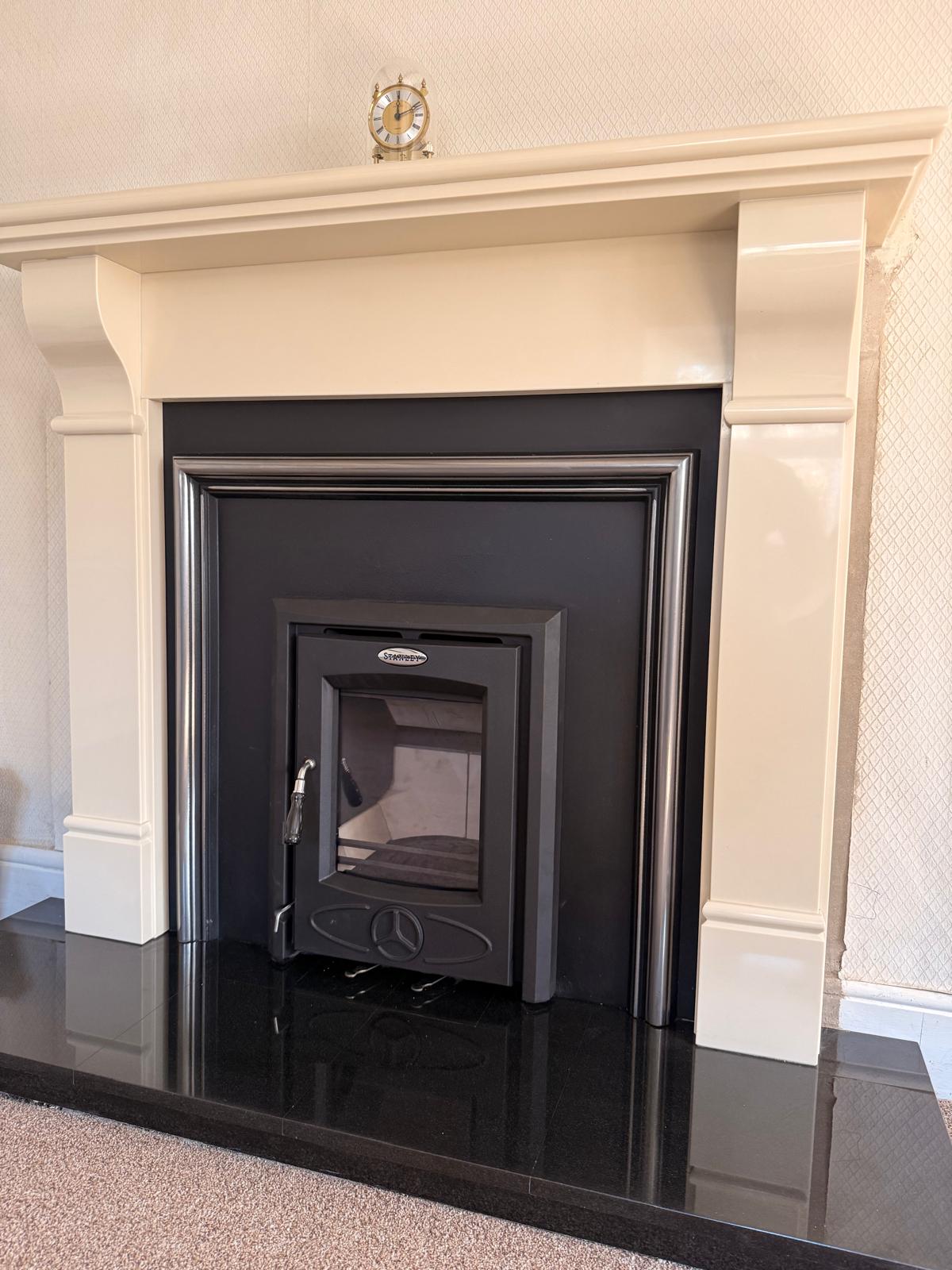
Wood burning stoves in Kilkenny. FAQ
We always burned anthracite. Can I put in a wood burning stove?
Yes, but check the flue before you buy the stove. TGD J Table 2 allows 125 mm for smokeless low-volatile fuel, which anthracite is, but requires at least 150 mm for seasoned timber, peat or bituminous coal. Around the old Castlecomer coalfield plenty of houses are set up for anthracite. Measuring the flue is part of the free survey.
How much does a stove cost to install in Kilkenny?
Inset €2,200 to €3,500. Freestanding €2,500 to €4,000. Boiler stove €3,500 to €5,500. A liner adds €1,000 to €2,500 where the survey calls for one, including a 125 mm to 150 mm conversion. Twin-wall flue where there is no chimney €1,800 to €3,200.
Should I just keep burning smokeless fuel instead?
A legitimate option worth pricing against a liner. A multi-fuel stove on the existing 125 mm flue avoids the relining cost. On SEAI's figures low-smoke coal ovoids are about 9.5c per kWh against bulk loose softwood at 8.5c, so wood only wins if you buy in bulk. Hardwood in small bags is 15.3c, well above the smokeless option.
Do I need an air vent for a stove in Ireland?
Yes. TGD J requires a permanent ventilation opening of at least 6,500 mm² free area for any non-room-sealed solid fuel appliance. There is no under-5 kW exemption here; that is the UK's Approved Document J.
What size stove do I need?
Room volume divided by 14 gives roughly the kilowatts to hold about 21°C. A 4 m by 5 m room with a 2.4 m ceiling comes to about 3.4 kW. Most Kilkenny homes end up on 4 to 6 kW, and oversizing is the more damaging mistake.
Does my chimney need lining?
Not automatically. In Kilkenny two situations make it likelier: a flue sized for anthracite when you want to burn wood, and an older wide flue built for an open fire that a modern stove cannot fill.
Can I run radiators off a stove?
Yes, with a boiler stove. The output splits. A 13 kW stove might give 4 kW to the room and 9 kW to the system, and you size the room against the 4. Budget two to three days.
What moisture content does firewood have to be?
S.I. 529/2022 sets 25% for wood sold for residential burning, tightening to 20% on 1 September 2026. The regulations govern sale rather than what you burn at home, and they do not apply to timber you season yourself.
Is there an SEAI grant for a stove?
No. Stoves appear at clause 6.16 of the Deep Retrofit technical specification, but Table 1 gives them no grant coverage.
How long does the installation take?
One day into a sound existing chimney, liner included in most cases. Two to three days for a boiler stove. Two to four days for a twin-wall flue where there is no chimney.
Do you cover the whole county?
Yes, across R95. Graiguenamanagh and the south-east about thirty-five minutes from base, Kilkenny City about fifty, Castlecomer and the north a little more.
Free planning tools
Plan your Kilkenny stove in 5 minutes, free
Related guides & nearby counties
Thinking about a stove in Kilkenny?
The survey is free and it measures the flue. If you are in an old coalfield house, that measurement decides whether you are buying a liner as well as a stove, and it is far cheaper to know now.