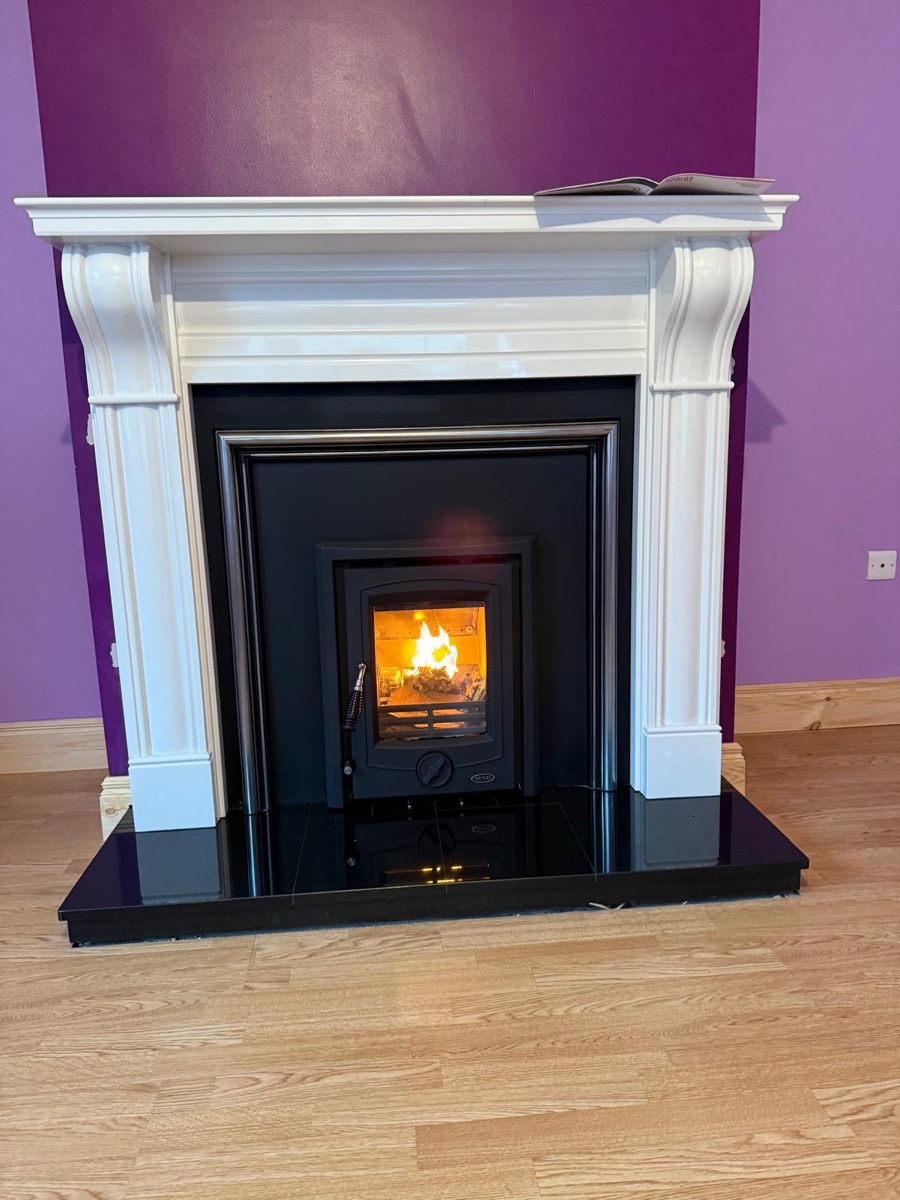
Wood burning stoves
across Carlow
Supplied and fitted from a base in Clonegall, ten minutes from the Wexford border. Free survey, chimney lined where it needs it, certificate the day we finish.
The shortest drive we make
J.Roberts Solid Fuel Services works out of Clonegall, in the south-east corner of County Carlow. Kildavin is seven minutes. Tullow is about twenty, Carlow Town roughly half an hour, Borris and Bagenalstown a little more. For a stove installation that matters at both ends: the survey gets booked quickly, and if the stove needs anything looked at after the first winter, it is a short run rather than a favour.
Carlow is the second smallest county in Ireland by area. There is nowhere in it that is difficult to get to, and there is nowhere in it we have not been.
In most of Carlow it is oil, and oil has had a bad year
Outside Carlow Town, most of the county heats with oil. Census 2022 counted 24,557 dwellings in Carlow, and nationally 41% of homes built before 1919 still run on oil against 9% of homes built since 2016. Rural Carlow is heavily weighted towards the former.
That is the context for a stove here, and it is worth putting real numbers on rather than a sales line. These are SEAI's own figures from the Domestic Fuel Cost Comparison, which is updated quarterly.
| Fuel, as bought | Cost per kWh |
|---|---|
| Softwood, bulk loose, delivered | 8.5c |
| Softwood, full pallet, delivered | 10.4c |
| Hardwood, small bags, collected | 15.3c |
| Kerosene (typical discounted) | 17.2c |
Read the top and the bottom of that together. Bulk loose softwood is half the cost of kerosene per unit of heat. Hardwood bought by the bag at a filling station is barely cheaper than the oil you are trying to get away from. It is the same stove in the same room either way, and the buying decides it.
Which means, in a county with plenty of sheds and outbuildings, the shed matters. Somewhere dry to stack a bulk load bought in spring is worth more than any feature on the stove itself.
Getting the size right matters more than getting the brand right
Almost everyone asks for too big a stove. The instinct is to buy plenty so the room is never cold, and it backfires. A stove too large for its room ends up run with the air shut down to make the place bearable, and a shut-down fire is a smouldering one. That deposits tar in the flue, blackens the glass within an evening, and voids the warranty on a good many stoves.
The starting point is arithmetic. Measure the room in metres, multiply length by width by height, divide by 14. That gives roughly the kilowatts needed to hold about 21°C on a cold day.
Worked example
A sitting room 4 m by 5 m with a 2.4 m ceiling is 48 m³. Divide by 14 and you get 3.4 kW. That room takes a 4 kW stove comfortably, or a 5 kW if the house is old and draughty. It does not want an 8 kW.
Adjust from there. A newer, well-insulated house near Carlow Town needs less than the sum suggests. A stone farmhouse outside Myshall with single glazing, solid walls and an open stairwell needs more, and the open stairwell in particular is worth flagging at survey because it turns one room into two.
Most Carlow homes land on 4 to 6 kW. The stove size calculator runs the same arithmetic with the adjustments built in, and the stove selector narrows the type in four steps. Inset, freestanding, boiler and pellet are covered in full on the main stove installation guide.
Fitted to Part J, not to the UK rulebook
A lot of stove advice aimed at Irish homeowners is quietly British. It cites DEFRA exemption, Smoke Control Areas, HETAS registration and Approved Document J, none of which govern an installation in Carlow. The document that does is Technical Guidance Document J, published under the Building Regulations.
Air supply, and there is no 5 kW exemption here
You will read everywhere that a stove under 5 kW needs no air vent. That is the UK rule. Irish TGD J requires a permanent ventilation opening for any non-room-sealed solid fuel appliance, with a free area of at least 6,500 mm², whatever the output. Above 5 kW in a reasonably airtight house you add 550 mm² per extra kilowatt, so an 8 kW stove needs 8,150 mm².
The catch is the words free area: the open area air can actually pass through, not the size of the hole. A grille eats into it considerably, so the core drilled through the wall ends up larger than people expect. It is the single most common thing found missing on stoves fitted by somebody else.
Flue size and hearth
TGD J Table 2 sets 150 mm minimum internal diameter for a closed appliance up to 20 kW burning seasoned timber, peat or bituminous coal. Only smokeless low-volatile fuel or wood pellets may go to 125 mm. Plenty of stoves ship with a 125 mm spigot, which is fine for smokeless fuel and not compliant for wood.
A constructional hearth is at least 125 mm of solid non-combustible material; a free-standing hearth on a non-combustible floor can be 12 mm. Back boilers are their own case at 125 mm, or 25 mm on non-combustible supports at least 25 mm high.
Worth adding plainly: there is no statutory register of stove installers in the Republic. HETAS left Ireland in March 2022, OFTEC registration carries no self-certification rights here, and METAC trains rather than registers. Anybody claiming to be on the Irish register is describing something that does not exist. Check insurance, previous work and the certificate instead.
Will the chimney you have take a stove?
Often, yes, and without lining. TGD J asks that the flue be suitable, not that it be lined as a matter of routine. A sound masonry flue of the right size can take a stove exactly as it stands, and plenty of Carlow chimneys surveyed for a stove have needed nothing done to them at all.
Lining becomes necessary for one of four reasons: the flue is oversize for the stove, which is common where a chimney built for an open fire is being reused; it leaks between floors because the parging has broken down; the camera shows cracking; or there is no chimney at all, in which case it is a twin-wall insulated flue built from the stove up through the roof.
Older Carlow farmhouses throw up the oversize problem most often. A wide flue built for a turf fire will not be filled by a 5 kW stove, and the gases slow and condense on the way up rather than drawing cleanly. That is a safety point as much as an efficiency one.
The chimney suitability checker gives you a sense of where yours stands in five questions. If it turns out the stack itself needs work, that is covered on chimney repair in Carlow.
What a stove costs in Carlow
Real ranges covering labour, materials, waste away, commissioning and the certificate. Where the chimney needs work that line is added on top rather than buried in the fit price.
| Work | Typical range | Time on site |
|---|---|---|
| Home survey, CCTV where needed | Free, no obligation | About an hour |
| Inset stove, supplied and fitted | €2,200 – €3,500 | 1 day |
| Freestanding stove, supplied and fitted | €2,500 – €4,000 | 1 day |
| Boiler stove, plumbed into your heating | €3,500 – €5,500 | 2 – 3 days |
| Chimney liner, if the survey calls for one | €1,000 – €2,500 | Same day as the fit |
| Twin-wall flue, where there is no chimney | €1,800 – €3,200 | 2 – 4 days |
A stove into a sound, correctly sized chimney with a usable hearth sits at the bottom of its band. The same stove into a farmhouse outside Hacketstown needing a liner, a new hearth and a cored vent sits near the top, plus the liner line. The survey is free precisely because nobody can tell which you are from a phone call.
Prices include VAT. Indicative only, with an exact figure in writing after the survey.
What actually happens in your sitting room
Dust sheets down and the floor covered first, because breaking out a fireplace opening makes a mess and there is no way around it. The old fire or insert comes out and the opening gets checked properly once it is empty. That is the point where the occasional surprise turns up, and if it does you hear about it before it costs anything.
If a liner is going in, that is roof work: fed down from the top, connected at the stove, sealed at the pot with a closure plate and cowl. The hearth goes in next where the existing one does not meet the 125 mm or 12 mm required, then the stove is set, levelled and connected.
The air vent is cored through the outside wall and grilled. Least glamorous part of the day, most often skipped by others, worth watching go in.
Then it gets lit before we leave, partly to check the draw and partly because you should see it working. Expect a smell off the paint curing for the first few fires; that is normal and it passes. You get shown how to light it, how to run the air controls, what to burn and what never to, and the certificate goes in your hand before the van moves. Everything that came out goes with us.
Running the radiators off the fire
In a Carlow farmhouse on kerosene, this is the install that moves the numbers most. A boiler stove heats the room it stands in and sends the rest to your cylinder and radiators, so an evening's fire is doing work the oil burner would otherwise be doing at 17.2 cent a kilowatt hour.
Two things are worth understanding before committing. The first is that the output splits, and people get caught by the headline figure. A 13 kW boiler stove might put 4 kW into the room and 9 kW into the water. You size the room against the 4, not the 13. Size against the 13 and you end up with a sitting room nobody can sit in and a stove that gets run shut down all winter.
The second is that it is a plumbing job as much as a stove job. The stove ties into your existing system, and it needs a heat leak radiator that cannot be valved off, so the fire always has somewhere to put its heat if the pump stops or the power goes. That radiator is not optional and it is not an upsell. It is what stops the system boiling during a power cut, which in rural Carlow is not a hypothetical.
Expect two to three days on site rather than one, and expect us to want a look at the cylinder and the controls at survey stage rather than on the morning we arrive. If the existing system is oil with a modern cylinder it is usually straightforward. Older gravity-fed setups need more thought and occasionally more work.
Worth being honest about the limit, too: a boiler stove supplements an oil system, it rarely replaces it outright. You still want the burner there for the mornings nobody wants to be lighting a fire.
What you burn decides how long the installation lasts
A new liner can be tarred up inside two winters by wet timber. It is the fastest way to undo a good installation and it is entirely avoidable.
Under S.I. 529/2022, wood sold for burning in homes must be at or below 25% moisture, tightening to 20% from 1 September 2026. Two things get misreported constantly: the regulations govern the sale of fuel rather than what you burn in your own house, and they do not touch timber you cut and season yourself.
Which is relevant in Carlow, because a lot of households here are burning their own. If you are seasoning timber off your own land, split it, stack it off the ground with the wind through it, and give it two summers rather than one. A moisture meter costs about fifteen euro and settles the argument.
Never burn treated or painted timber, pallets, chipboard, MDF or driftwood. They release chemicals that corrode a liner from the inside, and they are not pleasant coming back into the room either.
Have the flue swept once a year for a stove in regular use. Not because an insurer demands it, because no Irish insurer makes annual sweeping a condition of cover whatever you have been told, but because it is the cheapest hour you will spend on the thing.
Every corner of the county
Carlow's Eircode routing keys are R93 for Carlow Town and its surrounds and R21 for Muine Bheag. Stoves fitted across both and everywhere between.
One man, one van, his own name over the door
Johnny Roberts runs J.Roberts Solid Fuel Services on his own out of Clonegall. The person who surveys your room is the person who fits the stove and the person who comes back if it does not draw right.
That is why the advice here is as blunt as it is. There is no percentage in selling anybody a stove that is wrong for the room when you are the one who has to return to it.
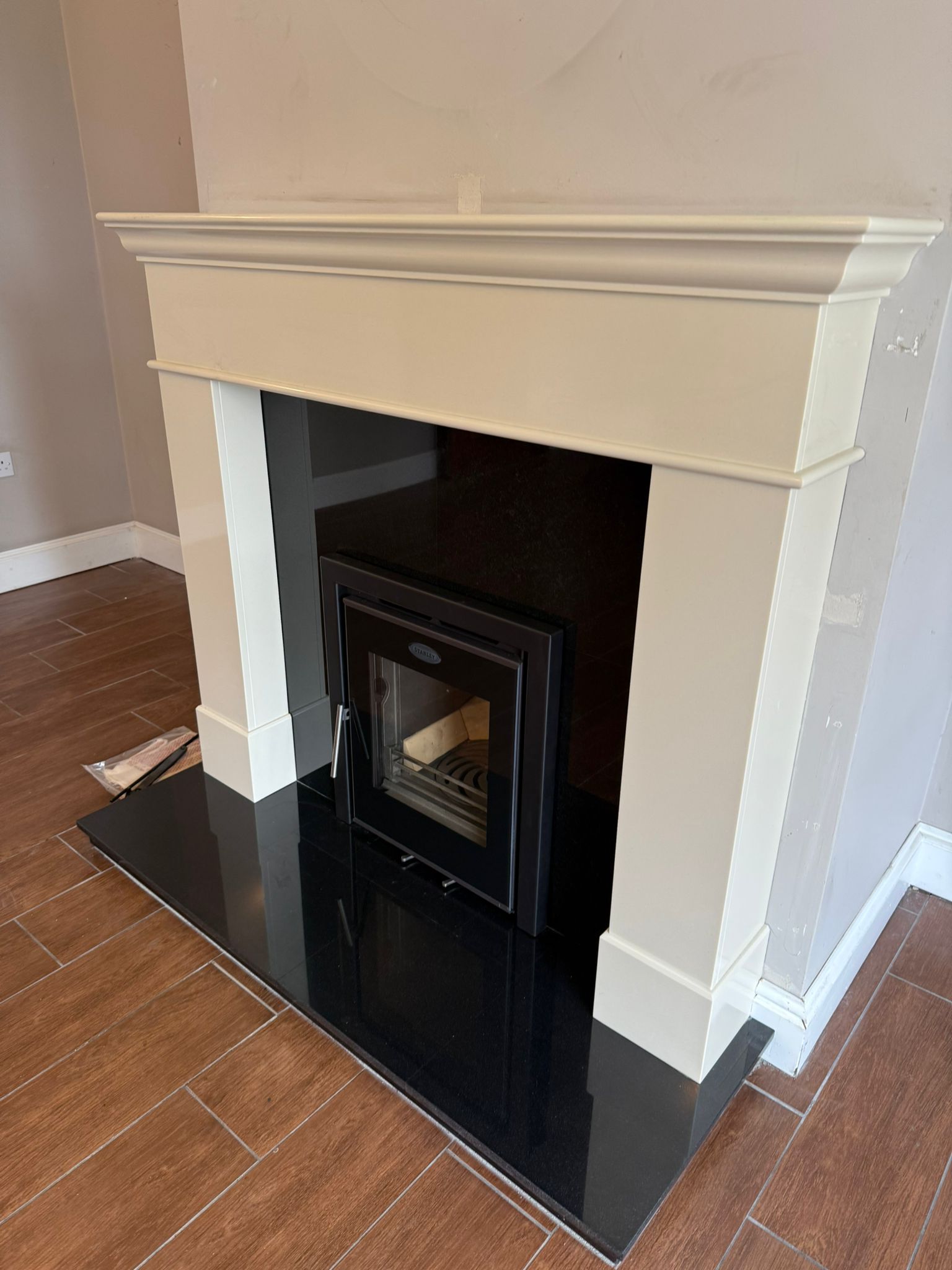
Wood burning stoves in Carlow. FAQ
How much does a stove cost to install in Carlow?
An inset stove supplied and fitted is €2,200 to €3,500. A freestanding stove €2,500 to €4,000. A boiler stove plumbed into your heating €3,500 to €5,500. A liner adds €1,000 to €2,500 where the survey calls for one, and a twin-wall flue where there is no chimney is €1,800 to €3,200.
Do I need an air vent for a stove in Ireland?
Yes. TGD J requires a permanent ventilation opening of at least 6,500 mm² free area for any non-room-sealed solid fuel appliance. There is no under-5 kW exemption in Ireland. That rule is from the UK's Approved Document J and gets quoted at Irish homeowners constantly.
What size stove do I need?
Room volume in cubic metres divided by 14 gives roughly the kilowatts to hold about 21°C. A 4 m by 5 m room with a 2.4 m ceiling comes to about 3.4 kW. Most Carlow homes end up on 4 to 6 kW, and oversizing is the more damaging mistake.
Is a stove cheaper to run than oil?
It depends how you buy the wood. On SEAI's figures bulk loose softwood delivered is about 8.5c per kWh against kerosene at 17.2c. Hardwood in small bags is about 15.3c, which barely beats the oil. The buying decides it, not the stove.
Does my chimney need lining?
Not automatically. TGD J requires the flue to be suitable, not lined as a matter of course. Lining is needed where the flue is oversize, leaks between floors, or shows cracking on camera. Older Carlow farmhouse flues built for turf fires are the ones most often oversize for a modern stove.
What size flue does a wood burning stove need?
At least 150 mm internal diameter for a closed appliance up to 20 kW burning timber, peat or bituminous coal, under TGD J Table 2. Only smokeless fuel or pellets may use 125 mm. Many stoves ship with a 125 mm spigot, so this catches people out.
Can I run radiators off a stove?
Yes, with a boiler stove. The output splits. A 13 kW stove might give 4 kW to the room and 9 kW to the system, and you size the room against the 4. It needs plumbing in and a heat leak radiator that cannot be valved off, so budget two to three days.
What moisture content does firewood have to be?
S.I. 529/2022 sets 25% for wood sold for residential burning, tightening to 20% on 1 September 2026. The regulations govern sale rather than what you burn at home, and they do not apply to timber you cut and season yourself.
Is there an SEAI grant for a stove?
No. Stoves appear at clause 6.16 of the Deep Retrofit technical specification, but Table 1 gives them no grant coverage. There is no stove grant in Ireland.
How long does the installation take?
One day into a sound existing chimney, liner included in most cases. Two to three days for a boiler stove. Two to four days for a twin-wall flue where there is no chimney.
Are you actually based in Carlow?
Yes. Clonegall, in the south-east corner of the county. Kildavin is seven minutes, Tullow about twenty, Carlow Town roughly half an hour. Carlow is the home county rather than a service area added to a list.
Free planning tools
Plan your Carlow stove in 5 minutes, free
Related guides & nearby counties
Thinking about a stove in Carlow?
The survey is free and there is no obligation attached to it. Worst case you find out the chimney is grand and you needed less than you thought.