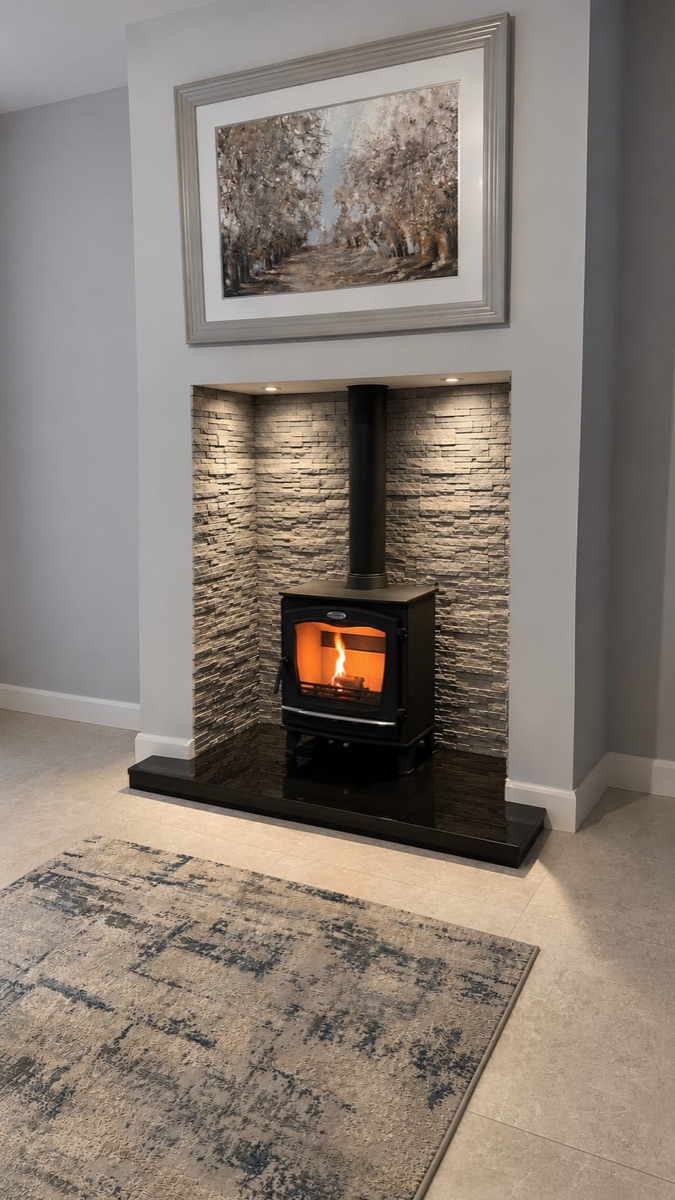
Wood burning stoves
across Wexford
Supplied and fitted, from Bunclody to Kilmore Quay. Free survey, chimney lined where it needs it, certificate issued the day we finish.
In Wexford it's oil, or it's fire
Natural gas never reached most of this county. Census 2022 records just 1.2% of Wexford homes on natural gas, the second lowest rate of any local authority in Ireland, against roughly a third of homes nationally. Two thirds of the county, 67.3%, heats with oil.
That leaves solid fuel doing far more work here than the national average. 14% of Wexford households use solid fuel as their main heating against 8.9% nationally, and the split tells you something useful: coal is a town fuel here, 19.4% of households in New Ross, 18% in Enniscorthy, while wood is a countryside fuel, at 5.1% of rural households versus 1.4% in the towns.
So the stove conversation in Wexford is rarely about replacing gas. It is about an open fire that throws most of its heat up the chimney, or an oil bill that spikes every cold snap. A properly sized stove in the right room changes both.
Work out what size you need →How Wexford heats
Main central heating fuel · CSO Census 2022
- Oil 67.3%
- Coal 10.6%
- Electricity 9.9%
- Wood & pellets 3.1%
- Natural gas 1.2%
Nationally, natural gas heats 32.7% of homes. In Wexford it heats 1.2%. Second lowest in Ireland.
An open fire sends most of
your heat up the chimney
These are SEAI's own published figures, not ours, same document, same basis, so the comparison is like for like.
| Appliance | Seasonal efficiency | Cost per useful kWh |
|---|---|---|
| Open fire | 20 – 30% | ~35c |
| Closed stove | 50 – 80% | ~13c |
| Stove with back boiler | 65 – 85% | — |
| Electric heating (day rate) | — | 34.4c delivered |
Where those numbers come from
SEAI's Domestic Fuels. Comparison of Energy Costs puts softwood logs, full pallet, 25% moisture, at 10.41 cent per kWh delivered. Burn those in a stove running at 80% and you are paying about 13 cent per useful kWh. Burn the identical logs on an open fire at 30% and the same heat costs about 35 cent, because two thirds of it went up the flue.
Worth one honest caveat: SEAI's 50–80% stove band is measured on coal. They publish no separate figure for wood-burning stoves, so we quote the band they actually publish rather than a better-sounding number from elsewhere.
SEAI's own BER tool recommends this upgrade
If your BER assessment records an open fire, it is modelled at 30% efficiency. SEAI's BER Advisory Report then offers, as a recommended upgrade, "install solid fuel closed room heater or stove with min 60% efficiency". There is also a second, quieter gain: an open chimney is counted as 40 m³/h of ventilation loss in the BER calculation, and a closed flue halves that to 20. We will not put a number on the grade change, a secondary heater carries limited weight in the calculation, but the direction is SEAI's own, not a sales claim.
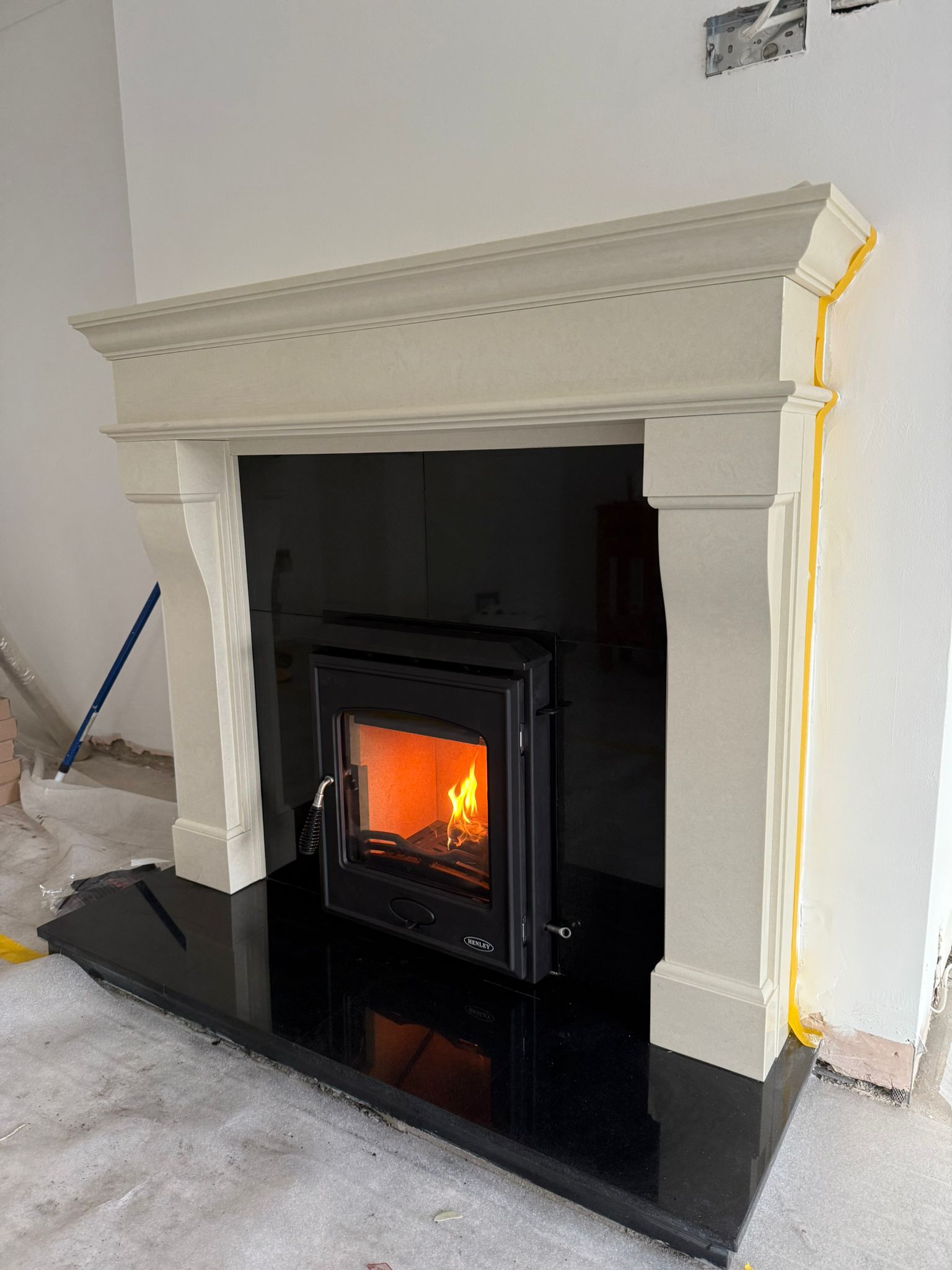
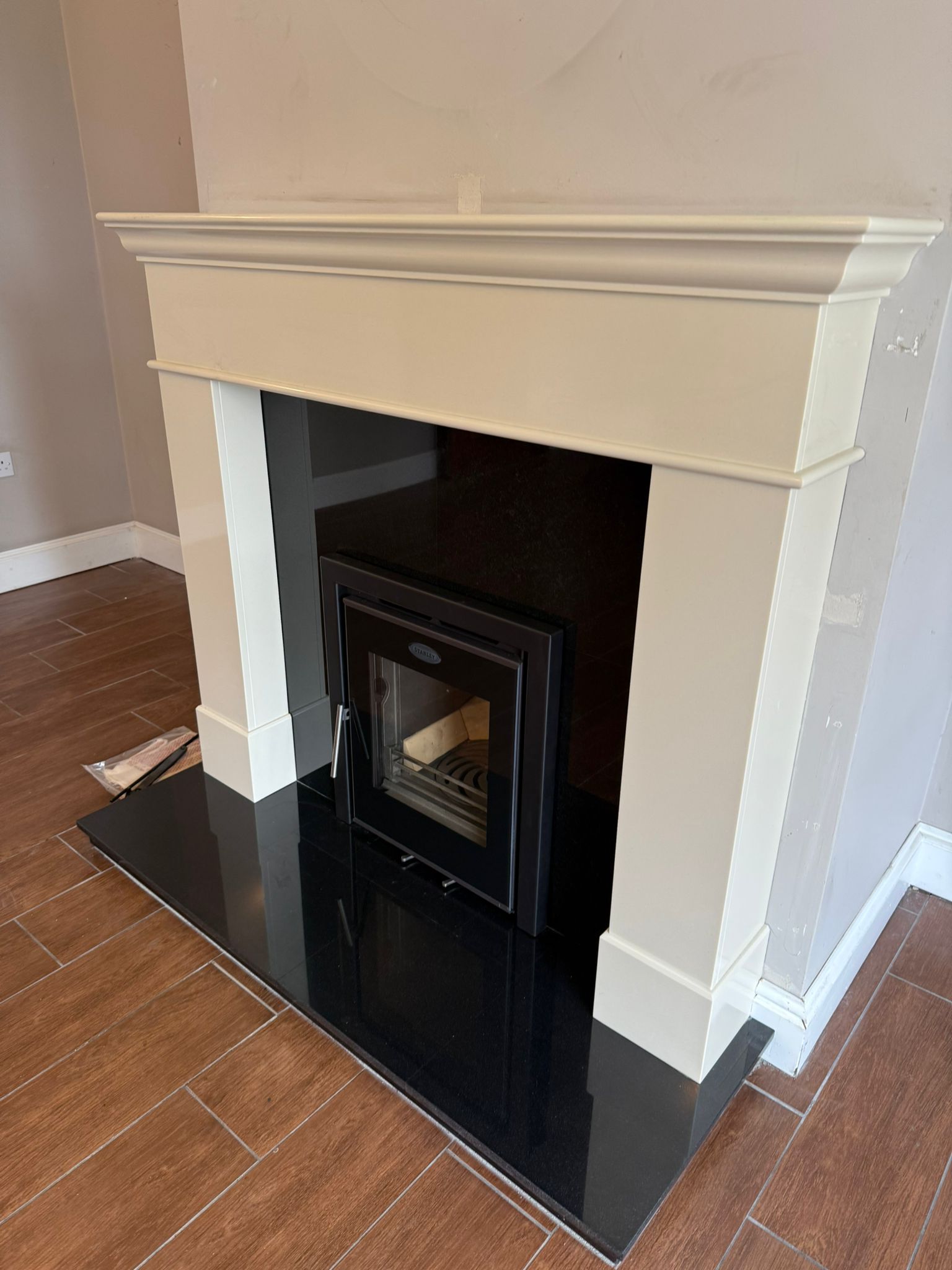
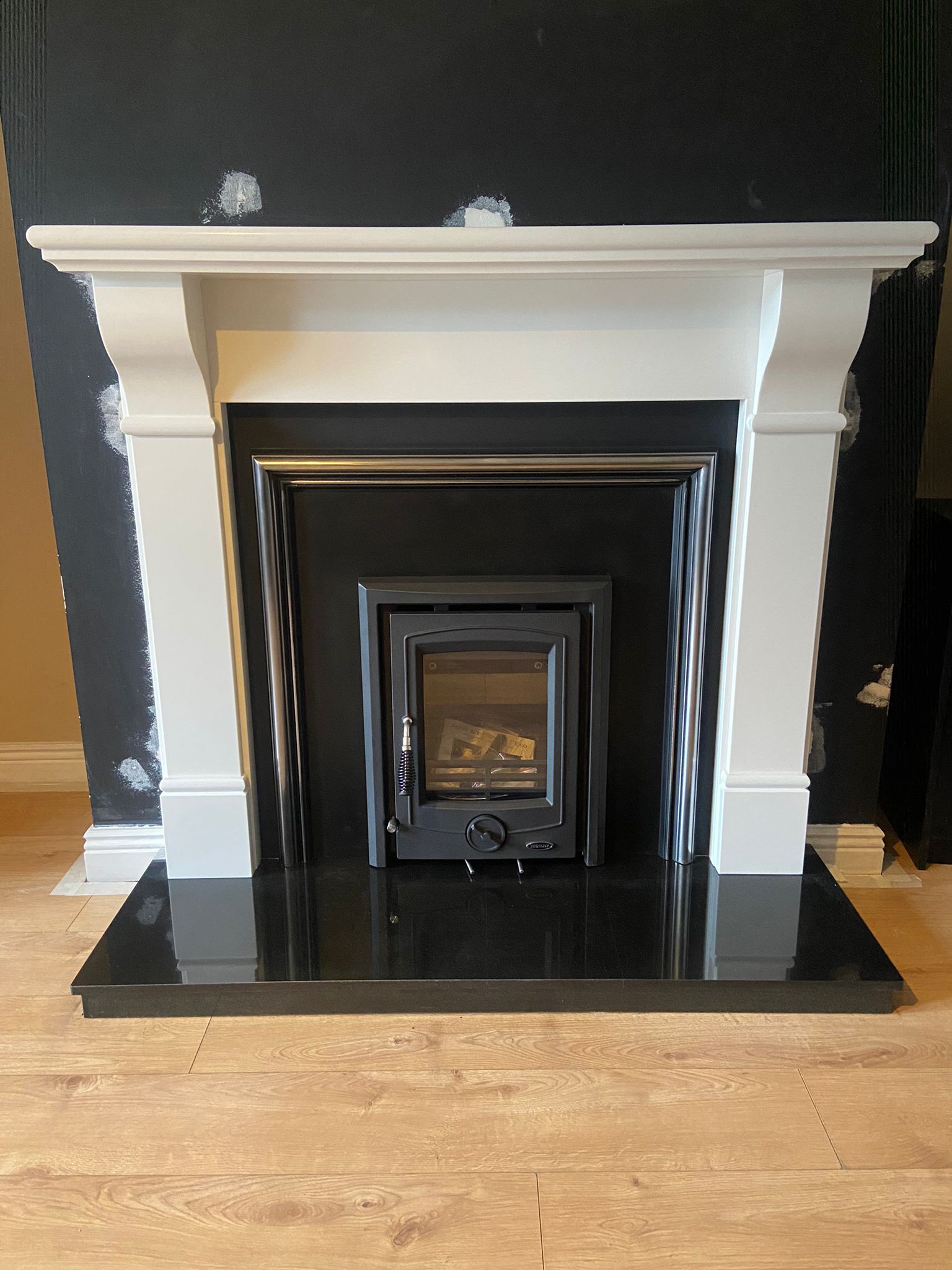
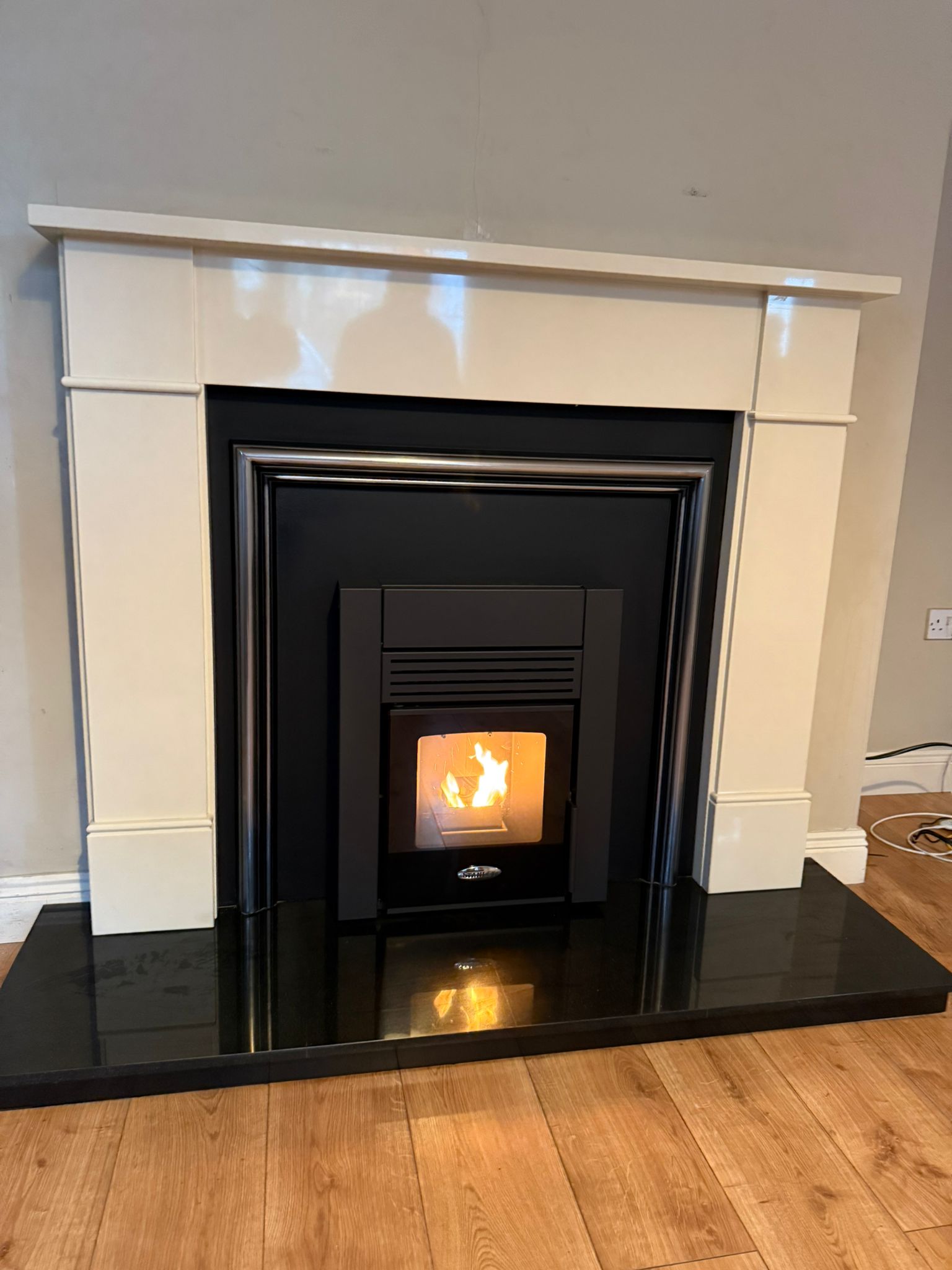
Fitted to Part J,
certified on the day
Part J of the Building Regulations applies to a stove installation no matter how old the house is, the regulations bite on the work, not the building.
The hearth
A constructional hearth is solid non-combustible material, at least 125mm thick, projecting 500mm in front of the recess and 150mm each side. A free-standing hearth is at least 12mm thick and 840mm × 840mm.
The stove sits at least 150mm from the sides and rear, and 225mm clear at the front. Where the hearth comes within 150mm of a wall, that wall has to be solid non-combustible to 1.2m above it.
Air supply
A stove needs 550mm² of permanent ventilation per kW, with a 6,500mm² minimum. In a typical older Wexford house that minimum covers any stove up to about 11.8kW; in a deep-retrofitted airtight house a 10kW stove needs 9,250mm².
One rule people get caught by: an extract fan should not be in the same room as an open-flued solid fuel appliance. It can pull flue gases back into the room. We check this at survey.
Carbon monoxide alarm
Required, not optional. A CO alarm to I.S. EN 50291 goes in the room with the stove and either inside each bedroom or within 5m of the bedroom door.
Siting matters: 1 to 3 metres horizontally from the appliance, and if ceiling mounted, at least 300mm from any wall. Fitted and positioned properly as part of every installation.
Notice plate & certificate
Part J requires a durable notice plate permanently fixed, recording the flue category, the liner type and size, the manufacturer, the date and the installer.
You also get the certificate of installation the day we finish. Your home insurer will ask for it, without it, a fire-related claim can get difficult.
Does my chimney have to be lined?
Not automatically, and it's worth saying so, because plenty of installers imply otherwise.
What the regulations require is that the flue be suitable for the appliance. TGD J says a flue being brought back into use should be checked and altered if necessary, and that a flue may need relining to reduce its area, because oversize flues can be unsafe. Lining is the usual way of achieving suitability. It is not a blanket legal requirement.
In practice most old Wexford chimneys do need it, and the reason is physics rather than paperwork. An open fire sent a large volume of hot, air-diluted gas up the flue. A modern stove is far more efficient, so it sends much less gas, much cooler, a typical stove runs a flue gas temperature around 250–330°C. A chimney needs roughly 150–450°C to draw properly. Below that the gas condenses inside the flue and forms tar, which stains through the chimney breast and becomes the fuel for a chimney fire.
The geometry makes it worse. A 150mm liner is 17,671mm². A typical old 225mm square Wexford flue is 50,625mm² — nearly three times the area. All that extra volume is cold surface for condensation. It is also why 5,725 pre-1919 Wexford households matter here: those flues are usually bare brick or stone, parged with lime that has been eaten away by decades of coal smoke.
The CCTV survey tells us which category yours is in before you spend anything. Sometimes the answer is genuinely "this is fine".
What a stove costs in Wexford
We publish real ranges rather than hiding behind "contact us", but they are a guide, not a quote. The survey is free and the written price after it is fixed.
| Work | Typical range | What moves the price |
|---|---|---|
| Inset stove, supply & fit | €2,200 – €3,500 | Stove chosen, surround, opening size |
| Freestanding stove, supply & fit | €2,500 – €4,000 | Stove chosen, hearth, connection |
| Back boiler stove, supply & fit | €3,500 – €5,500 | Output, plumbing, cylinder work |
| Chimney lining | €1,000 – €2,500 | Flue height, liner grade, access |
| Twin wall flue (no chimney) | €1,800 – €3,200 | Route, roof penetration, height |
| Home survey | Free, no obligation | Includes CCTV where needed |
There is no SEAI grant for a stove. SEAI's own technical standards list stoves as measure 6.16 with no coverage under any of their five schemes. Their grants target insulation, windows, heat pumps, controls and solar. Anyone telling you a stove is grant-aided is mistaken.
One adjacent scheme is worth knowing about: the Housing Aid for Older People Grant, up to €10,700, means tested, for homeowners aged 66 and over, administered by your local authority. gov.ie lists wood pellet stoves among eligible works. That is pellet specifically, not multi-fuel. Worth a call to Wexford County Council if it might apply to you.
The figures above are indicative ranges for guidance only. They are not a quote and not an offer. What you actually pay depends on the stove you choose, the state of the chimney, and access. Jonathon gives you a fixed written price after the survey, and the survey is free.
Every corner of the county
Roughly half of County Wexford's population lives outside any town or village, so most of our installations are at rural properties. We cover all four postal areas.
| Town / area | Eircode | Population | What we typically fit |
|---|---|---|---|
| Wexford Town | Y35 | 21,524 | Inset stoves into 19th-century terraced fireplaces |
| Enniscorthy | Y21 | 12,310 | Oldest stock in the county, lining almost always needed |
| Gorey | Y25 | 11,517 | Newer stock, more twin wall flue work |
| New Ross | Y34 | 8,610 | Highest coal use in Wexford, multi-fuel stoves |
| Courtown | Y25 | 4,365 | Holiday homes, quick-response stoves for seasonal use |
| Rosslare & Harbour | Y35 | 4,042 | Exposed coastal, anti-downdraught cowls |
| Bunclody | Y21 | 2,053 | Ten minutes from our yard, often same-week survey |
| Ferns | Y21 | 1,317 | Older village core, unlined stone flues |
| Kilmore Quay | Y35 | 447 | Coastal cottages, holiday properties |
We also cover Castlebridge, Kilmuckridge, Taghmon, Camolin, Blackwater, Bridgetown, Tagoat, Barntown, Clonroche, Oulart, Fethard-on-Sea, Campile, Duncannon, Curracloe, Carne, Kiltealy, Rathnure, Wellingtonbridge and every townland in between.
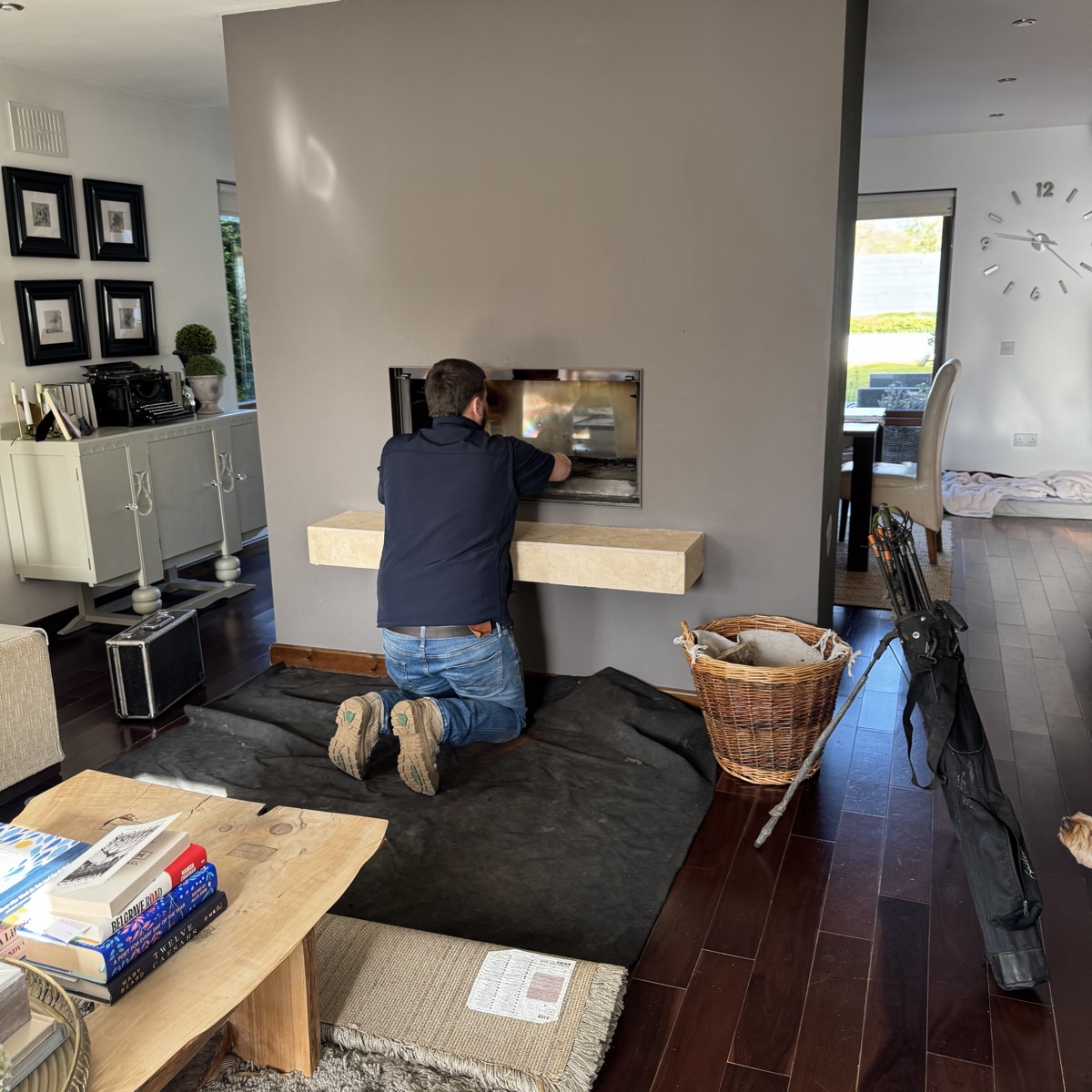
The man behind
the business
Jonathon Roberts runs J.Roberts Solid Fuel Services from Clonegall, Co. Carlow, ten minutes from the Wexford border at Bunclody. He does the survey, he does the fit, and he is the one you deal with from the first phone call to the certificate at the end.
No subcontractors, no showroom pressure, no different crew turning up than the one who quoted. 49 Google reviews at 4.9 stars, and the thing customers mention most often is that the place was left clean.
Wood burning stoves in Wexford. FAQ
Free planning tools