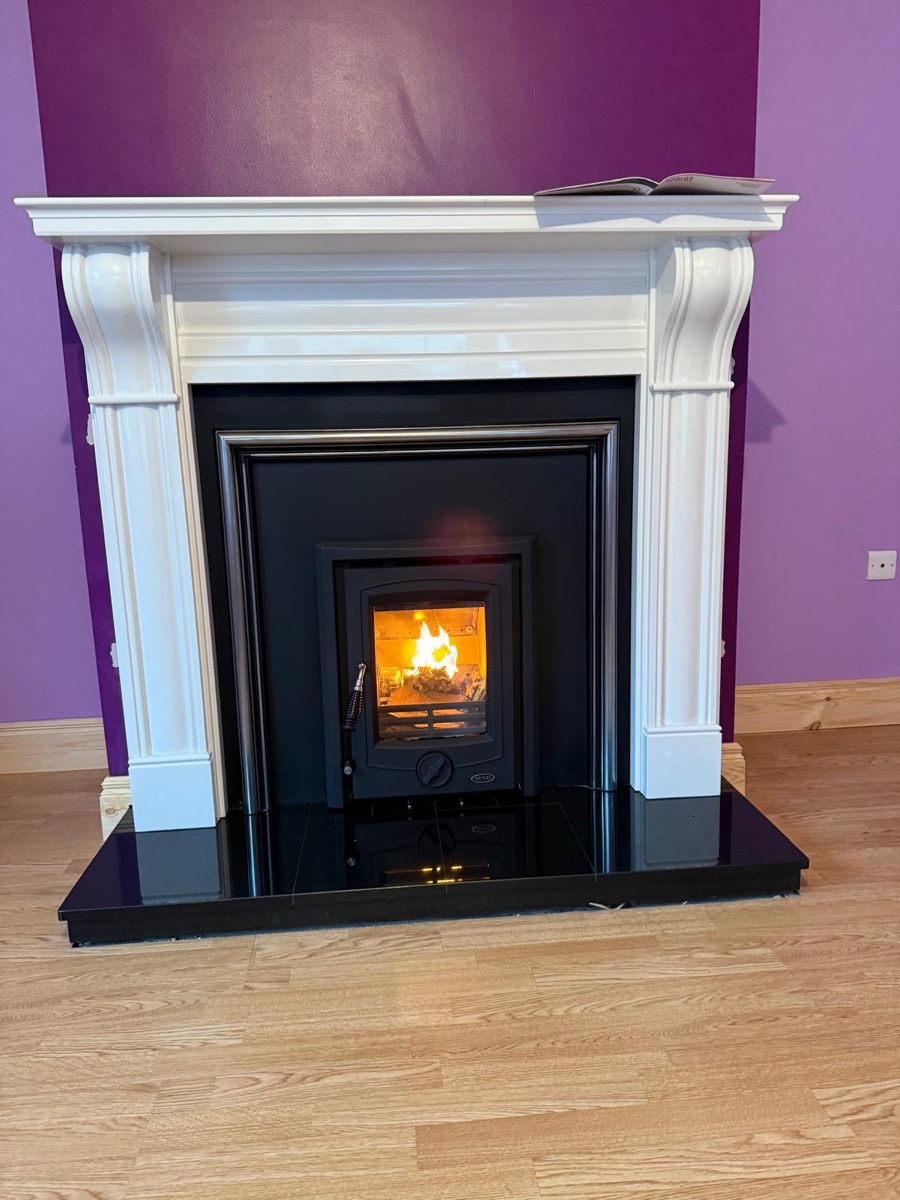
Wood burning stoves
across Offaly
Open turf fires closed in properly, oversize flues lined, multi-fuel grates that actually burn turf. Free survey, camera up the flue before you buy anything.
In Offaly, the job is usually closing in an open turf fire
Most stove pages written for Ireland assume you are choosing a stove. In Offaly the more common situation is that you already have a fire, it is open, it burns turf, and it is throwing most of its heat up the chimney.
Census 2022 recorded 27% of Offaly households heating mainly with peat, including turf. That is the highest rate of any county in the State, against 3.7% nationally. This is Bord na Móna country and the fuel habit runs deep.
So the useful question here is not which brand. It is what happens when you close that fire in, and the answer has three parts that all get decided by one camera survey.
The heat gain is large. An open fire loses most of the fuel's energy straight up the flue and pulls heated room air out to feed itself. A closed stove sold today must hit at least 65% seasonal efficiency under EU law. Same turf, considerably warmer room.
The flue is almost certainly too big. It was built for an open turf fire, which needed that volume. A 5 kW stove cannot fill it, so a liner is the likely answer rather than the surprise.
And there is probably tar up there. Turf tars a flue faster than timber. That has to be dealt with before a stove starts running hotter fires up the same chimney.
Which is why the order of work is: a camera goes up the flue before you buy anything. Not after the stove is ordered, not on the morning of the fit.
Straight about distance: the van works out of Clonegall, Co. Carlow, so Tullamore is around an hour and a half and Edenderry, on the Kildare side, is closer. A supply and fit with a liner is a full day or more and absorbs that comfortably.
What actually changes when you close the fire in
An open fire is a very inefficient way to heat a room, and the reason is worth understanding rather than taking on trust.
It loses heat two ways at once. Most of the energy in the fuel goes straight up the flue as hot gas that never touches the room. And because the fire needs a lot of air, it pulls warmed air out of the room and up the chimney with it, drawing cold replacement air in under doors. That is why the hearth is roasting and the far corner is cold.
Efficiency figures for open fires are commonly put in the region of 20% to 30%. A closed stove works differently: the fire is sealed behind glass, combustion air is controlled rather than unlimited, and the body of the stove radiates into the room instead of venting.
EU Regulation 2015/1185 has required at least 65% seasonal space heating efficiency for closed-fronted solid fuel room heaters sold in the EU since 1 January 2022. Everything on sale meets it, so treat a shop presenting that baseline as a special feature with some caution.
| Open turf fire | Closed stove | |
|---|---|---|
| Heat into the room | Commonly put at 20% to 30% | At least 65%, required by EU law since 2022 |
| Room air | Pulls warm air out of the room | Controlled air, much less draw |
| Overnight | Banked down, smoulders, tars the flue | Holds heat longer at a cleaner burn |
| Flue needed | Large, by design | 150 mm for turf, so usually a liner |
| What you lose | Nothing | The open flame, and some people mind |
That last row is not a throwaway. An open turf fire in an Offaly kitchen is not only a heating appliance, and anybody who tells you the decision is purely arithmetic is selling something. It is worth being clear that you are trading the open flame for a considerably warmer room on the same fuel.
The chimney that served the open fire is too big for the stove
This is the part that decides the budget, and it is the direct consequence of the conversion above.
A flue built for an open turf fire is enormous by modern standards, and it had to be. An open fire produces a large volume of relatively cool gas and needs a big flue to move it. Close the fire in and you have a 5 kW appliance producing a fraction of that volume, in a chimney sized for the old job.
The result is a flue the stove cannot fill. The gases slow, they cool, and they reach their condensation point inside the masonry rather than above it. That condensate is acidic, it soaks into the brickwork and it does real damage over a few winters. An oversize flue is a safety problem, not merely an inefficiency.
So in Offaly, budget for a liner as the likely answer. It is €1,000 – €2,500, and going in expecting it and being told you do not need it is a much better afternoon than the reverse.
It is not automatic. TGD J asks that the flue be suitable for the appliance, not that it be lined as routine. The camera decides.
The size rule, and it bites hard in this county. Under TGD J Table 2 a closed appliance up to 20 kW burning timber, peat or bituminous coal needs at least 150 mm internal diameter. Only smokeless fuel or wood pellets may drop to 125 mm, and a great many stoves ship with a 125 mm spigot. In the county with the highest turf use in Ireland, that is a trap worth naming.
Hearths. TGD J 2.7.1 calls for a constructional hearth of at least 125 mm, a free-standing stove on a non-combustible floor at least 12 mm, and a back boiler 125 mm, or 25 mm on 25 mm non-combustible supports.
For a rough read before booking, the chimney suitability checker asks five questions.
Whatever is already up that chimney has to come out first
This is the most common finding on an Offaly survey and it is specific to a county burning turf at seven times the national rate.
Turf carries moisture and burns at a lower flame temperature than seasoned hardwood, so the gases cool sooner on the way up and lay down tar higher in the flue. Add the habit of banking the fire down overnight, which is exactly the low-temperature, low-airflow, incomplete-combustion condition that produces tar, and Offaly flues carry more of it than anywhere.
It does not look like soot. Heavy turf tar is a hard, glossy, almost varnished coating on the flue wall, sometimes in ridges, and a brush will not shift it. It needs rotary work and sometimes chemical treatment first.
Here is why it matters before a stove rather than after. A stove run properly burns hotter and cleaner than the open fire it replaced. That is the point of it. But a hotter fire running up a flue that carries years of accumulated tar is the textbook set-up for a chimney fire: fuel on the flue wall, and finally enough heat to light it.
On a badly loaded flue, lining is genuinely cheaper than repeated attempts to clean it, and it solves the oversize problem in the same visit. Two jobs, one liner.
More on the mechanism, and what it does to the masonry, on the Offaly chimney repair page.
Multi-fuel, not wood-only, and it is not a marketing distinction
In a county where 27% of households burn turf, this is the specification mistake that costs people the most satisfaction, and it is easy to avoid once somebody explains the mechanism.
Wood burns best sitting on its own ash, taking air from above. A dedicated wood burner therefore has a flat bed, no grate and no ashpan. Leaving a bed of ash in it is correct rather than lazy.
Turf and coal need air from underneath. A multi-fuel stove has a raised riddling grate with an ashpan below, so primary air comes up through the fuel bed and the ash can be riddled clear rather than smothering the fire.
Put turf on a wood-only stove and it will not get the air it needs. The result is disappointing rather than dangerous: a fire you spend the evening fighting, poor output, and a lot of smoke that ends up as tar in the flue rather than heat in the room. Which, in the county with the most tar in its chimneys already, is the last thing anyone needs.
So the specification conversation starts with what is in your shed. If the honest answer is "turf mostly, timber when we have it", that is a multi-fuel stove with a proper riddling grate, and there is nothing wrong with saying so.
The stove selector asks about fuel first for this reason.
The ventilation catch nobody warns you about
There is a version of the ventilation problem that is specific to converting an open fire, and it surprises people because the house worked fine for decades.
The open fire was doing the ventilating. It pulled a large volume of air through the room continuously, which is exactly why it was inefficient, and that draw masked whether the house had adequate purpose-provided ventilation. It did not need to be adequate. The fire was moving enough air to hide the question.
Close the fire in and that draw drops sharply. A ventilation shortfall that was always present, and always invisible, can now show up as a stove that smokes back into the room on lighting or when a door is opened.
TGD J 4.2.1 requires a permanent vent of at least 6,500 mm² of free area for any non-room-sealed solid fuel appliance, plus 550 mm² per kilowatt above 5 kW, so an 8 kW stove needs 8,150 mm². There is no under-5kW exemption in Ireland; that is UK Approved Document J, as are DEFRA exemption and Smoke Control Areas. HETAS withdrew from Ireland in March 2022.
The vent gets cut in and sized to the output as part of the installation. It is a small job at the time and an intrusive one afterwards, which is the argument for getting it right first rather than discovering it in November.
Getting the size right matters more than getting the brand right
The most common mistake is buying too big, and it is especially tempting when replacing an open fire, because people size the stove against the fireplace opening rather than the room.
An oversized stove gets run shut down to stop the room becoming unbearable, and a stove run shut down smoulders. Smouldering produces tar, tar coats the flue, and tar is what catches fire. You would have swapped an inefficient open fire for a stove that recreates the exact problem you just paid to have cleaned out.
A rough starting point for a reasonably insulated modern room is the volume in cubic metres divided by fourteen. A 4 by 5 metre room with a 2.4 metre ceiling is 48 cubic metres, so roughly 3.5 kW. Most Offaly sitting rooms land between 4 and 6 kW. An older farmhouse room with solid walls and single glazing needs more than the arithmetic suggests, which is a common situation here.
The stove size calculator does this properly, with insulation and window area factored in.
If the goal is to heat more than the one room, that is a boiler stove rather than a bigger room heater, and it is a different conversation and a different price. It plumbs into a radiator circuit and the output is split between the room and the water.
What a stove costs in Offaly
Supply and fit, including VAT, labour, flue components, hearth work where needed, waste away and the certificate.
| Work | Typical range |
|---|---|
| Home survey | Free, no obligation |
| Inset stove, supplied and fitted | €2,200 – €3,500 |
| Freestanding stove, supplied and fitted | €2,500 – €4,000 |
| Boiler stove, plumbed to radiators | €3,500 – €5,500 |
| Chimney liner, likely on an old open-fire flue | €1,000 – €2,500 |
| Twin-wall flue, where there is no chimney | €1,800 – €3,200 |
The line that moves most in this county is the liner, and the reason is the conversion itself: the flue was built for the fire you are replacing. Assume it is coming and be pleased if the camera says otherwise. Heavy tar removal, where the flue is being cleaned rather than lined, is quoted separately after the survey because it depends entirely on what is up there.
Indicative only. An exact figure follows the survey, in writing, before any work starts.
What the day actually looks like
Converting an open fire to an inset or freestanding stove, with a liner, is a long day or two. Without a liner it is a day. A boiler stove plumbed into an existing heating system is two to three, because the plumbing is the bulk of it.
Dust sheets go down first and the old fireplace opening comes out, which on an open turf fire usually means taking out a good deal more masonry than people expect. If a liner is going in, it is fed from the top of the stack and connected at the stove, then sealed at the pot with a proper closure plate rather than mortar and hope. The hearth is checked or built to TGD J 2.7.1, the vent is cut in and sized to the output, and the stove is set, connected and levelled.
Then it gets lit and tested before anybody leaves, with a smoke test on the flue and a check that the draw is right with the doors and windows shut. That last check is the one that gets skipped elsewhere, and on an open-fire conversion it is the one that catches the ventilation problem described above while there is still time to fix it.
You get a certificate of installation on the day, the old fireplace and packaging taken away, and a straight explanation of how to run it. That conversation matters with a multi-fuel stove, because riddling and ash management are habits rather than instincts, and they are different habits from tending an open fire.
Full detail on the main stove installation page.
Where we fit stoves in Offaly
Offaly has three Eircode routing keys for a fairly small county: R35 Tullamore, R42 Birr and R45 Edenderry. They face in three different directions, and Edenderry is closer to Kildare than it is to Birr. Portarlington straddles the boundary with Laois.
Three things are worth saying on the first call: the town, what you burn, and whether the fire you have now is open or already closed in. The third one tells us more about the job than the first two.
One tradesman, not a showroom
Johnny Roberts runs J.Roberts Solid Fuel Services on his own out of Clonegall, Co. Carlow. Ring the number and you get him. The person who surveys the flue is the person who fits the stove.
There is no salesperson in the middle and nothing being cleared off a floor, which matters most on a conversion like this, because it means the answer can be "that flue needs lining and here is the camera footage" rather than a cheaper quote that ignores it.
There is no statutory register for solid fuel work in Ireland, so what is actually checkable is the insurance, the work itself and the certificate. All three are available to see.
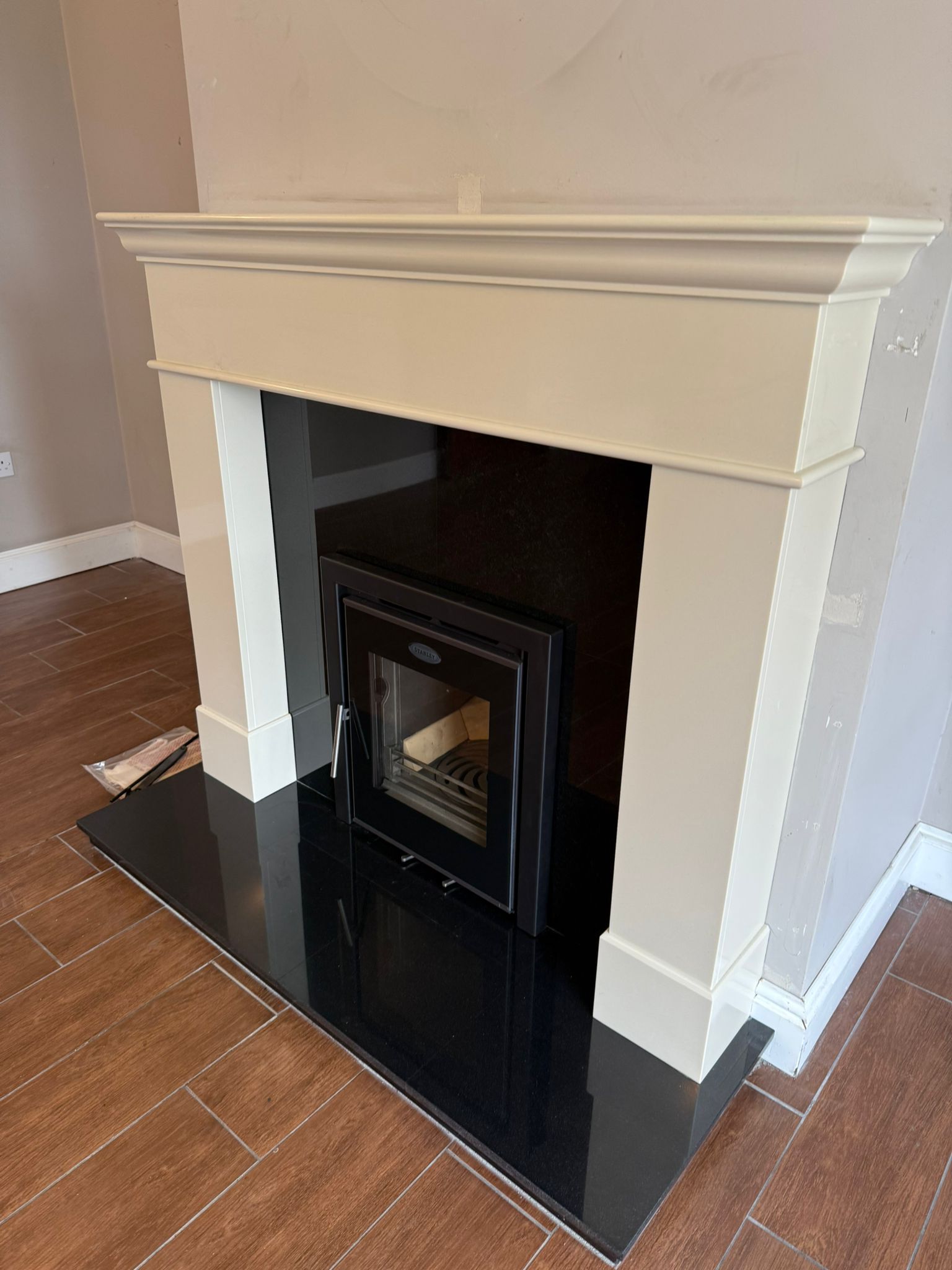
Stoves in Offaly. FAQ
Is a stove really better than the open fire we have?
For heat in the room, yes, and by a wide margin. An open fire loses most of the fuel's energy straight up the flue, with figures of 20% to 30% efficiency commonly quoted, and it also pulls heated air out of the room to feed itself. EU Regulation 2015/1185 has required at least 65% seasonal space heating efficiency for closed-fronted solid fuel room heaters sold in the EU since 1 January 2022, so anything on sale today clears that bar. Closing the fire in is the single biggest change most Offaly houses can make to how warm the room gets on the same amount of turf. What you give up is the open flame, and some people genuinely mind that.
Our flue was built for an open turf fire. Will it take a stove?
It will, but it very often needs lining first, and in this county that is closer to the default than the exception. A flue built to serve an open turf fire is enormous, because an open turf fire needed that volume to draw at all. Connect a 5 kW stove to it and the stove cannot fill it. The gases slow, cool and reach their condensation point inside the masonry instead of leaving the top, and that condensate is acidic. TGD J asks that the flue be suitable for the appliance rather than lined as routine, so the camera decides, but budget for a liner as the likely answer rather than the surprise.
I burn turf. Do I need a particular kind of stove?
A multi-fuel one, and it matters more here than anywhere. Census 2022 recorded 27% of Offaly households heating mainly with peat including turf, the highest rate of any county in the State against 3.7% nationally. Wood burns best on a flat bed of its own ash with air coming from above, so a dedicated wood burner has no grate and no ashpan. Turf and coal need air from underneath, so a multi-fuel stove has a raised riddling grate with an ashpan below it. Burning turf on a wood-only stove is disappointing rather than dangerous: it will not get the air it needs and you will spend the evening fighting it.
Does burning turf change the flue size I need?
Yes, and it catches people out constantly. Under TGD J Table 2 a closed appliance up to 20 kW burning timber, peat or bituminous coal needs a flue of at least 150 mm internal diameter. Only smokeless fuel or wood pellets may drop to 125 mm. A great many stoves ship with a 125 mm spigot, so in the county with the highest turf use in Ireland it is entirely possible to buy a stove that is legal for somebody else's fuel and not for yours. The survey establishes this before anything is ordered.
What does a stove cost fitted in Offaly?
An inset stove supplied and fitted runs €2,200 to €3,500, freestanding €2,500 to €4,000, and a boiler stove plumbed to radiators €3,500 to €5,500. Add €1,000 to €2,500 for a liner, which on an old open-turf-fire flue is likely rather than optional, or €1,800 to €3,200 for a twin-wall flue where there is no chimney. The survey is free and nothing is quoted until a camera has been up the flue, so the liner is priced into the job rather than appearing on fitting day.
There is years of tar up our chimney. Does that stop a stove going in?
No, but it has to be dealt with first, and it is the most common thing found on an Offaly survey. Heavy turf tar is a hard, glossy coating rather than loose soot, and a brush will not shift it. It needs rotary work and sometimes a chemical treatment. On a badly loaded flue, lining is genuinely cheaper than repeated attempts to clean it, and the liner solves the sizing problem at the same time. What you should not do is fit a stove and start running hotter fires up a tarred flue, because that is the standard set-up for a chimney fire.
Do I need an air vent?
Yes. TGD J 4.2.1 requires a permanent vent of at least 6,500 mm² of free area for any non-room-sealed solid fuel appliance, with a further 550 mm² per kilowatt above 5 kW, so an 8 kW stove needs 8,150 mm². There is no under-5kW exemption in Ireland; that is UK Approved Document J, as are DEFRA exemption and Smoke Control Areas. There is a specific catch when converting an open fire: the old fire was pulling so much air through the room that the house never felt short of it. Close the fire in and that draw drops, so a ventilation problem that was always there can show up as a newly smoky stove.
What size stove do I need?
Most Offaly sitting rooms land between 4 and 6 kW. A rough guide for a reasonably insulated modern room is the volume in cubic metres divided by fourteen, so a 4 by 5 metre room with a 2.4 metre ceiling is about 3.5 kW. An older farmhouse room with solid walls and single glazing needs more than the arithmetic suggests. Too big is worse than too small: an oversized stove gets run shut down to make the room bearable, and a stove run shut down smoulders, and smouldering tars the flue. In the county with the most tar in its chimneys already, that is worth avoiding.
The house was empty for years. Can a stove go into that flue?
Usually yes, but survey it first. Census 2022 recorded 2,491 vacant dwellings in Offaly and 799 of those were recorded vacant in the 2016 census as well, so buying a long-empty house here is common. A dormant flue collects jackdaw nests, there is no sweeping record and nothing is documented about its condition. If the previous household burned turf, the tar is still up there. None of that stops a stove going in. It means the camera goes up before the order is placed, so the liner is in the quote instead of being a surprise.
Is there a grant for a stove?
No. The SEAI Domestic Technical Standards document contains a clause referencing stoves, but the eligibility table gives them no scheme coverage. If a retailer tells you a grant is available, ask them to point at the table. There is also no statutory installer register in Ireland for solid fuel; HETAS withdrew in March 2022 and is a UK body regardless. What is actually checkable is public liability insurance, previous work in your area, and the certificate issued at the end.
Do you actually come to Offaly?
Yes, for work that justifies the trip. The van works out of Clonegall in Co. Carlow, so Tullamore is around an hour and a half and Edenderry, over on the Kildare side, is closer. A supply and fit with a liner is a full day or more and absorbs that comfortably. A small one-off call-out does not, and you will be told so on the phone. Offaly work gets batched, so if a neighbour or a family member needs something as well, mention it and both get quoted in the one visit.
Free planning tools
Plan your Offaly stove in 5 minutes, free
Related guides & nearby counties
Thinking about a stove in Offaly?
The survey is free and a camera goes up the flue before anything is ordered. If you have an open turf fire now, say so on the call, because that changes the whole shape of the job.