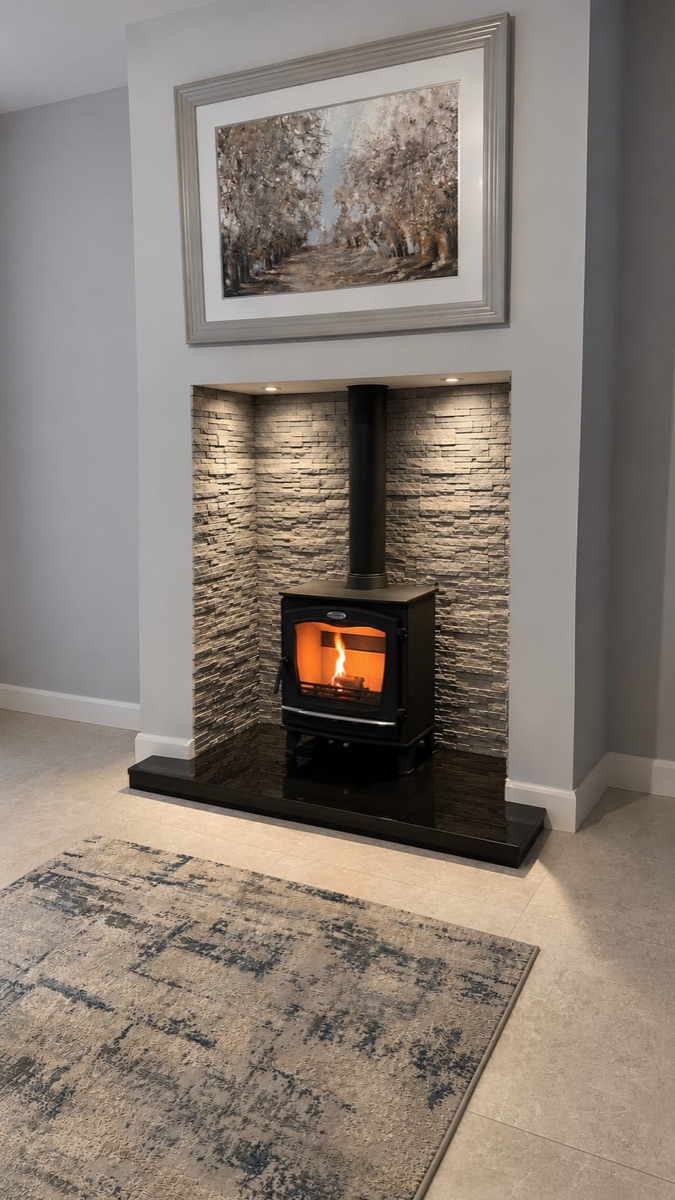
Wood burning stoves
across Westmeath
Free camera survey, and the footage is yours to keep whether you use us or not. On a job worth thousands, that makes a second opinion cost nothing.
Westmeath is better served than the rest of the midlands, so here is a useful page instead of a sales pitch
Across Laois, Offaly and Longford, the pages that rank for stove and chimney work belong to roofing companies. Westmeath is different. There is a genuine specialist working in this county doing camera surveys, draft testing and relining, which is the same job done properly and a good deal closer to you than Clonegall.
Pretending otherwise would be a poor way to start, and easily checked.
So this page does something more useful than claiming to be the only option. It sets out what to ask anybody who quotes you, including us. A stove fitted properly is a few thousand euro and the decisions that matter are made before the order is placed, not on fitting day.
The one concrete thing we offer that is worth knowing: the survey is free and the CCTV footage is yours to keep, whether or not you use us. That means you can put the same footage of your own flue in front of two people and compare what each one says about it, rather than comparing two prices for two different descriptions of the job.
If the local answer is better, take it. On small jobs it probably is, because the van works out of Clonegall, Co. Carlow and Mullingar is around an hour and a half, Athlone longer again. A supply and fit with a liner absorbs that comfortably. A call-out does not.
Five questions worth putting to any installer
These are the questions where a good answer and a vague one are easy to tell apart, and they are the ones that decide whether the job goes well.
| Ask | What a good answer sounds like |
|---|---|
| Does a camera go up the flue before I order, or after? | Before. The flue decides the budget more than the stove does, so finding out afterwards is the wrong way round. |
| What flue diameter does my fuel need? | They should ask what you burn first. Under TGD J Table 2 it is 150 mm for timber, peat or bituminous coal; only smokeless fuel or pellets may drop to 125 mm. |
| What size vent are you cutting in? | A number in square millimetres, not a reassurance. TGD J 4.2.1 sets 6,500 mm² minimum plus 550 mm² per kW above 5 kW. |
| What certificate do I get? | A certificate of installation on the day. There is no statutory register in Ireland, so the certificate and the insurance are what is actually checkable. |
| Can I see your public liability insurance? | Yes, without hesitation. Anybody working on your roof should produce it on request. |
The second row is the most revealing of the five, because the correct answer depends on something about your household rather than about the stove. If an installer quotes a flue diameter without asking what you burn, they are quoting from a catalogue.
There is one more thing worth watching for, and it is not a question. If anybody mentions a grant, a HETAS registration or DEFRA exemption, be careful. There is no SEAI grant for a stove: the Domestic Technical Standards document has a clause referencing them but the eligibility table gives them no scheme coverage. HETAS withdrew from Ireland in March 2022 and is a UK body in any case, and DEFRA exemption and Smoke Control Areas are UK law that does not apply here.
An oil county, which is what makes the sums work
Census 2022 put 50.3% of Westmeath households on oil for central heating, well above the national 39%. Oil is the most expensive of the common mains-alternative fuels, and that gap is the whole financial argument for a stove.
On the SEAI domestic fuel cost comparison, in cent per useful kilowatt hour delivered: bulk loose softwood about 8.5, wood pellets in bulk 10.25, softwood by the pallet 10.41, mains gas 13.00, hardwood by the pallet 14.40, hardwood in small bags 15.26, discounted kerosene 17.20, electricity on direct debit 34.38.
Kerosene at 17.20 against bulk loose softwood at 8.5 is roughly double, and in Westmeath that comparison applies to half the county.
The 8.5 cent figure carries a condition that decides everything: you need to take about three cubic metres loose in summer and keep it dry. On most Westmeath properties that is straightforward. In a Mullingar or Athlone town terrace it often is not, and buying in small bags as you go costs 15.26, which is a far less interesting number.
Two honest caveats. If you already burn turf, and 13.5% of the county does against 3.7% nationally, you are not comparing against kerosene at all. Turf bought or cut locally may undercut everything on that list, and for you the gain is efficiency and control over an open fire rather than a fuel saving. And a room heater will not warm the bedrooms. If cutting the oil bill is the actual goal, that points at a boiler stove plumbed into the radiator circuit you already have, which is a bigger job and a different price.
Running costs from the SEAI domestic fuel cost comparison.
Will the chimney you have take a stove?
This decides the price, and it cannot be answered from a photograph of the fireplace by anybody, however local.
Size first. Under TGD J Table 2, a closed appliance up to 20 kW burning timber, peat or bituminous coal needs a flue of at least 150 mm internal diameter. Only smokeless fuel or wood pellets may drop to 125 mm, and a great many stoves ship with a 125 mm spigot. With 13.5% of this county on turf, that is a live trap rather than a technicality.
The opposite problem is common on the older stock. Westmeath farmhouses often have a flue built for an open turf fire, which is enormous by modern standards because an open turf fire needed the volume. Connect a 5 kW stove and it cannot fill it, so the gases slow, cool and condense inside the masonry rather than leaving the top. That condensate is acidic.
Relining is therefore often right even where the chimney looks perfectly sound from the road. It is not automatic, though. TGD J asks that the flue be suitable, not that it be lined as routine, and plenty of chimneys here pass. The camera decides, and you should be shown the footage rather than told the conclusion.
Hearths. TGD J 2.7.1 calls for a constructional hearth of at least 125 mm, a free-standing stove on a non-combustible floor at least 12 mm, and a back boiler 125 mm, or 25 mm on 25 mm non-combustible supports.
Ventilation. TGD J 4.2.1 requires a permanent vent of at least 6,500 mm² of free area, plus 550 mm² per kilowatt above 5 kW, so an 8 kW stove needs 8,150 mm². There is no under-5kW exemption in Ireland. The version that catches people out is an older house that has had new windows fitted: the fabric tightens and a fire that drew perfectly for thirty years starts smoking.
For a rough read before booking anybody, the chimney suitability checker asks five questions.
Multi-fuel or wood-only, and why the grate is not a detail
Census 2022 recorded 13.5% of Westmeath households heating mainly with peat, including turf, against 3.7% nationally. That is enough that the wood-only stove suited to a Dublin suburb is often the wrong appliance here.
Wood burns best on a flat bed of its own ash, with air from above. A dedicated wood burner therefore has no grate and no ashpan, and leaving a bed of ash in it is correct rather than lazy.
Turf and coal need air from underneath. A multi-fuel stove has a raised riddling grate with an ashpan below, so primary air comes up through the fuel bed and the ash can be riddled clear instead of smothering the fire.
Put turf on a wood-only stove and it will not get the air it needs. The result is disappointing rather than dangerous: a fire you spend the evening fighting, poor output, and smoke that ends up as tar in the flue rather than heat in the room.
So the conversation starts with what is in your shed, not with a brochure. And it is the first thing a good installer asks, which is why it is row two of the table above.
The stove selector asks about fuel first for this reason.
Over a thousand Westmeath houses stood empty across two censuses
Census 2022 recorded 3,095 vacant dwellings in Westmeath, down 17% from 3,728 in 2016. Underneath that, 1,006 dwellings were recorded vacant in 2016 and again in 2022, which is the highest such figure of any county in this part of the country.
Those houses are being bought and brought back into use, and a stove is very often on the list. None of the following stops one going in. It changes the order of operations.
Jackdaws. An unused pot is an attractive nest site and a nest can fill a metre or more of flue. It is the commonest cause of a smoke-back on a first fire in a renovated house.
Nothing is documented. No sweeping record, no known history, nothing an insurer can be shown later. That is an hour's work at the start.
Cold chimneys deteriorate faster. A stack unheated for six winters has had no warm flue drying it from the inside, which in a county of lakes and persistent damp compounds the freeze-thaw problem. More on that on the Westmeath chimney repair page.
The practical consequence is budgetary. Survey first and the liner, if it is needed, is priced into the job. Survey last and it arrives as a surprise on fitting day, on a renovation where the money is already spoken for.
Getting the size right matters more than getting the brand right
The most common mistake is buying too big. An oversized stove gets run shut down to stop the room becoming unbearable, and a stove run shut down smoulders. Smouldering produces tar, tar coats the flue, and tar is what catches fire. The oversized stove is both less pleasant and less safe than the correctly sized one.
A rough starting point for a reasonably insulated modern room is the volume in cubic metres divided by fourteen. A 4 by 5 metre room with a 2.4 metre ceiling is 48 cubic metres, so roughly 3.5 kW. Most Westmeath sitting rooms land between 4 and 6 kW. An older farmhouse room with solid walls and single glazing needs more than the arithmetic suggests.
The stove size calculator does this properly, with insulation and window area factored in, and it is worth running before anybody quotes so you have your own number to compare theirs against.
On efficiency, EU Regulation 2015/1185 has required at least 65% seasonal space heating efficiency for closed-fronted solid fuel room heaters sold in the EU since 1 January 2022. Everything on sale meets it. If a shop presents that baseline as a special feature of a particular model, treat the rest of what they say with the same caution, and be wary of comparative emissions claims in either direction.
What a stove costs in Westmeath
Supply and fit, including VAT, labour, flue components, hearth work where needed, waste away and the certificate. Published so you have something to hold a local quote against.
| Work | Typical range |
|---|---|
| Home survey | Free, no obligation |
| Inset stove, supplied and fitted | €2,200 – €3,500 |
| Freestanding stove, supplied and fitted | €2,500 – €4,000 |
| Boiler stove, plumbed to radiators | €3,500 – €5,500 |
| Chimney liner, if the survey calls for it | €1,000 – €2,500 |
| Twin-wall flue, where there is no chimney | €1,800 – €3,200 |
If a quote comes in well under these, the useful question is not whether it is too cheap. It is which line is missing: the liner, the hearth work, the vent, or the certificate. Ask which, and the answer tells you most of what you need to know.
Indicative only. An exact figure follows the survey, in writing, before any work starts.
What the day actually looks like
A straightforward inset or freestanding fit into a sound flue is a day. Add a liner and it is a long day or two. A boiler stove plumbed into an existing oil-fired system is two to three days, because the plumbing is the bulk of the work rather than the stove.
Dust sheets go down first and the fireplace opening comes out. If a liner is going in, it is fed from the top of the stack and connected at the stove, then sealed at the pot with a proper closure plate rather than mortar and hope. The hearth is checked or built to TGD J 2.7.1, the vent is cut in and sized to the output, and the stove is set, connected and levelled.
Then it gets lit and tested before anybody leaves, with a smoke test on the flue and a check that the draw is right with the doors and windows shut. That last check is the one most likely to be skipped by anybody in a hurry, and it is the one that finds a ventilation problem while there is still time to fix it. Ask for it by name.
You get a certificate of installation on the day, the old fireplace and packaging taken away, and a straight explanation of how to run it. With a multi-fuel stove that last conversation matters, because riddling and ash management are habits rather than instincts.
Full detail on the main stove installation page.
Where we fit stoves in Westmeath
Westmeath uses two Eircode routing keys, one for each of its two towns: N91 Mullingar and N37 Athlone. They are genuinely far apart, so work here gets batched onto one run.
Athlone straddles the Shannon. The east bank is Westmeath and the west bank is Roscommon, so a street on one side of the bridge is in a different county from a street on the other. Coverage is Leinster plus Waterford, which means the Westmeath side. If you are on the Roscommon bank, somebody nearer is the better answer.
Three things are worth saying on the first call: the town, what you burn, and roughly how big the room is. Those three get an estimate close on the first conversation, from us or from anybody else worth ringing.
One tradesman, not a showroom
Johnny Roberts runs J.Roberts Solid Fuel Services on his own out of Clonegall, Co. Carlow. Ring the number and you get him. The person who surveys the flue is the person who fits the stove.
There is no salesperson in the middle and nothing being cleared off a showroom floor, which mostly matters because it means the recommendation can be "that flue will not take that stove" without costing anybody a commission.
In a county that already has somebody competent, the useful offer is not a claim about being better. It is a free survey with footage you keep, so you can compare two opinions on the same flue.
Stoves in Westmeath. FAQ
There are stove people in Westmeath already. Why get a quote from you?
Because a second quote costs you nothing and this is a job worth several thousand euro. Westmeath is genuinely better served than the rest of the midlands: across Laois, Offaly and Longford every top result is a roofing company, and here there is a real specialist doing camera surveys, draft testing and relining. That is worth saying plainly rather than pretending otherwise. What we offer is a free survey where the CCTV footage is yours to keep whether or not you use us, so you can put the same footage in front of two people and compare what each one says about it. If the local answer is better, take it.
What should I ask any stove installer before I commit?
Five things. Will a camera go up the flue before I order the stove, or after? What internal diameter does my fuel need under TGD J Table 2, and does the stove you are proposing meet it? What size permanent vent are you cutting in, in square millimetres? What certificate do I get on completion? And can I see your public liability insurance? A good installer answers all five without hesitating. The flue diameter one is the most revealing, because the correct answer depends on what you burn: 150 mm for timber, peat or bituminous coal, and only smokeless fuel or wood pellets may drop to 125 mm.
Will a stove save me money in Westmeath?
Probably, because this is an oil county. Census 2022 put 50.3% of Westmeath households on oil for central heating against a national 39%. On the SEAI fuel cost comparison discounted kerosene is about 17.20 cent per useful kilowatt hour and bulk loose softwood is about 8.5 cent. The 8.5 figure needs three cubic metres taken loose in summer and kept dry, which is straightforward on most Westmeath properties and harder in a Mullingar or Athlone town terrace. If you already burn turf, you are not comparing against kerosene at all and the gain is efficiency over an open fire rather than a fuel saving.
What does a stove cost fitted in Westmeath?
An inset stove supplied and fitted runs €2,200 to €3,500, freestanding €2,500 to €4,000, and a boiler stove plumbed to radiators €3,500 to €5,500. Add €1,000 to €2,500 for a liner if the survey calls for one, or €1,800 to €3,200 for a twin-wall flue where there is no chimney. These are worth comparing against a local quote rather than taking on trust, which is rather the point of this page.
I burn turf. Do I need a different stove?
A multi-fuel one. Census 2022 recorded 13.5% of Westmeath households heating mainly with peat including turf, against 3.7% nationally. Wood burns best on a flat bed of its own ash with air from above, so a dedicated wood burner has no grate and no ashpan. Turf and coal need air from underneath, so a multi-fuel stove has a raised riddling grate with an ashpan below it. Burning turf on a wood-only stove is disappointing rather than dangerous: it will not get the air it needs and you will spend the evening fighting it.
Does my chimney need relining?
Not automatically. TGD J asks that the flue be suitable for the appliance, not that it be lined as routine. Relining becomes necessary where the flue is oversize for the stove, leaks between floors, or shows cracking on camera. Older Westmeath farmhouses often have a wide flue built for an open turf fire, and a small stove connected to it means the gases cool and condense inside the masonry instead of leaving. The camera decides, not a guess from the fireplace, and you should be shown the footage rather than told the conclusion.
Do I need an air vent?
Yes. TGD J 4.2.1 requires a permanent vent of at least 6,500 mm² of free area for any non-room-sealed solid fuel appliance, with a further 550 mm² per kilowatt above 5 kW, so an 8 kW stove needs 8,150 mm². There is no under-5kW exemption in Ireland; that is UK Approved Document J, as are DEFRA exemption and Smoke Control Areas. Ask any installer for the figure in square millimetres rather than a general assurance that ventilation is covered. It is a number, and it should be quoted as one.
What size stove do I need?
Most Westmeath sitting rooms land between 4 and 6 kW. A rough guide for a reasonably insulated modern room is the volume in cubic metres divided by fourteen, so a 4 by 5 metre room with a 2.4 metre ceiling is about 3.5 kW. An older farmhouse room with solid walls and single glazing needs more than the arithmetic suggests. Too big is worse than too small: an oversized stove gets run shut down to make the room bearable, and a stove run shut down smoulders, and smouldering is what tars a flue.
The house was empty for years. Can a stove go into that flue?
Usually yes, but survey it first, and Westmeath has more of these houses than any county nearby. Census 2022 recorded 3,095 vacant dwellings and 1,006 of those were recorded vacant in the 2016 census as well, so over a thousand houses here stood empty across two counts. A dormant flue collects jackdaw nests, there is no sweeping record and nothing is documented about its condition. None of that stops a stove going in. It means the camera goes up before the order is placed, so the liner is in the quote instead of being a surprise on fitting day.
Half of Athlone is in Roscommon. Do you cover that side?
The town straddles the Shannon, with the east bank in Westmeath and the west bank in Roscommon, so a street on one side of the bridge is a different county from a street on the other. Coverage is Leinster plus Waterford, which means the Westmeath side. That is a real limit rather than a preference, and it is better said here than discovered on the phone. If you are on the Roscommon bank you should be talking to somebody nearer, and you should not be paying for the travel.
Is there a grant for a stove, and do you actually come to Westmeath?
No grant. The SEAI Domestic Technical Standards document contains a clause referencing stoves, but the eligibility table gives them no scheme coverage, so if a retailer tells you a grant is available, ask them to point at the table. There is also no statutory installer register in Ireland for solid fuel; HETAS withdrew in March 2022 and is a UK body regardless. On travel: the van works out of Clonegall in Co. Carlow, so Mullingar is around an hour and a half and Athlone longer again. A supply and fit with a liner absorbs that. A small call-out does not, and with a competent specialist already working this county, a small job is genuinely better given to somebody nearer.
Free planning tools
Work out your own numbers before anybody quotes
Related guides & nearby counties
Thinking about a stove in Westmeath?
The survey is free and the footage is yours to keep, so you can take it to somebody else if you want to. On a job this size, that is worth an hour of anybody's time.