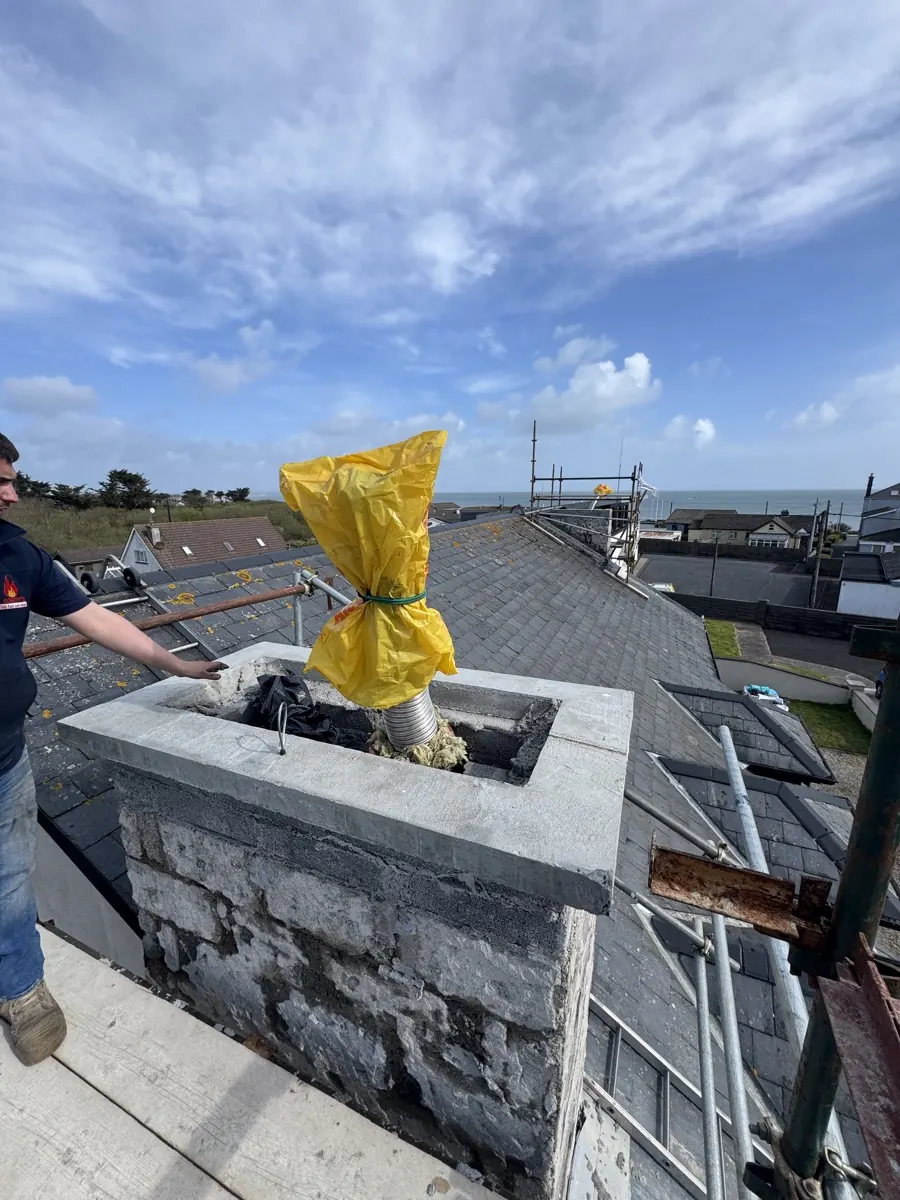
A chimney cowl is the cap fitted to the top of the chimney pot. It does one of three jobs: it keeps rain out, it keeps birds out, or it stops wind blowing smoke back down the flue. We fit a stainless steel rain and bird cowl as standard, at €100 fitted, and an anti-downdraught cowl where the chimney needs one, at €150 fitted. Those are Johnny's prices in October 2026.
A lot of chimney cowls are bought to fix a problem a cowl can't fix. The quickest way to avoid that is to work out which problem you have before you spend anything.
At a glance
- Rain or birds in the pot: stainless steel rain and bird cowl, €100 fitted.
- Smoke blowing back on windy days only: anti-downdraught cowl, €150 fitted.
- Smoke coming back on still days: an anti-downdraught cowl won't help. Have the flue checked.
What a chimney cowl does
An open pot is a hole in the roof with a pipe under it. Rain falls straight down the flue, and in a chimney that is not lit often it shows up as water in the grate or a damp patch on the chimney breast. A cap over the pot stops that.
Birds are the second reason. Jackdaws and crows nest in open chimney pots in spring. A nest can block a flue completely, and a blocked flue sends smoke and fumes back into the room the next time the fire is lit. A cowl with mesh around it is often sold as a bird guard or a crow guard.
Downdraught is wind coming over the roof and pushing down the flue, which blows smoke back into the room. An anti-downdraught cowl is shaped to turn that wind over the top of the pot.
Which chimney cowl do you need?
| What you are seeing | What it usually is | What to fit |
|---|---|---|
| Rain coming down the chimney, or birds in the pot | An open pot | Stainless steel rain and bird cowl |
| Smoke blows back into the room only on windy days | Downdraught | Anti-downdraught cowl |
| Smoke comes back when there is little or no wind | Lack of draw, not downdraught | Not an anti-downdraught cowl. Have the flue checked first |
| A stove going in on a new liner | Part of the liner job | The cowl is fitted with the liner |
The line between the second and third rows is the one people get wrong. ChimneyChoice, the Cork chimney supplier, put it plainly in their cowl guide: smoke that comes back only in windy weather is downdraught, and smoke that comes back in still weather is a lack of draught, which an anti-downdraught cowl does nothing for. They list an electric fan cowl as the only cowl that treats it.
Static, H and spinning anti-downdraught cowls
There are three kinds of anti-downdraught chimney cowl. A static cowl has no moving parts. An H cowl is shaped like the letter. A spinning cowl, also sold as a rotating or revolving cowl, turns in the wind. The same supplier guide suggests a static cowl for a mild problem, a spinning cowl for a severe one on a chimney over 6 metres, and an H cowl for a severe one on a shorter chimney. Which of the three suits depends on the chimney.
What a chimney cowl costs fitted
| Cowl | When it is fitted | Fitted price |
|---|---|---|
| Stainless steel rain and bird cowl | Always, as standard | €100 |
| Anti-downdraught cowl | Where the chimney needs one | €150 |
Johnny's prices, October 2026, cowl and fitting together. Ring to confirm the price for your chimney.
The rain and bird cowl Johnny fits is always stainless steel. A cowl sits in the weather and the smoke for years, and it is not something you want to be replacing. A flue cowl bought online still has to be got onto the pot.
Johnny works from Clonegall, on the Carlow and Wexford border, and a cowl on its own is a small job. Say where you are when you ring.
Is a chimney cowl necessary?
Not on every chimney. Technical Guidance Document J is the building regulations guidance for chimneys and stoves. Its section on solid fuel says where a flue outlet has to sit above the roof (2.3.3) and says nothing about putting a cowl on it. The word does not appear in the document. Gas flues are treated differently: section 3 asks for a terminal or guard on those.
A chimney cowl is worth fitting when rain is getting down the flue, birds are nesting in the pot, wind is blowing smoke back, or a stove is being fitted. On a stove job the liner is fed down from the top and sealed at the pot with a closure plate and a cowl, so the cowl comes as part of the liner.
Can you fit a chimney cowl yourself?
The fixing is simple. Most cowls strap or bolt around the pot. Getting to it is the hard part: the pot is at the top of the stack, which is above the ridge on most houses, and that is roof-ladder or scaffold work.
There is a second reason to have it done. Whoever fits the cowl is standing beside the pot, the mortar around it and the flashing below it, none of which you can see from the ground. If something up there is cracked, that is the day to find out. Our signs your chimney needs repair guide lists what to look for.
When a chimney cowl won't fix it
Smoke that comes back on a calm day is the common one. The chimney is not drawing, and the usual causes are a flue that is blocked or tarred, a flue too wide or too cold for the stove on it, or a room with no air coming in. TGD J asks for a permanent air vent of at least 6,500 mm² for a stove that takes its air from the room, and a stove starved of air will smoke whatever is on the pot. A camera inspection shows which it is.
Water is the other one. For example, if the chimney breast is still damp with a cowl on, the rain is getting in somewhere else, often at the flashing where the stack meets the roof or the mortar cap around the pots. That is a chimney repair, and the damage assessment tool will give you an idea of the scale.
A chimney cowl is a €100 answer. It is worth being sure it is a €100 problem first. When you ring, say what the chimney is doing and when it does it.
Chimney cowl questions
Is a chimney cowl necessary?
Not on every chimney. The solid fuel section of Technical Guidance Document J, the building regulations guidance for chimneys and stoves, says where a flue outlet must sit above the roof and does not ask for a cowl. A cowl is worth fitting when rain is getting down the flue, when birds are nesting in the pot, when wind blows smoke back into the room, or when a stove is fitted on a new liner.
What does a cowl do on a chimney?
It does one of three jobs. A rain and bird cowl keeps water and nesting birds out of the pot. An anti-downdraught cowl turns wind away so it cannot push smoke back down the flue. Some cowls do both.
How much does it cost to fit a chimney cowl in Ireland?
Johnny's prices in October 2026 are €100 for a stainless steel rain and bird cowl, fitted, and €150 for an anti-downdraught cowl, fitted. Ring to confirm the price for your chimney.
Can I install a chimney cowl myself?
The fixing is simple, usually a strap or bolts around the pot. Getting to it is the hard part, because the pot is at the top of the stack, above the ridge on most houses. If you are not set up to work safely at that height, it is a job to pay for.
What is the best type of chimney cowl for a stove?
When a stove is fitted on a new liner, the liner is sealed at the pot with a closure plate and a cowl as part of the job. On an existing chimney, a stainless steel rain and bird cowl is what Johnny fits as standard, with an anti-downdraught cowl only where the chimney needs one.
How do I stop downdraught in my chimney?
First check it is downdraught. If smoke only comes back into the room on windy days, an anti-downdraught cowl is the usual fix. If it comes back on still days, the chimney is short of draw, and an anti-downdraught cowl will not cure that. The flue, the air supply to the room and any blockage need to be checked.
Will a cowl stop birds nesting in my chimney?
That is what a rain and bird cowl is for: it closes off the open pot that jackdaws and crows nest in. If birds have already nested, the nest has to come out and the flue has to be swept before the cowl goes on.
Not sure a cowl is the answer?
Tell Johnny where you are, what the chimney is doing and when it does it, and ask whether a cowl is the fix.
Related reading
Sources: Johnny Roberts, October 2026 (what he fits and his fitted prices). Technical Guidance Document J, 2014 (air supply, Table 1; flue outlets, 2.3.3 and 3.6.4). ChimneyChoice, How to choose the right chimney cowl (downdraught against lack of draught; cowl types).