Stove maintenance before winter comes down to two jobs, in Johnny's words: get the chimney cleaned, and get the rope seals on the stove checked. Four more checks take a few minutes each and you can do them yourself: the glass, the fuel, the carbon monoxide alarm and the air vent.
None of it is complicated, and five of the six can be checked from the sitting room.
At a glance
- Chimney swept at least once a year, before the first fire.
- Rope seals: close the door on a strip of paper and pull. It should grip.
- Glass that blackens overnight means wet fuel or a stove run shut down.
- Wood on sale must now be under 20% moisture (Citizens Information).
- Carbon monoxide alarm tested and in date. Air vent open.
1. Get the chimney swept
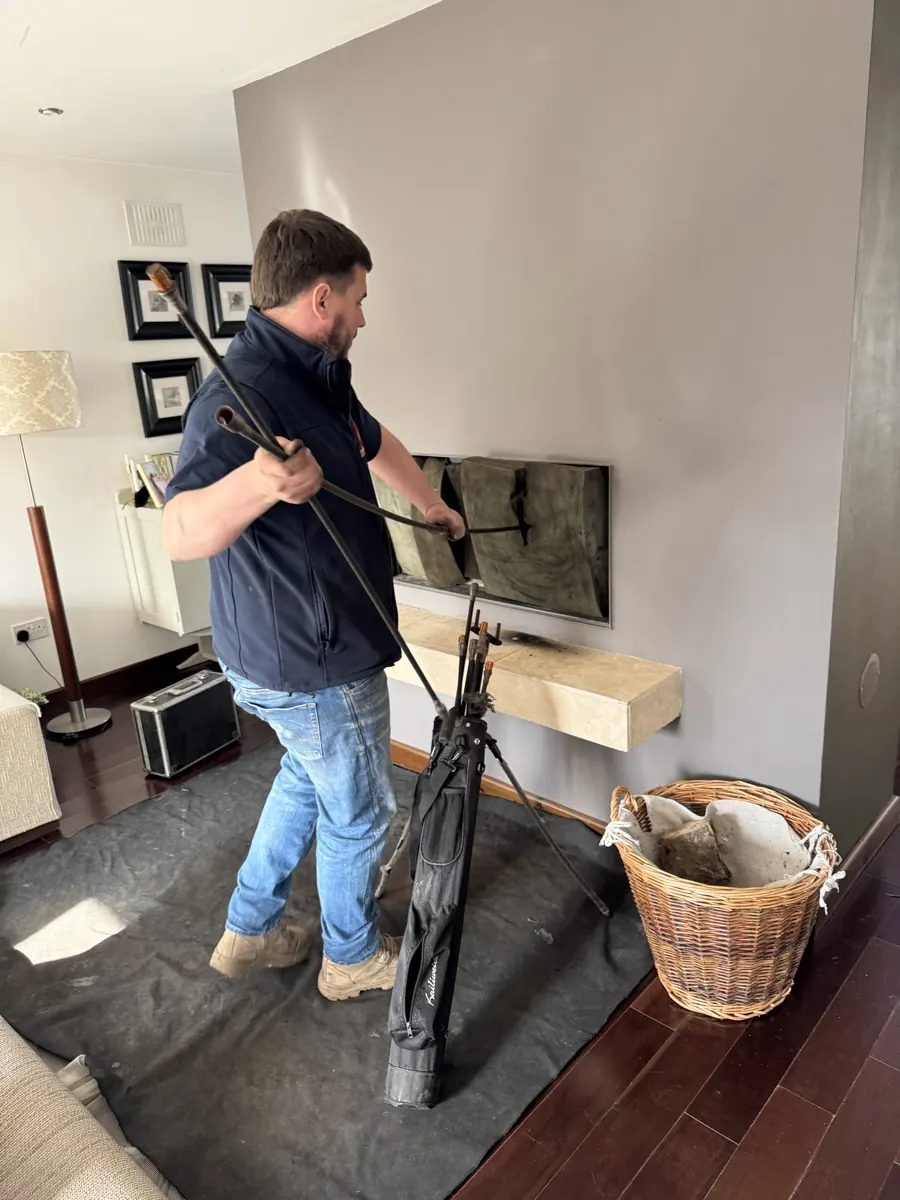
Have the chimney swept at least once a year for a stove in regular use, before the first fire. Waterford Stanley ask for more. Their manual for the Fern stove says the chimney should be cleaned twice a year, and before use if the stove has sat idle over the summer. It asks for the flue pathways inside the stove to be cleaned monthly, or less often depending on the soot the fuel makes, and for the flueways to be checked before lighting after a shut-down period. The first fire of October is exactly that.
The same manual names the most common cause of fumes coming back into a room: a blocked flueway or chimney. A summer is long enough for a bird to build in an open pot, which is one reason we fit a rain and bird cowl as standard.
2. Check the rope seals
The rope seal is the woven rope around the stove door, and it is what makes the air controls mean anything. If the door doesn't seal, air gets in around it, the fire burns faster than you have set it, and you go through more fuel for the same heat. It is one of the two things Johnny says to have checked before winter, and efficiency is the reason he gives.
You can test it yourself with the stove cold. Close the door on a strip of paper and pull. You should feel it grip. If the paper slides out freely, the rope is not sealing at that spot. Do all four sides, and pay attention to the corners and the latch side. Rope that shows wear, such as fraying, flattening, hardening or coming away from the door, is finished.
Rope is a wearing part, like brake pads. Stanley's warranty covers rope seals for the first year only. A stove rope replacement is a small job next to anything else on this list.
3. Clean the glass, and find out why it went black
Stove glass is meant to clean itself. Stanley's manual says the glass self-cleans when the stove is run at its higher air settings, and gives three reasons for a build-up: low draught, poor quality fuel, or running the stove at its minimum air setting for long periods.
To clean stove glass, wait until it is cool, then use a soft cloth and warm soapy water. For stubborn deposits the manual allows grade 0 steel wool, taking care that grit from coal or ash doesn't scratch the glass. That last point is worth knowing if you use the damp-newspaper-and-ash trick: fine wood ash only, and gently.
If the glass is black again the next morning, the cleaning isn't the problem. Either the fuel is wet or the stove is being run shut down. Both tar the flue as well as the glass, and the flue is the one you can't see. Glass that is cracked is different: don't light the stove until it has been replaced with the right ceramic glass for the model.
4. Check what you are burning
What you burn is part of stove maintenance too. Moisture content is the share of a log's weight that is water. Since 1 September 2026, wood sold in Ireland in units of two cubic metres or less must have a moisture content under 20%. The limit was 25% before that. The rule is in the solid fuel regulations, S.I. No. 529 of 2022. They first set the change for September 2025, and S.I. No. 389 of 2025 moved it to 2026.
Two details get lost. The regulations govern what is sold, not what you burn in your own house, and they don't cover timber you cut and season yourself. If you are seasoning your own, split it, stack it off the ground with the wind through it, and give it two summers rather than one. A moisture meter settles any argument.
Never burn treated or painted timber, pallets, chipboard, MDF or driftwood. Wet timber tars a liner, and it is the fastest way to undo a good stove installation.
5. Test the carbon monoxide alarm
Technical Guidance Document J, section 1.5.2, covers any new or replacement stove. It asks for a carbon monoxide alarm in the room where the stove is, and another either inside each bedroom or within 5 metres of the bedroom door, measured along the corridor.
Press the test button, then look for the date. TGD J notes that the sensor in a carbon monoxide alarm has a limited life and can stop working while the electronics carry on, which is why alarms are required to show when they have reached the end of it. An alarm past that date is a piece of plastic on the wall.
If an alarm sounds when the stove is lit, Stanley's instructions are short: open the doors and windows, leave the house, and let the fire go out. Don't relight it until the cause has been found.
6. Make sure the air vent is open
A stove that takes its air from the room needs a permanent air vent. In most houses built before 2008, TGD J sets it at 550 mm² per kW of the stove's rated output and never less than 6,500 mm². In an airtight house it is more. Permanent ventilation means a vent that stays open. A vent that has been taped over, stuffed with a cloth or blocked by a sofa since last March is not doing its job, and a stove short of air burns dirty and can smoke back into the room.
What it costs if the check finds something
| What turns up | The fix | Fitted price |
|---|---|---|
| Rain or birds getting into the pot | Stainless steel rain and bird cowl | €100 |
| Smoke blowing back on windy days | Anti-downdraught cowl | €150 |
| Flue cracked or tarred on the camera | Chimney liner | €1,000 – €2,500 |
| Stove past repair | New inset stove, supplied and fitted | €2,200 – €3,500 |
Cowl prices are Johnny's, October 2026. Liner and stove prices include VAT and are a guide until the survey.
When to stop and ring someone
- Smoke or fumes come back into the room, in any weather.
- The carbon monoxide alarm has sounded.
- The door fails the paper test and new rope doesn't cure it.
- The glass is cracked, or the firebricks have broken up.
- You can see tar running at the flue pipe joints.
Stove maintenance only goes so far, and each of those is a reason not to light the stove until someone has looked at it. If the stove is old enough that the repairs are adding up, the stove installation cost page and the guide to choosing a stove will tell you what a replacement involves.
Stove maintenance questions
How often should a stove and chimney be serviced?
Have the chimney swept at least once a year for a stove in regular use. Waterford Stanley's manual for their Fern stove asks for the chimney to be cleaned twice a year, and for the flue pathways inside the stove to be cleaned monthly, or less often depending on the fuel. Check the door rope seals at the start of each winter.
How do I know if my stove rope seal needs replacing?
With the stove cold, close the door on a strip of paper and pull. If the paper slides out with little or no resistance, the rope is not sealing at that spot. Repeat on all four sides. Rope that is frayed, flattened, hard or coming away from the door also needs replacing.
Why does my stove glass keep going black?
Stanley's manual gives three causes: low draught, poor quality fuel, or running the stove at its minimum air setting for long periods. The glass cleans itself when the fire burns hot at a higher air setting. If it blackens every night, the fuel is too wet or the stove is being run shut down.
How do you clean badly stained stove glass?
Wait until the glass is cool. Use a soft, non-abrasive cloth with warm soapy water. For stubborn deposits Stanley's manual allows grade 0 steel wool, taking care that grit from coal or ash does not scratch the glass.
What moisture should firewood be?
Since 1 September 2026, wood sold in Ireland in units of two cubic metres or less must have a moisture content under 20%. The rule covers what is sold, not what you burn, and it does not cover timber you cut and season yourself.
Where should a carbon monoxide alarm go for a stove?
For a new or replacement stove, Technical Guidance Document J asks for one alarm in the room where the stove is, and one either inside each bedroom or within 5 metres of the bedroom door, measured along the corridor. Alarms have a limited life, so check the end-of-life date on the unit as well as pressing the test button.
Did the check turn something up?
Smoke coming back, cracked glass, a door that won't seal, or a stove that has had its day. Tell Johnny what you found.
Related reading
Sources: Johnny Roberts, October 2026 (the two checks that matter most; cowl prices). Waterford Stanley, Fern installation and operating instructions (chimney and flueway cleaning, glass cleaning, rope seal warranty, carbon monoxide steps). Technical Guidance Document J, 2014 (carbon monoxide alarms, air supply). S.I. No. 529 of 2022, S.I. No. 389 of 2025 and Citizens Information (wood moisture limit).