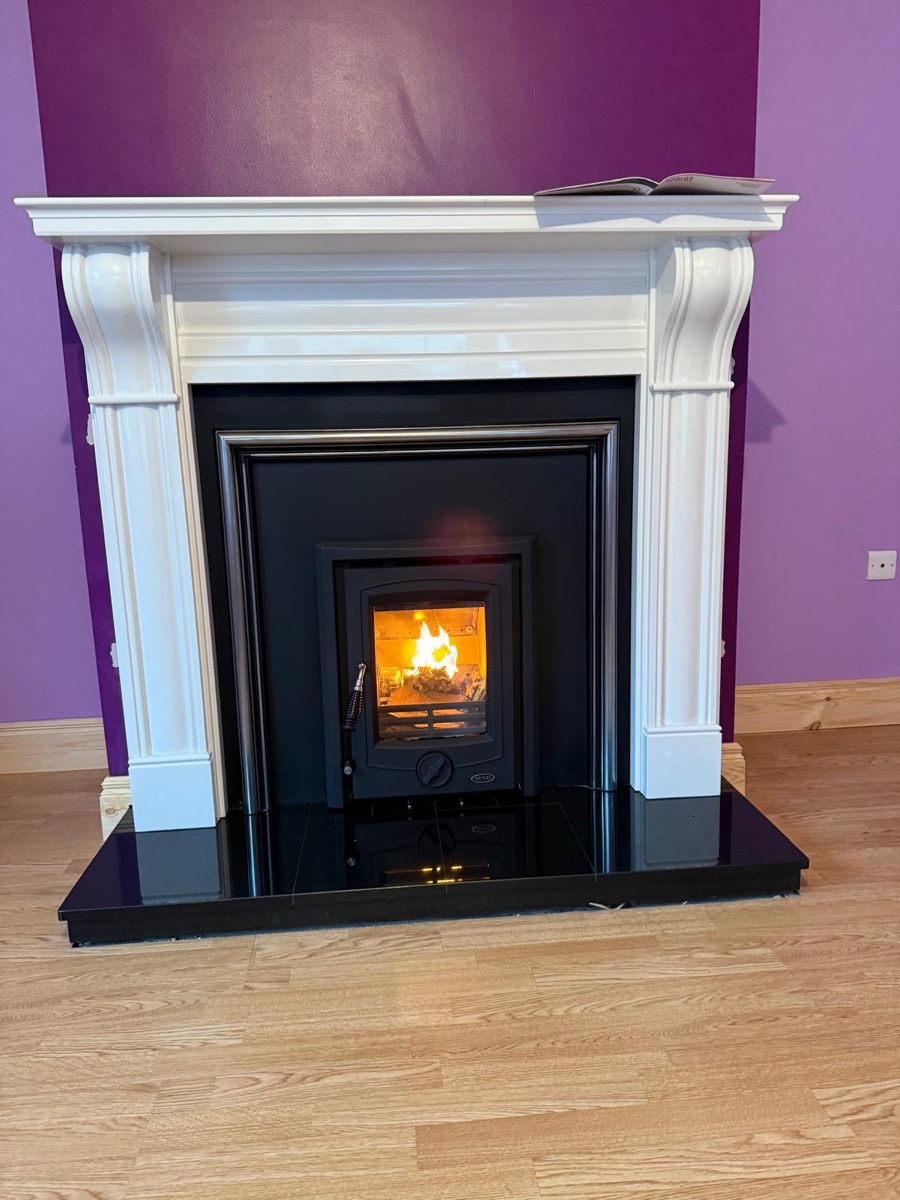
Wood burning stoves
across Meath
Navan, Trim and Kells to the Ashbourne commuter belt. Free survey, flue measured before you buy, certificate the day we finish.
In Meath the same stove costs very different money
Meath built more new housing than almost anywhere in the country between 2016 and 2022, and it also has some of the oldest domestic stock in Leinster. Which of those two houses you live in decides your quote far more than which stove you pick.
In a new house, in Ashbourne, Dunboyne, Dunshaughlin, Ratoath or the Laytown to Bettystown strip, the two questions are whether there is a chimney at all and whether the house is airtight enough to starve the stove. A twin-wall flue and a properly cut vent can add more than the appliance.
In an old house, around Trim, Kells, Athboy, Oldcastle or the Boyne valley, there is definitely a chimney, and it is almost certainly far too wide for a modern stove. That usually means a liner.
Both are ordinary jobs. Neither is quotable from a photograph of the fireplace, which is why the survey is free and a camera goes up the flue before anybody sells you anything.
Straight about distance: the van works out of Clonegall, Co. Carlow, so Navan is about ninety minutes and south Meath a good deal less. For a supply and fit that is workable. For somebody wanting a fitter to call round on Tuesday to look at a cowl, it is not.
The fastest-growing housing stock in the State, and the least stove-friendly
Census 2022 recorded Meath's stock of habitable dwellings rising 12% between 2016 and 2022, level with Kildare and the joint highest in the country. The CSO also notes that South Dublin, Kildare and Meath each built more than three times as many occupied dwellings in that period as in the five years before it.
Nationally, nearly half of everything built between 2016 and Census 2022 uses electricity as its main central heating, against about 10% of the stock built from before 1919 up to 2015. Very little new housing uses solid fuel at all. So Meath has an unusually large number of houses that were simply never designed around a stove.
No chimney
Common across the newer estates. The answer is an insulated twin-wall flue run up through the house or the gable. It works well and looks deliberate when routed properly, but it is a structural job and the route gets agreed on the survey. Budget €1,800 to €3,200 for the flue on top of the stove.
Airtight construction
A stove burns air and a modern house does not leak any. TGD J 4.2.1 requires a permanent vent of at least 6,500 mm² of free area for any non-room-sealed solid fuel appliance, with a further 550 mm² per kilowatt above 5 kW in an airtight dwelling, so an 8 kW stove needs 8,150 mm². That is a real hole in a real wall, cut as part of the installation rather than left as a snag.
Worth stating plainly: there is no under-5kW exemption in Ireland. That comes from UK Approved Document J. So do DEFRA exemption and Smoke Control Areas, and HETAS withdrew from Ireland in March 2022. Ireland's fuel rule is S.I. 529/2022, nationwide since 31 October 2022, governing the fuel that may be sold rather than which appliance you may own.
Heat pump houses
Increasingly the default in newer Meath estates. A stove in a heat-pump house is a specific job rather than a generic one and the ventilation question is sharper. Say so when you ring and the survey looks at the right things.
Housing figures from the CSO Census 2022 preliminary results and Profile 2, Housing in Ireland.
Boyne valley houses nearly always need a liner
Trim, Kells, Athboy, Oldcastle, Slane and the farms between them are stone and rendered houses with thick walls, tall stacks and flues built for open fires that burned coal and turf for well over a century.
TGD J does not require lining as a matter of routine. It requires the flue to be suitable. In these houses it usually is not, because the flue is far wider than a modern stove can fill. The gases slow, cool and condense inside the masonry rather than leaving, and that condensate is acidic. An oversize flue is a genuine safety problem, not merely an inefficiency.
The second thing the camera looks for is what the old fuel left behind. A flue that has carried turf for decades tars faster than one that has carried seasoned timber, because turf burns cooler and wetter and cool wet smoke condenses on the way up. Tar is what catches fire.
Diameter matters here too. Under TGD J Table 2, a closed appliance up to 20 kW burning timber, peat or bituminous coal needs at least 150 mm internal diameter. Only smokeless fuel or wood pellets may drop to 125 mm, and plenty of stoves ship with a 125 mm spigot. If you intend to burn turf, that decision is made before you buy, not after.
Hearths need checking against TGD J 2.7.1: a constructional hearth of at least 125 mm, a free-standing stove on a non-combustible floor at least 12 mm, and a back boiler 125 mm, or 25 mm on 25 mm non-combustible supports. An original flagstone often looks the part and is thinner than it needs to be.
If you want a rough read before booking, the chimney suitability checker asks five questions and tells you what is likely.
Whether it saves you anything depends on how you buy wood
On the SEAI domestic fuel cost comparison, in cent per useful kilowatt hour delivered: bulk loose softwood about 8.5, wood pellets in bulk 10.25, softwood by the pallet 10.41, mains gas 13.00, hardwood by the pallet 14.40, hardwood in small bags 15.26, discounted kerosene 17.20, electricity on direct debit 34.38.
Meath is a county with real storage. Most houses outside the town centres have a shed, a yard or an outbuilding, which means buying three cubic metres loose in summer at 8.5 cent is genuinely achievable here in a way it is not in a Dublin terrace. That is what decides whether a stove pays for itself.
Against kerosene at 17.20 cent, which heats a great many rural Meath houses, well-bought timber is a large saving. Against mains gas at 13.00 cent in the commuter towns, only bulk timber wins and bagged hardwood loses. In an all-electric new build at 34.38 cent, almost any wood is cheaper.
There is no SEAI grant for a stove. The Domestic Technical Standards document contains a clause referencing them, but the eligibility table gives them no scheme coverage. If a retailer says a grant is available, ask them to point at the table.
Running costs from the SEAI domestic fuel cost comparison.
Getting the size right matters more than getting the brand right
The most common mistake is buying too big. An oversized stove in a well-insulated Ashbourne semi gets run shut down to stop the room becoming unbearable, and a stove run shut down smoulders. Smouldering produces tar, tar coats the flue, and tar is what catches fire. The oversized stove is therefore both less pleasant and less safe than the correctly sized one.
A rough starting point for a reasonably insulated modern room is the room volume in cubic metres divided by fourteen, which gives kilowatts. A 4 by 5 metre room with a 2.4 metre ceiling is 48 cubic metres, so roughly 3.5 kW. Most Meath sitting rooms land between 4 and 6 kW. Draughty older farmhouses need more, new builds need less, and a high-ceilinged old room should be sized on the usable lower volume rather than the raw figure.
The stove size calculator does this properly with insulation and window area factored in.
On efficiency, EU Regulation 2015/1185 has required at least 65% seasonal space heating efficiency for closed-fronted solid fuel room heaters sold in the EU since 1 January 2022. Everything currently on sale meets it, so be wary of a shop selling that baseline as a feature, and wary of comparative emissions claims in either direction.
What a stove costs in Meath
Supply and fit, including VAT, labour, flue components, hearth work where needed, waste away and the certificate.
| Work | Typical range |
|---|---|
| Home survey | Free, no obligation |
| Inset stove, supplied and fitted | €2,200 – €3,500 |
| Freestanding stove, supplied and fitted | €2,500 – €4,000 |
| Boiler stove, plumbed to radiators | €3,500 – €5,500 |
| Chimney liner, common on Boyne valley houses | €1,000 – €2,500 |
| Twin-wall flue, where there is no chimney | €1,800 – €3,200 |
A realistic old-house budget in Meath is the stove plus the liner. A new-build budget is the stove plus twin-wall and the vent. The number that surprises people is never the stove itself.
Indicative only. An exact figure follows the survey, in writing, before any work starts.
What actually happens in your sitting room
A straightforward installation is one day. A liner adds a few hours. A twin-wall flue through two floors, or an opening that has to be rebuilt, is two days.
The room gets covered before anything starts, floor and furniture both. Opening up an old Meath farmhouse fireplace that has been closed since the seventies produces a remarkable quantity of soot and rubble, and there is often a flagstone hearth or a cast surround worth protecting rather than levering out.
Hearth first if one is needed, then the stove set and levelled, then the flue connected and sealed at the register plate. A liner is fed from the top and connected before the closure plate goes on. The vent is cut and fitted as part of the installation.
Then it is lit and left running while the draw, the seals, the door rope and the flue temperature are checked. You get shown how to run it, which mostly means how not to run it shut down, because that is what wrecks flues.
Everything goes on the van. The certificate is issued before we leave. Keep it with the house paperwork, because insurers ask for evidence of a compliant installation after a fire and buyers' solicitors ask during a sale.
Running the radiators off the fire
A boiler stove has a water jacket and heats radiators as well as the room. In Meath it makes most sense in rural houses off the gas network running on kerosene, where against 17.20 cent per useful kilowatt hour a boiler stove burning bulk timber at 8.5 cent changes the winter bill in a way a room heater never will.
It is a bigger job. The stove is plumbed into the heating system, which needs the right pipework, a heat leak radiator that cannot be valved off, and correct integration with whatever boiler is already there. A back boiler also brings the stricter hearth requirement under TGD J 2.7.1.
It also demands more of the owner. A boiler stove wants feeding properly and running hot. Somebody who lights a fire twice a week for the look of it should buy a room heater and spend the difference on better wood.
In a gas-heated Ashbourne or Dunboyne house it rarely makes financial sense at all. Say what your house runs on when you ring and the recommendation follows from that rather than from what is in stock.
What you burn decides how long the installation lasts
Under S.I. 529/2022, wood sold for residential burning in Ireland must be at or below 25% moisture content, tightening to 20% from 1 September 2026. The regulation governs the sale of fuel, so it does not cover timber you season yourself, though the same physics does.
Wet wood is the most expensive mistake available. A large part of the energy goes into boiling off water instead of heating the room, and the cooled smoke condenses in the flue as tar. That is the mechanism behind most chimney fires and it is entirely avoidable.
Turf deserves a note in Meath because plenty of houses in the north and west of the county still burn it. Turf burns cooler and wetter than seasoned hardwood, so a flue carrying it tars faster and wants looking at more often. That is a fact about the fuel rather than a criticism of it, and it is worth knowing before choosing between a 125 mm and a 150 mm flue.
If you have the space to store wood properly, and most Meath houses do, that single decision matters more to the running cost than anything on the price list above.
Every corner of the county
Meath spans several Eircode routing keys, and one of them crosses the county line.
| Key | Post town |
|---|---|
| C15 | Navan |
| A82 | Kells (also Kingscourt and Virginia, Co. Cavan) |
| A84 | Ashbourne |
| A85 | Dunshaughlin |
| A86 | Dunboyne |
| A83 | Enfield |
| A92 | Laytown, Bettystown, Mornington (also Drogheda and Ardee, Co. Louth) |
That last row surprises people. A92 straddles the county boundary, so the Laytown to Mornington strip shares a routing key with Drogheda. If you are on the coast north of the Boyne, the Louth page is worth a look too. A82 is likewise shared with Cavan, so county cannot be inferred from the first three characters.
South Meath is closest to base, so Enfield, Dunboyne and Trim are easiest to schedule. Tell us the town and the era of the house when you ring and the estimate lands far closer first time.
One man, one van, his own name over the door
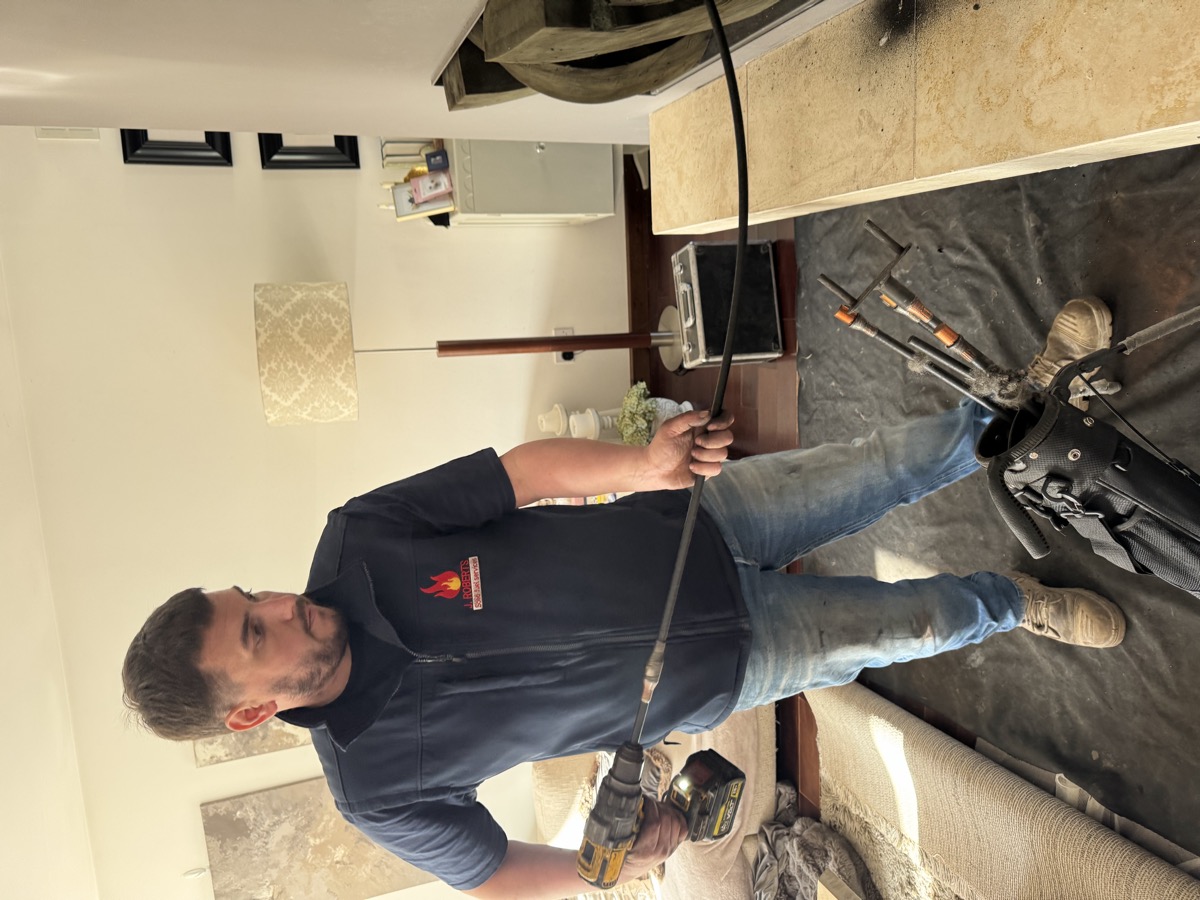
Johnny Roberts runs J.Roberts Solid Fuel Services on his own out of Clonegall, Co. Carlow. The person who surveys your room is the person who fits the stove and the person who comes back if something needs adjusting.
There is no statutory register for solid fuel installers in Ireland. HETAS withdrew in March 2022 and is a UK body regardless. So what is checkable is the public liability insurance, previous work, and the certificate at the end. Ask any fitter for all three.
Wood burning stoves in Meath. FAQ
What does a stove cost fitted in Meath?
An inset stove supplied and fitted runs €2,200 to €3,500, freestanding €2,500 to €4,000, and a boiler stove plumbed to radiators €3,500 to €5,500. Add €1,000 to €2,500 for a liner, which is common on Boyne valley houses, or €1,800 to €3,200 for a twin-wall flue where there is no chimney. The survey is free and a camera goes up the flue before you buy anything. The number that surprises people is never the stove.
My house has no chimney. Can I still have a stove?
Yes, using an insulated twin-wall flue run up through the house or the gable. It comes up a lot in Meath because the county built more new housing than almost anywhere between 2016 and 2022, and newer estates were designed around gas or a heat pump rather than solid fuel. Budget €1,800 to €3,200 for the flue on top of the stove, and expect the route to be agreed on the survey rather than over the phone.
Do I need an air vent, even in a new house?
Especially in a new house. TGD J 4.2.1 requires a permanent vent of at least 6,500 mm² of free area for any non-room-sealed solid fuel appliance, with a further 550 mm² per kilowatt above 5 kW in an airtight dwelling, so an 8 kW stove needs 8,150 mm². There is no under-5kW exemption in Ireland; that is UK Approved Document J and it gets quoted here by mistake constantly. Meath's habitable stock rose 12% between 2016 and 2022, joint highest in the State, so this is a very common call here.
Does an old Boyne valley house need a liner?
Usually, and it is better to budget for it. TGD J asks that the flue be suitable rather than lined as routine, but in a house around Trim, Kells, Athboy or Oldcastle the flue was built for an open fire and is far wider than a modern stove can fill. The gases slow, cool and condense inside the masonry instead of leaving, and that condensate is acidic. An oversize flue is a safety problem, not just an inefficiency. Being told you do not need one is the good surprise.
Will a stove actually save me money?
In Meath, more often than in most counties, because storage is realistic here. On the SEAI comparison bulk loose softwood is about 8.5 cent per useful kilowatt hour against discounted kerosene at 17.20 and mains gas at 13.00. Most Meath houses outside the town centres have a shed or a yard, so buying three cubic metres loose in summer is achievable. Buy it in small bags at 15.26 cent and it loses to gas. The storage decision matters more than the stove.
What size stove do I need?
Most Meath sitting rooms land between 4 and 6 kW. A rough guide for a reasonably insulated modern room is the volume in cubic metres divided by fourteen, so a 4 by 5 metre room with a 2.4 metre ceiling is about 3.5 kW. Draughty older farmhouses need more and new builds need less. Too big is worse than too small, because an oversized stove gets run shut down, and a stove run shut down smoulders and tars the flue.
Can I burn turf in it?
Yes, if the stove is multi-fuel, and plenty of houses in the north and west of Meath still do. It changes the specification though. TGD J Table 2 requires at least 150 mm internal flue diameter for a closed appliance burning timber, peat or bituminous coal, and only smokeless fuel or pellets may drop to 125 mm. A lot of stoves ship with a 125 mm spigot, so that decision is made before you buy. Turf also burns cooler and wetter, so the flue tars faster and wants checking more often.
Is there a grant for a stove?
No. The SEAI Domestic Technical Standards document contains a clause referencing stoves, but the eligibility table gives them no scheme coverage. If a retailer tells you a grant is available, ask them to point at the table. There is also no statutory installer register in Ireland for solid fuel; HETAS withdrew in March 2022 and is a UK body in any case, as are DEFRA exemption and Smoke Control Areas.
How wet can the wood be?
Wood sold for residential burning in Ireland must be at or below 25% moisture content under S.I. 529/2022, tightening to 20% from 1 September 2026. That regulates the sale of fuel, so it does not cover timber you season yourself, though the physics is the same either way. Wet wood spends its energy boiling off water instead of heating the room, and the cooled smoke condenses in the flue as tar. That is how most chimney fires start.
How long does the installation take?
A straightforward fit is one day. A liner adds a few hours. A twin-wall flue through two floors, or an opening that has to be rebuilt, is two days. The room is covered properly before anything starts, everything goes on the van afterwards, and the certificate is issued before we leave. Keep it with the house paperwork; insurers ask for it after a fire and solicitors ask during a sale.
Do you actually come to Meath?
Yes, for work that justifies the trip. The van is based in Clonegall, Co. Carlow, so Navan is about ninety minutes and south Meath a good deal less. For a supply and fit, particularly one with a liner or a twin-wall flue, that is absorbed into a job that was always going to take a day or more. For somebody wanting a fitter to call round on Tuesday to look at a cowl, you are better served locally and you will be told so on the phone.
Free planning tools
Plan your Meath stove in 5 minutes, free
Related guides & nearby counties
Guides
Chimneys in Meath
Thinking about a stove in Meath?
Tell us the era of the house and whether there is a chimney, and you will get a straight answer on what it actually costs before anybody sells you anything.