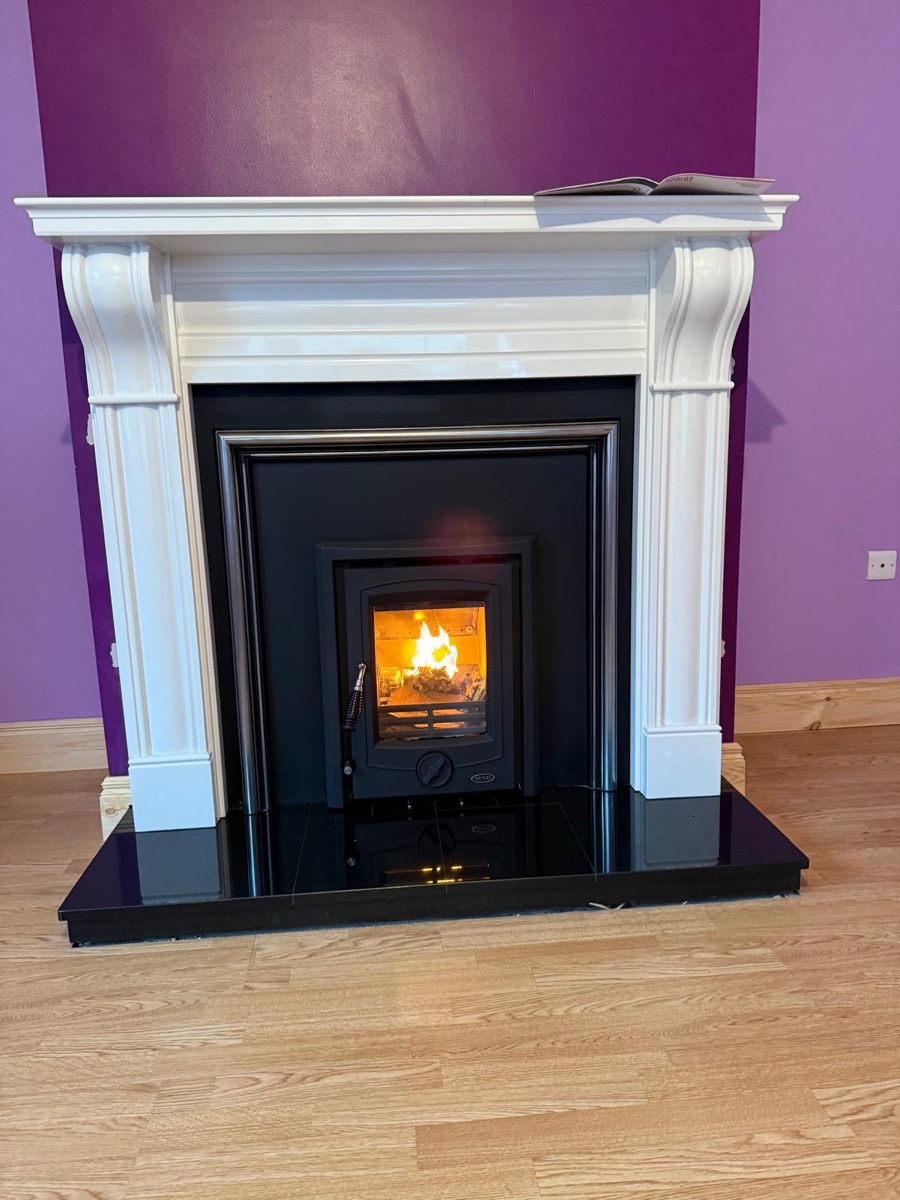
Wood burning stoves
across Dublin
Period terraces, multi-flue stacks and new builds with no chimney at all. Free survey, the right flue identified before you buy, certificate the day we finish.
A Dublin stove is rarely a simple supply-and-fit, and here is why
Most of the country buys a stove and has it fitted into the fireplace that is already there. Dublin is different in three specific ways, and all three change the budget rather than the stove.
One: the flue is usually far too big. A Victorian or Georgian flue was built for an open fire consuming a great deal of air. Connect a modern 5 kW stove to it and the gases slow, cool and condense in the masonry instead of leaving. In a Dublin period house a liner is close to standard rather than an upsell, so budget for it from the outset.
Two: on a period house nobody knows which flue is which. One stack routinely carries four to eight flues serving different rooms on different floors. Which pot belongs to the sitting-room opening is worked out with a camera and smoke, not assumed.
Three: a lot of newer Dublin housing has no chimney at all. If the design assumed gas or a heat pump, a stove means an insulated twin-wall flue routed up through the building, which is the biggest single cost swing on this page.
The van is based in Clonegall, Co. Carlow. Tallaght is around seventy-five minutes, the north side closer to two hours. For a supply-and-fit with a liner that is a fine trade. For someone wanting a fitter to call round on Tuesday to look at a cowl, it is not, and you will be told so.
In most of Dublin a stove will not cut your heating bill
Dublin is the most gas-connected part of the country. On the SEAI domestic fuel cost comparison, mains gas runs about 13.00 cent per useful kilowatt hour. Bulk loose softwood is 8.5 cent and beats it. Hardwood bought in small bags is 15.26 cent and loses to it.
The catch is storage. Buying wood at 8.5 cent means taking three cubic metres loose in summer and having somewhere dry to keep it. That is straightforward on a half acre in Meath. In a Ranelagh terrace with a small yard it is often not realistic, and a household that buys bags as it goes is paying more per kilowatt hour than the gas boiler it is trying to avoid using.
So the honest position for most Dublin buyers: buy the stove because you want a fire in the room. It is a good reason, it is the real reason in the great majority of cases, and it means the stove should be sized for the room rather than sized to heat a house it will never heat.
Where the sums do work in Dublin
Houses off the gas network, largely in the outer county, running on kerosene at roughly 17.20 cent per useful kilowatt hour. And any household with a genuine wood supply and somewhere to store it. Electricity on direct debit is about 34.38 cent, so in an all-electric house even indifferently bought wood is cheaper.
Running costs from the SEAI domestic fuel cost comparison, in cent per useful kilowatt hour delivered.
Fitting a stove into a Georgian or Victorian house
This is the most common Dublin stove job and it is the one most often quoted badly, because the quote is given from a photograph of the fireplace rather than from a look up the flue.
Identifying the right flue
One stack, several flues, each serving a different room, all leaning around each other inside the brickwork to reach separate pots. Some will have been capped at some point in the last century and forgotten. The survey establishes which flue actually serves your opening, whether it is clear from top to bottom, and whether it is shared with the house next door. Connecting to the wrong one is not a small mistake.
Why a liner is nearly always needed
TGD J does not require lining as a matter of routine. It requires the flue to be suitable. In a Dublin period house it usually is not, because the flue is far wider than a modern stove can fill. The result is slow, cooling gases condensing inside soft brick, which is both an efficiency problem and a genuine safety one. Expect the liner in the budget and treat it as a bonus if the camera says otherwise.
Fireplace openings and hearths
Period openings are often larger than the stove and sometimes need building back. The hearth needs checking against TGD J 2.7.1: a constructional hearth of at least 125 mm, a free-standing stove on a non-combustible floor at least 12 mm, and a back boiler 125 mm, or 25 mm on 25 mm non-combustible supports. An original stone or slate hearth slab frequently looks the part and is thinner than it needs to be.
Protected structures and conservation areas
A great deal of period Dublin sits in an Architectural Conservation Area, and some houses are individually protected. Work affecting the character of a protected structure can need consent, and anything altering the roofline or the pots is exactly the kind of thing that does. If your house is protected, check with your local authority before ordering anything. It is a phone call, and it is far cheaper than the alternative.
No chimney, airtight, or somebody else's flue
The CSO found that nearly half of the housing stock built between 2016 and Census 2022 uses electricity as its main heating, against about 10% of everything built from before 1919 up to 2015. Very few new properties use solid fuel at all. In practice that means new Dublin housing was not designed with a stove in mind.
No chimney. The usual answer is an insulated twin-wall flue running up through the house or the gable. It works well and it looks deliberate when routed properly, but it is a structural job with a route that has to be agreed on the survey. Budget €1,800 to €3,200 for the flue on top of the stove.
Airtight construction. A stove burns air and a modern house does not leak any. TGD J 4.2.1 requires a permanent vent of at least 6,500 mm² of free area for any non-room-sealed solid fuel appliance, plus 550 mm² per kilowatt above 5 kW in an airtight dwelling, so an 8 kW stove needs 8,150 mm². There is no under-5kW exemption in Ireland. That is UK Approved Document J and it gets quoted here constantly.
Apartments and conversions. This is where Dublin buyers most often get caught. A period house split into flats may have a flue that formally belongs to another unit, or a stack in shared ownership. Beyond the physics, the lease or the management company rules may simply prohibit a solid fuel appliance. Check the lease before you buy a stove, not after.
Heat pump houses. Increasingly common in the outer county. A stove in a heat-pump house is a specific job rather than a generic one, and the ventilation question is sharper. Say so when you ring.
Dublin was first, and the rules are Irish
Dubliners generally know there are restrictions on solid fuel, and they are right. The detail is usually hazy, and a lot of online advice quietly fills the gap with British law.
The accurate version: the ban on the sale of bituminous, or smoky, coal took effect in Dublin from 1990, years ahead of the rest of the country, and the improvement in the city's air was measurable. It was extended town by town afterwards, and since 31 October 2022 it has been national under S.I. 529/2022. That regulation prohibits retailing or distributing solid fuel for domestic heating that is not an approved fuel, and an approved coal product or manufactured solid fuel must have a smoke emission rate below 10 grams per hour.
Two consequences. It governs what may be sold and distributed, not which appliance you may own. And Dublin no longer has a special regime: the same rules apply in Kerry.
What does not apply here at all is the British framework. DEFRA exemption, Smoke Control Areas and Approved Document J are UK law, and HETAS withdrew from Ireland in March 2022. If a retailer sells you a "DEFRA exempt" stove as though Irish law demanded it, they are quoting the wrong jurisdiction. There is also no SEAI grant for a stove: the technical standards document has a clause referencing them, but the eligibility table gives them no scheme coverage.
On wood, S.I. 529/2022 requires wood sold for residential burning to be at or below 25% moisture, tightening to 20% from 1 September 2026. It regulates the sale, so timber you season yourself is outside it, though the physics is identical. Wet wood spends its energy boiling off water and condenses in the flue as tar, which is how most chimney fires start.
Sources: the EPA's Solid Fuel Regulations page and S.I. No. 529/2022.
Getting the size right matters more than getting the brand right
The most common mistake is buying too big, and Dublin period rooms encourage it because they look enormous. A high Georgian ceiling adds volume that the stove does not usefully heat, since the heat sits above head height.
A rough starting point for a reasonably insulated modern room is the volume in cubic metres divided by fourteen. For a period room with a four-metre ceiling, size on the usable lower volume and the insulation reality rather than the raw figure, or you end up with a stove that has to be run shut down. A stove run shut down smoulders, smouldering makes tar, and tar is what catches fire. That matters more on an old wide Dublin flue than anywhere else.
Most Dublin sitting rooms land between 4 and 7 kW. The stove size calculator handles insulation, window area and ceiling height properly.
On flue diameter, TGD J Table 2 requires at least 150 mm internal diameter for a closed appliance up to 20 kW burning timber, peat or bituminous coal. Only smokeless fuel or wood pellets may drop to 125 mm, and plenty of stoves ship with a 125 mm spigot.
On efficiency, EU Regulation 2015/1185 has required at least 65% seasonal space heating efficiency for closed-fronted solid fuel room heaters sold in the EU since 1 January 2022. Everything currently on sale meets it, so be wary of a shop selling that baseline as a feature, and wary of comparative emissions claims in either direction.
What a stove costs in Dublin
Supply and fit, including VAT, labour, flue components, hearth work where needed, waste away and the certificate.
| Work | Typical range |
|---|---|
| Home survey | Free, no obligation |
| Inset stove, supplied and fitted | €2,200 – €3,500 |
| Freestanding stove, supplied and fitted | €2,500 – €4,000 |
| Boiler stove, plumbed to radiators | €3,500 – €5,500 |
| Chimney liner, near standard on a period house | €1,000 – €2,500 |
| Twin-wall flue, where there is no chimney | €1,800 – €3,200 |
What your house type usually means
| House | Usual flue situation | Typical all-in |
|---|---|---|
| Georgian or Victorian terrace | Multi-flue stack, oversize flue, liner near certain | €3,200 – €6,500 |
| 1930s to 1970s semi | Single flue, often serviceable, camera decides | €2,200 – €4,500 |
| 1990s to 2010s estate house | Chimney present, liner sometimes, vent usually needed | €2,500 – €4,500 |
| Built since 2016 | Frequently no chimney at all, twin-wall flue, vent essential | €4,300 – €7,200 |
| Apartment or period conversion | Flue may belong to another unit; check the lease first | Survey first |
A realistic Dublin period-house budget is the stove plus the liner, so €3,200 to €6,500 all in for a straightforward job. A new build with no chimney is the stove plus twin-wall. The number that surprises people is never the stove.
Indicative only. An exact figure follows the survey, in writing, before any work starts.
What actually happens in your sitting room
A straightforward fit is one day. A liner adds a few hours. A twin-wall flue through two or three floors, or an opening that has to be rebuilt, is two days.
The room is covered first, floor and furniture both. Opening up a Dublin fireplace that has been closed since the sixties produces a genuinely startling amount of soot and rubble, and on a period house there is often a cast iron insert or a slate surround that wants protecting rather than levering out.
Hearth first if one is needed, then the stove set and levelled, then the flue connected and sealed at the register plate. A liner is fed from the top and connected before the closure plate goes on. The vent is cut and fitted as part of the installation, not left as a snag for somebody else.
Then it is lit and left running while the draw, the seals, the door rope and the flue temperature are all checked. You get shown how to run it, which mostly means how not to run it shut down.
Everything goes on the van, and parking is worth a word: on a street with residents' permits or pay and display, a loading spot has to be arranged, which is another reason Dublin jobs are scheduled rather than squeezed in. The certificate is issued before we leave.
Across the city and county
Dublin's routing keys run D01 to D24, odd north of the Liffey and even south, plus D6W, the one that defeats every address form on the internet. The county beyond the postal districts uses A and K keys.
Four local authorities cover it: Dublin City Council, Fingal, South Dublin and Dún Laoghaire-Rathdown. Which one you are in matters if a twin-wall flue changes the external appearance of a building in a conservation area.
South-west Dublin is the closest side of the city to base, so Tallaght, Clondalkin and Templeogue are the easiest to schedule. Tell us the area, the era of the house and whether there is a chimney at all, and the estimate lands far closer first time.
One man, one van, his own name over the door
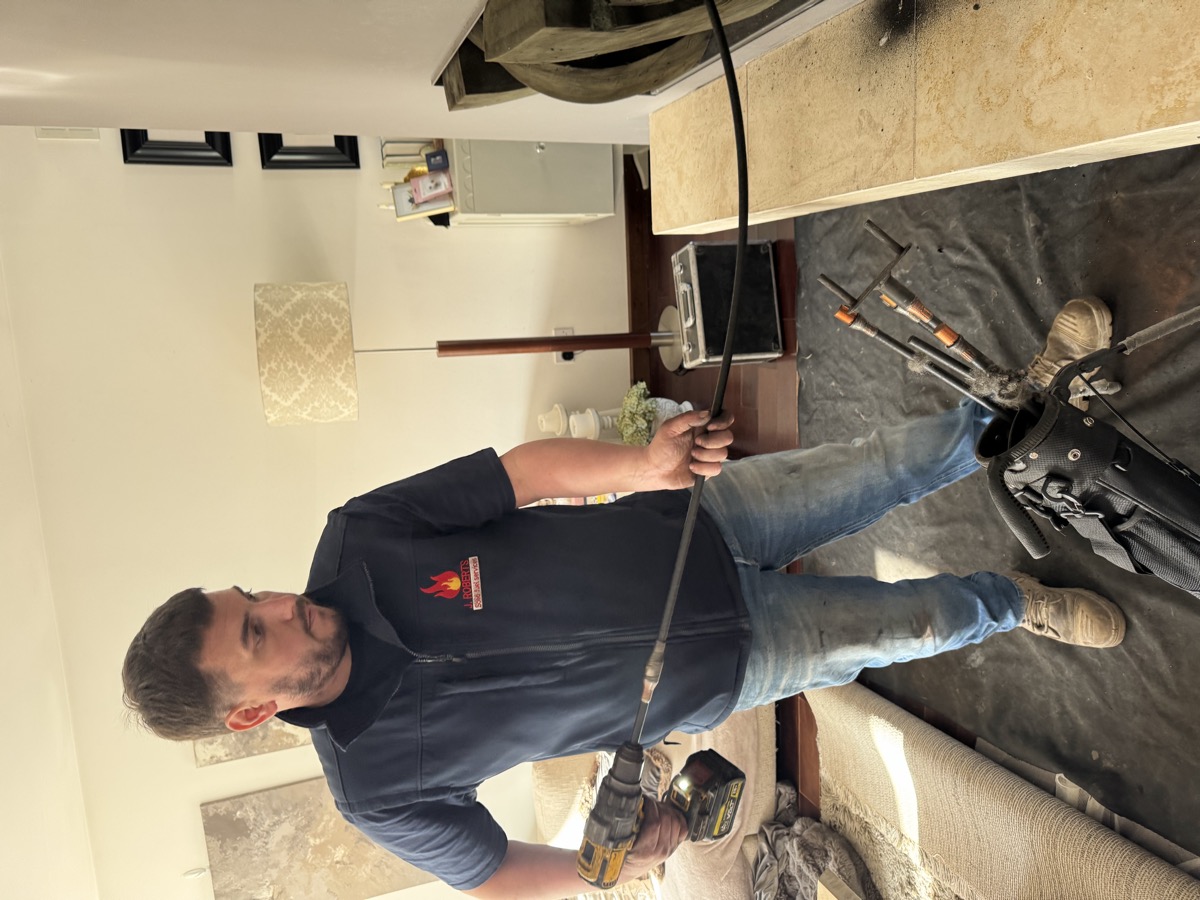
Johnny Roberts runs J.Roberts Solid Fuel Services on his own out of Clonegall, Co. Carlow. The person who surveys your room is the person who fits the stove and the person who comes back if something needs adjusting.
There is no statutory register for solid fuel installers in Ireland. HETAS withdrew in March 2022 and is a UK body regardless. So what is actually checkable is the public liability insurance, previous work, and the certificate at the end. Ask any fitter for all three.
Wood burning stoves in Dublin. FAQ
Will a stove save me money in Dublin?
Usually not, and it is better to know that first. Dublin is heavily gas connected, and mains gas runs about 13.00 cent per useful kilowatt hour on the SEAI comparison. Bulk loose softwood at 8.5 cent beats it, but buying at that price means taking three cubic metres loose in summer and having somewhere dry to store it, which a city terrace often cannot. Hardwood in small bags is 15.26 cent and loses to gas. Where the sums do work is off the gas network against kerosene at 17.20 cent, or in an all-electric house at 34.38 cent.
Does a Dublin period house always need a liner?
Not always, but close enough that you should budget for one. TGD J requires the flue to be suitable rather than lined as routine. In a Georgian or Victorian house the flue was built for an open fire and is far wider than a modern stove can fill, so the gases slow, cool and condense inside soft brickwork instead of leaving. That is a safety problem as well as an efficiency one. The camera decides, and being told you do not need a liner is the good surprise.
What does a stove cost fitted in Dublin?
An inset stove supplied and fitted runs €2,200 to €3,500, freestanding €2,500 to €4,000, and a boiler stove plumbed to radiators €3,500 to €5,500. Add €1,000 to €2,500 for a liner, which is near standard on a period house, or €1,800 to €3,200 for a twin-wall flue where there is no chimney. A realistic Dublin period-house budget is €3,200 to €6,500 all in. The number that surprises people is never the stove.
My house has no chimney. Can I still have a stove?
Yes, with an insulated twin-wall flue routed up through the house or the gable. This is common in newer Dublin housing because the design assumed gas or a heat pump. The CSO found nearly half of the stock built between 2016 and 2022 uses electricity as its main heating, and very few new properties use solid fuel at all. Budget €1,800 to €3,200 for the flue on top of the stove, and expect the route to be agreed on the survey rather than over the phone.
Can I put a stove in an apartment or a period conversion?
Sometimes, and this is where Dublin buyers most often get caught. In a house split into flats the flue serving your fireplace may formally belong to another unit, or the stack may be in shared ownership. Separately from the physics, the lease or the management company rules may simply prohibit a solid fuel appliance. Check the lease before you buy a stove rather than after, because that is not a problem any fitter can solve on the day.
Do I need a DEFRA exempt stove in Dublin?
No. DEFRA exemption, Smoke Control Areas and Approved Document J are UK law with no effect in Ireland, and HETAS withdrew from Ireland in March 2022. A lot of stove advice aimed at Irish homeowners is quietly British and this is the most common example. The Irish rules are S.I. 529/2022 for fuel and Technical Guidance Document J for installation. There is also no SEAI grant for a stove: the technical standards document has a clause, but the eligibility table gives stoves no scheme coverage.
What can I actually burn in Dublin?
Approved fuel, and the rule is now national rather than a Dublin one. The ban on selling bituminous or smoky coal took effect in Dublin from 1990, ahead of the rest of the country, and since 31 October 2022 S.I. 529/2022 has applied across the State. It prohibits retailing or distributing solid fuel for domestic heating that is not an approved fuel, with approved coal products required to have a smoke emission rate below 10 grams per hour. It governs what may be sold, not which appliance you may own.
Do I need an air vent, even in an old house?
Yes. TGD J 4.2.1 requires a permanent vent of at least 6,500 mm² of free area for any non-room-sealed solid fuel appliance, with a further 550 mm² per kilowatt above 5 kW in an airtight dwelling, so an 8 kW stove needs 8,150 mm². There is no under-5kW exemption in Ireland; that is UK Approved Document J. Older Dublin houses often leak enough air to disguise the problem until the windows are replaced, at which point the stove suddenly starts smoking and nobody connects the two events.
My house is a protected structure. Does that stop me?
Not necessarily, but check before ordering anything. A great deal of period Dublin sits in an Architectural Conservation Area and some houses are individually protected. Work affecting the character of a protected structure can require consent, and anything altering the roofline, the pots or the external appearance is exactly the sort of thing that does. Your local authority will tell you on the phone, and that call is far cheaper than the alternative.
What size stove suits a big Georgian room?
Smaller than the room volume suggests. A four-metre ceiling adds volume the stove does not usefully heat, because the heat sits above head height. Size on the usable lower volume and the real insulation rather than the raw figure. Most Dublin sitting rooms land between 4 and 7 kW. Buying too big is the common mistake: an oversized stove gets run shut down, a stove run shut down smoulders, and smouldering tars the flue, which matters more on a wide old Dublin flue than anywhere else.
Do you actually travel to Dublin?
Yes, for work that justifies the trip. The van is based in Clonegall, Co. Carlow, so Tallaght is around seventy-five minutes and the north side closer to two hours. A supply and fit with a liner is a full day or more and absorbs that easily. Somebody wanting a fitter to call round on Tuesday to look at a cowl is better served locally, and you will be told that on the phone rather than after a wasted morning.
Free planning tools
Plan your Dublin stove in 5 minutes, free
Related guides & nearby counties
Guides
Chimneys in Dublin
Thinking about a stove in Dublin?
Tell us the era of the house and whether there is a chimney, and you will get a straight answer on what it actually costs before anybody sells you anything.